



A Skills-Based Approach to Career Transitions: Identifying Pathways for Workers and Communities Facing Economic Disruption
Matthias Oschinski and Steven Tobin







Canada is facing a range of challenges that will drive economic transformation at the national, regional and local levels. The relationship with the United States, its largest trading partner, is changing. Investment in defence is growing. Global energy markets are shifting as investment in clean energy and electrification is rising. The changing climate and geopolitical tensions are creating new risks for supply chains. And automation and artificial intelligence are increasingly being adopted in manufacturing and resource sectors.
A 2025 report by the Institute for Research on Public Policy (IRPP) argues that Canada needs a smarter industrial strategy to successfully navigate change. Part of this success lies in understanding the importance of place: national industrial priorities are implemented in specific places, where local assets, infrastructure, labour markets and institutions shape whether investments succeed and who benefits.
This brief builds on the IRPP report’s recommendations and findings from the IRPP’s multi-year Community Transformations Project. We examine how Canada’s industrial policy connects national priorities with regional and local economic development, and where gaps remain. We then consider how place-based industrial policy could address those gaps.
Many of the assets and industries central to Canada’s national priorities — from diversifying trade and developing major projects to building defence industrial capacity — are concentrated in particular communities and regions. So are key economic development opportunities in areas such as critical minerals and clean electricity. Major projects and other priority areas, including housing and infrastructure, also depend on place-specific capacity, supply chains and institutions.
These geographic patterns and local conditions matter for both economic performance and equity. From an economic performance perspective, progress toward national goals depends on the ability to address local barriers to development. It also hinges on the ability to draw on assets, skills and innovation beyond major urban and well-established industrial centres, including in smaller cities, rural areas, northern regions and Indigenous traditional territories. From an equity perspective, national investments and major projects do not automatically translate into strong local benefits, broader regional resilience or more equitable outcomes. Their benefits and risks can be unevenly distributed across places and people.
Place-neutral policy is not necessarily neutral in effect. Investment and support can disproportionately flow toward regions that already have stronger industrial ecosystems, research institutions and access to capital.
Place is already reflected in parts of Canada’s industrial policy system. However, links to regional and local economic development remain uneven and limited. Gaps arise at three levels:
In Canada, responsibility for accounting for differences across regions and places often falls to Regional Development Agencies (RDAs) and subnational governments, while place-based approaches remain insufficiently integrated into national strategies and policies.
A more place-based approach to industrial policy could help address these gaps by bringing top-down and bottom-up approaches together. In practice, industrial strategies and major projects with significant regional and community implications should consider local assets, barriers and priorities in industrial policy decisions. These efforts should be supported by the human, financial and institutional capacity needed to translate national investment into local outcomes.
The IRPP recommends a comprehensive framework to address these gaps at three levels: industrial policy strategy, implementation and community capacity.
Designing industrial strategies and major projects with these regional and local conditions in mind can help ensure communities capture a reasonable share of the benefits without bearing a disproportionate share of the associated risks.
Governments should identify early where place-based elements are needed and adapt policy design accordingly. This can be done through differentiated eligibility, project size thresholds, financing and cost-sharing terms for public funding and tax incentives, complementary local investments and supports, and major project planning that addresses potential local and regional benefits, risks and capacity needs. This process should draw on the knowledge and expertise of regional and local actors, including Regional Development Agencies, Community Futures Organizations (CFOs), municipal economic development offices, Indigenous economic development corporations, colleges, workforce development bodies, local unions and community innovation hubs.
For major federal industrial policy initiatives with significant regional or local implications, Regional Development Agencies should have a standing role in program design, project assessment or implementation, as appropriate. Regional Development Agencies should work with provincial, territorial, Indigenous and municipal governments, communities and local economic actors, including economic development organizations, sector and technology associations and cluster organizations, to identify significant local opportunities and the barriers that limit them. They should also work together to help connect those priorities to the federal programs and policy tools that can support them. This would formalize and strengthen functions that Regional Development Agencies already perform.
They should support innovation and entrepreneurship that reflect the distinct assets, knowledge and economic opportunities of rural, northern and Indigenous communities. Capacity funding should include multi-year support for economic development staff and strategic planning, funds for feasibility and early project development work, and technical support to prepare proposals and manage implementation. Communities hosting or affected by major projects should also receive capacity funding early in project planning so they can identify priorities, assess options and negotiate local and regional benefit arrangements before key decisions are finalized.
Industrial policy is playing a more prominent role in Canada’s response to a changing economic and geopolitical environment. Shifting trade relationships, growing defence commitments, the global energy transition, climate-related supply chain disruptions and the diffusion of automation and artificial intelligence are reshaping the conditions for growth and competitiveness in Canada.
These shifts are often framed as national or sectoral challenges, but they also have a spatial dimension. The economic transformations underway, and the national priorities emerging in response, ultimately converge in places. They interact with the assets, industries and capabilities in specific communities and regions. National economic transformations affect, and are experienced by, communities and regions differently.
This policy brief is the fourth in a series under the IRPP’s Community Transformations Project examining how to better support communities and workers across Canada through economic transformations. Previous briefs focused on community-led economic development, place-based skills development, and community-wide supports for mass layoffs and major closures. This brief turns to industrial policy and examines how place can shape both national economic performance and local outcomes. It also builds on the recommendations of an IRPP (2025a) report that argues Canada needs a smarter industrial strategy to successfully navigate economic change.
In this brief, we use “place” as a working term for the subnational geographies — like communities, regions, industrial clusters and other functional economic areas — where people and economic activity are connected (McCann, 2023; OECD, 2020a). These places do not always align with existing administrative boundaries. Labour markets, supply chains, infrastructure networks and other economic relationships often link multiple municipalities or regions, making functional economic geographies an important complement to administrative ones (OECD, 2020a). Different places also bring together different combinations of natural and physical assets, workers and skills, firms, infrastructure, institutions, knowledge and networks that shape their economies and economic opportunities (McCann, 2023; OECD, 2025a).
This spatial dimension of economic transformation has implications for both national economic performance and the distribution of its benefits and costs (Barca et al., 2012; OECD, 2025b). From an economic performance perspective, national ambitions depend in part on mobilizing assets and opportunities across places and on the local conditions that shape how effectively they can be used (OECD, 2026a). From an equity perspective, economic transformations can create benefits, risks and adjustment pressures that are distributed unevenly across communities and populations (figure 1).

Canada’s current national priorities, including trade diversification, accelerated major project development and enhanced defence industrial capacity, draw on assets and productive systems across the country (Prime Minister of Canada, 2025). These national priorities are advanced through economic development in critical minerals, defence, clean electricity, energy exports, advanced manufacturing and artificial intelligence (Department of Finance Canada, 2025a; Karpinski & Carré, 2026; Natural Resources Canada [NRCan], 2026a).
Many assets and systems underpinning those priorities are geographically concentrated. Mining activity and investment, including in critical minerals, are concentrated in particular provinces, territories and mining centres (Karpinski & Carré, 2026). Provincial and territorial electricity systems reflect different regional resource endowments (NRCan, 2026a). And trade diversification depends on specific ports and transportation corridors (Department of Finance Canada, 2025a). The federal government’s current portfolio of major projects further reflects this pattern, with nationally significant investments spanning mines, ports, energy infrastructure and trade corridors, located where assets and opportunities are concentrated (Department of Finance Canada, 2025a; Major Projects Office [MPO], 2026a).
The economic value of these assets also depends on the conditions surrounding them (Karpinski & Carré, 2026; OECD, 2025c). Major investments require workers with the appropriate skills, transportation and energy infrastructure, housing and community services, suppliers, access to capital, and institutions that can support training, innovation and implementation. These surrounding conditions can influence project competitiveness and the extent to which investment generates wider economic activity (Karpinski & Carré, 2026; OECD, 2025b, 2025c). Evidence from mining regions, for example, shows that workforce capacity, infrastructure, suppliers and local institutions can influence both project competitiveness and regional economic outcomes (OECD, 2025c).
Research on industrial clusters also reflects this relationship between economic performance and local productive systems. Wolfe and Southin (2026) draw on a wide body of cluster research to highlight the association between geographically concentrated networks of firms, specialized suppliers and knowledge institutions, and outcomes including productivity, innovation and new firm formation. Earlier Canadian research finds that the concentration of related industries in city-regions is associated with higher incomes and employment growth (Spencer et al., 2010). Research on eight Canadian ICT (Information and Communications Technology) clusters highlights the importance of both local factors — including civic associations and networks among firms and institutions — and external connections to knowledge, customers and markets in shaping cluster dynamism and competitiveness (Lucas et al., 2009). Geography alone does not determine economic performance, but the economic and institutional systems surrounding firms and investments can shape their ability to contribute to broader national economic objectives.
When local assets are underused, economic potential can remain unrealized; mobilizing those assets more fully can contribute to the national economy (OECD, 2025b). Rural areas, for example, account for around one-quarter of Canadian economic activity. But if the rate of new business creation in Canada’s rural areas had matched that of urban areas in 2018, there would have been approximately 8,100 additional rural businesses (OECD, 2024). While a variety of factors may contribute to lower rates of business creation in rural areas, the estimate illustrates the potential for increasing economic activity outside large urban centres.
Taken together, these dynamics mean that local assets and conditions matter beyond regional economic development: they can shape how effectively Canada is able to mobilize the resources, productive systems and investment opportunities on which national economic ambitions depend.
But local conditions also matter beyond national economic performance. They can shape how communities experience economic transformation.
The IRPP’s Community Transformations Project shows that the adjustment pressures associated with broader economic changes can be highly uneven across places. The IRPP’s analysis identifies 68 Canadian communities among the most susceptible to workforce disruption associated with the global energy transition, based on their dependence on large-emitting industries or globally traded sectors undergoing transformation (Chejfec et al., 2025). A similar analysis of local employment in sectors with a high proportion of exports to the United States identified 19 communities as among the most susceptible to workforce disruption from both changes in U.S. trade policy and the global energy transition (Chejfec, 2025; Yassin et al., 2026). Susceptibility does not predict that job losses will occur; rather, it identifies places where disruption, if it occurs, could have a greater impact. Many of these communities are on average smaller, rural or remote and less economically diversified than those not susceptible (Chejfec et al., 2025; Jackson, Samson, & Chejfec, 2025).
Research from the United States suggests that geographically concentrated trade shocks can also have political consequences: greater local exposure to Chinese import competition was associated with shifts in electoral outcomes, including increased ideological polarization (Autor et al., 2020).
Uneven exposure to disruption is one side of how economic transformation is experienced across places. The distribution of new economic opportunities is another. An investment can advance national objectives, such as increasing output, exports, energy security or supply chain resilience (Department of Finance Canada, 2025a; Karpinski & Carré, 2026), without delivering proportionate benefits to the community where it occurs (Krawchenko, Earley, & Shaw, 2026; OECD, 2025c; Söderholm & Svahn, 2015). Therefore, the presence of a major investment in a community does not, by itself, determine the extent to which the resulting employment, income and economic activity are connected to the surrounding economy.
Local benefits can depend on whether workers, businesses and Indigenous communities are able to participate in the economic activity that an investment generates. Employment and skills development, local procurement and supplier relationships, and Indigenous participation and ownership influence the extent to which income, business activity and economic value are linked to the surrounding economy (OECD, 2025c; Söderholm & Svahn, 2015). Evidence from mining regions shows that the strength of local employment and supplier linkages, as well as Indigenous participation and benefit-sharing arrangements, can influence how broadly the economic gains associated with resource development are distributed (OECD, 2025c; Söderholm & Svahn, 2015).
Communities can also face challenges in accommodating investment and population growth. Housing, transportation, utilities and public services can influence whether workers are able to live locally and whether growth strengthens rather than strains the surrounding community (OECD, 2025c). The IRPP’s profile on Neepawa, Manitoba, shows how rapid growth associated with agri-food investment generated employment and business opportunities while simultaneously increasing demand for housing, schools, health services and infrastructure (IRPP, 2026a). Economic growth can therefore bring substantial local benefits while also creating costs and pressures that can be concentrated in the communities experiencing that growth.
The extent of local benefits can also depend on whether communities can connect major investments to broader economic development. The extent of these connections can differ substantially across places depending on their existing firms, workforce, infrastructure and institutional capacity. Research on civic capital highlights how local networks and governance arrangements linking firms, governments and civic organizations can support collective action around regional economic opportunities, with different forms of collaboration emerging across local contexts (Creutzberg et al., 2024; Nelles & Wolfe, 2024; Wolfe, 2026a). Stronger connections to local supply chains and related economic activity can create opportunities for local firms and entrepreneurs and allow the effects of an investment to extend beyond the project itself, whereas weaker linkages can limit the amount of economic activity that remains in the surrounding region (OECD, 2025c; Söderholm & Svahn, 2015).
Place is not absent from Canadian industrial policy. But it is unevenly integrated across jurisdictions and throughout the architecture of industrial policy. Table 1 shows how place can be integrated into this architecture.
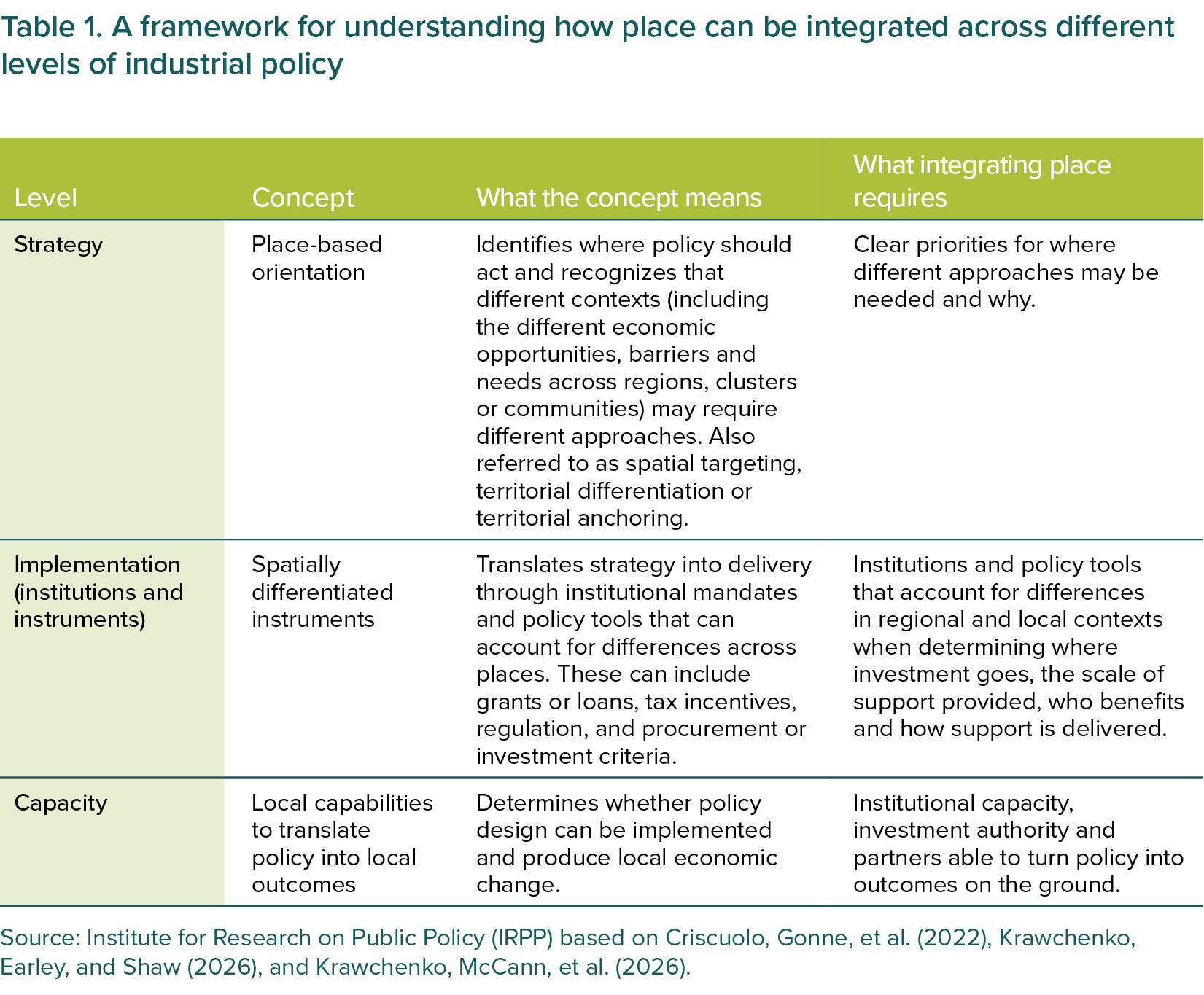
The extent to which place is incorporated varies across jurisdictions, with some provincial industrial approaches integrating it more strongly than others. At the federal level, where many of Canada’s largest-scale industrial policies sit, place is unevenly integrated. Even where policies and programs have substantial regional and local implications, they often give limited consideration to regional and local economic development (Krawchenko & Arcand, 2026; OECD, 2025a). The result is an underlying structural disconnect between national industrial priorities and local economic development (OECD, 2025a; Wolfe & Southin, 2026). The disconnect is reflected in three gaps:
An industrial strategy guides a co-ordinated group of policy instruments to achieve specific policy objectives (Criscuolo, Gonne, et al., 2022). These objectives can include economic growth, trade diversification, productivity and innovation, as well as social objectives, the energy transition, resilience to supply chain and economic disruptions, and economic development in particular sectors or places (Department of Finance Canada, 2025b; Krawchenko & Arcand, 2026; Krawchenko, McCann, et al., 2026).
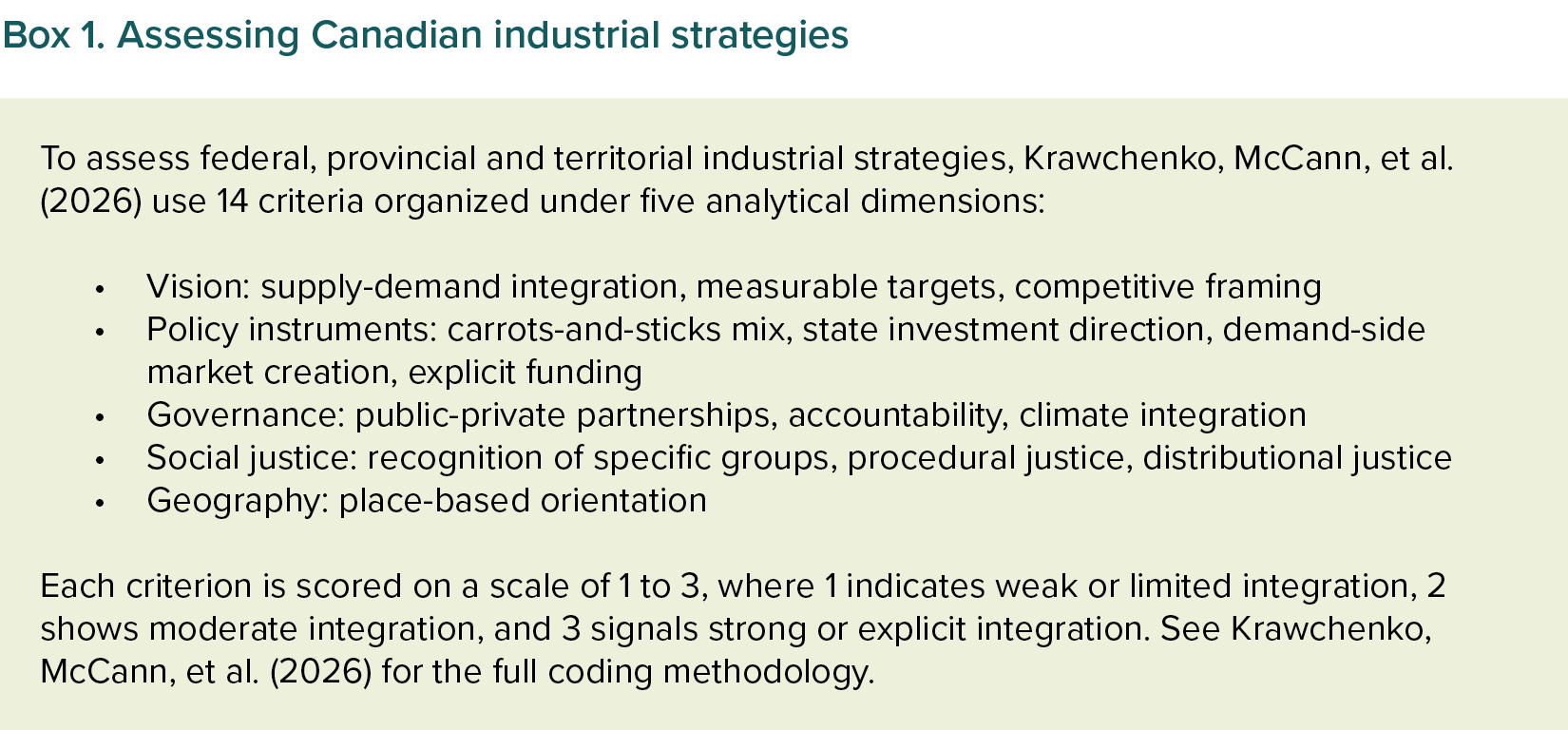
An analysis of 61 federal, provincial and territorial industrial strategy documents from 2015 to 2025 finds that “place” is unevenly reflected in Canadian industrial policy (Krawchenko, McCann, et al., 2026). The analysis assesses the high-level strategy documents against 14 criteria spanning five dimensions — vision, instruments, governance, social justice and geography (box 1).
Among the jurisdictions assessed, the federal government has the largest portfolio of industrial strategies. But the analysis finds its strategies score below the provincial and territorial average on place-based orientation.
Figure 2 (Panel A) shows the distribution of weak, moderate and strong place-based orientation scores across jurisdictions. Of the 12 federal industrial strategies assessed, only two had a strong score on place-based orientation. Federal strategies are less likely to identify specific regions, clusters or local systems and use policy tools that reflect regional and local differences in implementation (figure 2). Place-based orientation of industrial strategies also varies across industrial sectors (see Appendix A). For instance, the analysis finds that, on average, strategies covering sectors such as agri-food, forestry and advanced manufacturing integrate place to a relatively greater degree than those that cover other sectors like fossil fuels, innovation and digital technologies (Krawchenko, McCann, et al., 2026).
Some provincial portfolios show that industrial strategies can incorporate strong place-based elements. Eight of Quebec’s 11 industrial strategies score strongly on place-based orientation; four of British Columbia’s six strategies do so as well. Together, the two provinces account for nearly half of the assessed strategies that score strongly on place-based orientation (figure 2). Two top-scoring strategies illustrate what this looks like in practice.
Figure 2 (Panel B) compares each jurisdiction’s average (mean) place-based orientation score with its average across the other 13 non-place assessment criteria covering vision, policy instruments, governance and social justice (the non-place composite). The dashed lines show the averages across all provincial and territorial strategies for each of these measures, providing a benchmark for comparing jurisdictions.
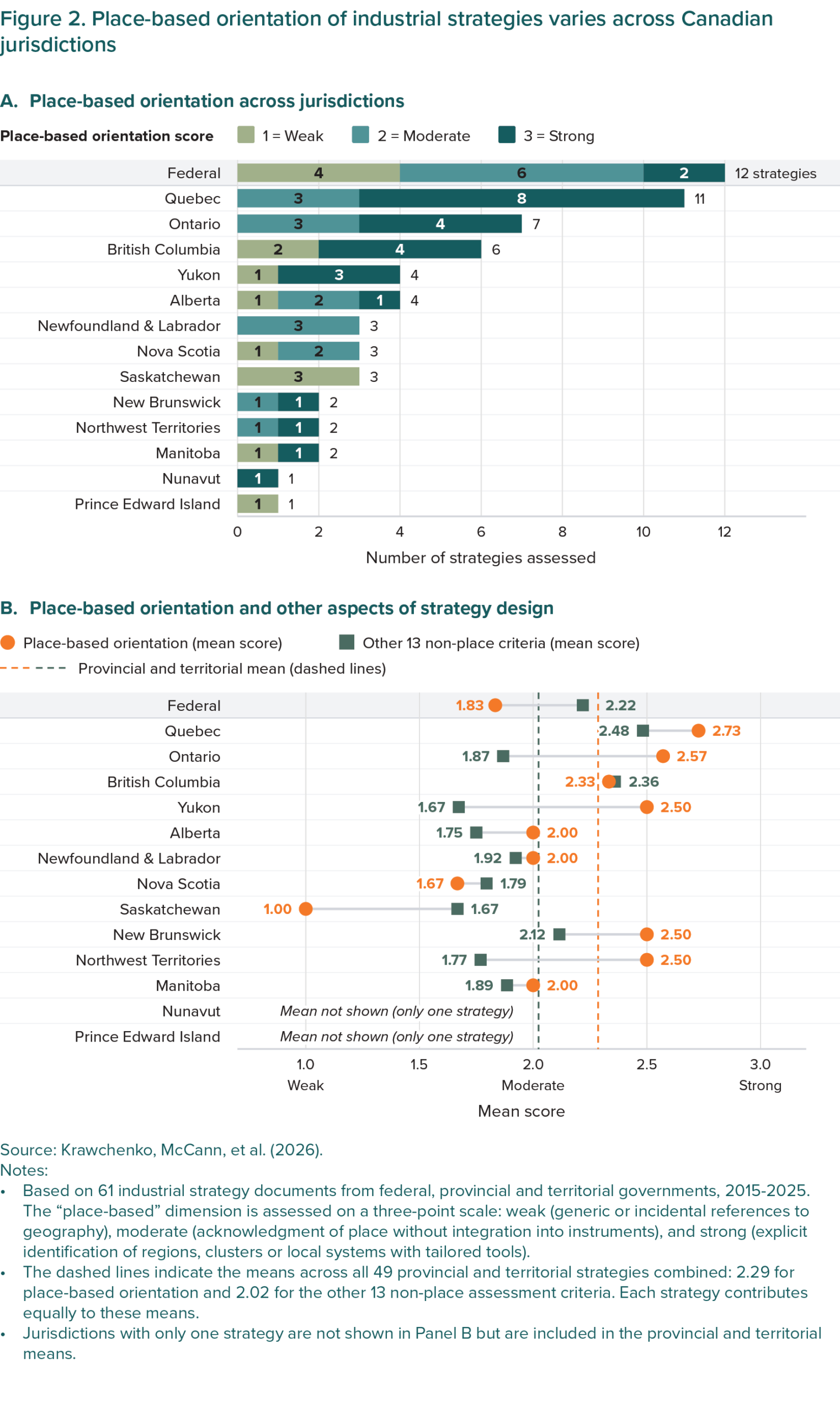
Federal strategies score below the provincial and territorial average on place-based orientation (1.83 versus 2.29), but above the provincial and territorial average on the other non-place criteria taken together (2.22 versus 2.02). This contrast suggests that place-based orientation is a particular gap in federal industrial strategies, even though they score comparatively well on other aspects of strategy design overall. On individual criteria, federal strategies score higher than the provincial and territorial average on competitive framing, social justice recognition and procedural justice, but lower on some operational elements of strategy design.
Provincial portfolios also vary in how they score on other non-place aspects of strategy design. Quebec, British Columbia and Ontario all score above the provincial and territorial average on place-based orientation. On the other 13 criteria combined, Quebec and British Columbia score above the average, while Ontario scores below it. In particular, Ontario’s strategies score lower on combining financial incentives with regulatory requirements and on specifying how proposed measures will be funded.
Across the 61 strategies analyzed, 14 have a weak place-based orientation. On average, these strategies score about 17 per cent lower on the non-place composite (the mean score across the other 13 assessment criteria of the strategy design) than those with strong place-based orientation (figure 3). The degree of place-based orientation in strategies appears to be associated with their overall quality on other dimensions, including operational components, the use of mixed incentives and accountability mechanisms.

An uneven focus on place also extends into the architecture of delivery and implementation across federal institutions and instruments. A scan of the federal industrial policy toolkit (see Appendix B) finds that tools with the most capital to spend are often not those with the strongest local development mandate.
Canada has federal institutions with regional or local economic development mandates, including Regional Development Agencies (RDAs) and the independent Community Futures Organizations (CFOs) they support. These institutions generally operate at a smaller scale than major industrial policy programs. Major federal industrial policy programs, on the other hand, are often organized around other criteria like sector, investment size, asset class or firm-level financing. Federal policy development and program decisions also have no consistent mechanism for drawing on the knowledge and expertise of local and regional institutions (Wolfe & Southin, 2026).
These two parts of the policy system are therefore not consistently integrated or co-ordinated (Samson et al., 2025) (see Appendix B). In a federation, weak policy co-ordination across orders of government can be a source of missed opportunities because national programs cannot deliver their full benefits without alignment with regional institutions and local conditions (Bradford, 2017; Conteh, 2020; Wolfe & Southin, 2026).
Promising local ideas and innovations, including in rural and remote communities, can also fall between the cracks if no formal mechanism connects local economic development opportunities with different levels of industrial planning at the provincial, territorial and federal levels (Wolfe & Southin, 2026). A project may extend beyond the mandate or capacity of conventional regional development programming, but remain too small, early-stage or locally specific for national industrial policy programs (Atlantic Canada Opportunities Agency [ACOA], 2023; OECD, 2026b; Prairies Economic Development Canada [PrairiesCan], 2025a).
These examples illustrate how gaps in federal programming can leave regionally or locally significant projects underserved:
Conversely, a major project may advance a national priority while leaving local workforce, housing, infrastructure, suppliers, Indigenous participation or diversification needs as an afterthought (Barca et al., 2012; Krawchenko, Earley, & Shaw, 2026).
By design, Regional Development Agencies reflect regional economic differences and maintain deep local networks with municipalities, firms, Indigenous organizations, post-secondary institutions and others in the ecosystem (Bradford, 2017). They also deliver some nationally co-ordinated industrial policy programs at the regional level (see Appendix C) (ISED, 2026b). In addition, Regional Development Agencies support a national network of Community Futures Organizations that are governed by local boards and provide local business support, financing and, in some cases, workforce development co-ordination (Jackson, Samson, & Chejfec, 2025).
Canada’s Regional Development Agencies have demonstrated strengths, including their ability to adapt national programs to regional contexts. The 2023 evaluation of REGI — a national program that is delivered through Canada’s seven Regional Development Agencies — found that firms receiving support through its business scale-up and productivity stream outperformed comparable firms that did not receive REGI support on revenue (18.3 per cent higher), employment (12.8 per cent higher) and export growth (13.5 per cent higher) (ACOA, 2023). The Federal Economic Development Agency for Northern Ontario (FedNor), for example, tailored the REGI program to its region by expanding eligibility to a wider variety of organizations, lowering investment maximums, focusing on regional innovation centres and offering targeted manufacturing streams (FedNor, 2024). Regional Development Agencies also deployed COVID-19 recovery and tariff-response programming through existing regional networks (see Appendix C).
However, the role of Regional Development Agencies in major industrial policy is constrained by scale (ACOA, 2023). Programs they deliver often support local infrastructure, small and medium-sized enterprises, tourism, community development and innovation ecosystems (see Appendix C) (ISED, 2026b; Samson et al., 2025). Compared with the largest federal industrial policy tools, these programs generally support smaller-scale and targeted projects (see Appendix B). More recently, the federal government expanded the use of Regional Development Agencies to deliver national priorities, including tariff response, defence-related investment and local infrastructure (FedDev Ontario, 2026a; Housing, Infrastructure and Communities Canada [HICC], 2026; ISED, 2026c, 2026d).
The REGI evaluation also identifies operational capacity pressures, including concerns about sufficient human resources for ongoing project monitoring and opportunities to improve approval timeliness and referral services (ACOA, 2023).
In addition, performance frameworks that guide Regional Development Agency spending tend to focus on firm- or program-level outputs (Samson et al., 2025). A review of the top 10 per cent of Regional Development Agency expenditures between 2019 and 2023 shows that some of the most common performance indicators included metrics such as the number of businesses and organizations supported, total cash invested in a project and the value of total investments generated (Samson et al., 2025). While useful, these indicators do not measure whether communities are becoming more economically diversified, more resilient to industrial disruption or better positioned to capture benefits from major projects (Bramwell et al., 2019).
Instrument design determines whether eligibility rules, thresholds, selection criteria and conditions account for where investment lands and how local economies are affected. Spatial considerations can be binding (i.e., built into eligibility or delivery), or soft, where geography matters through project location, cluster or resource location, Indigenous engagement or the inclusion of geographic factors in project scoring, but does not determine eligibility (Austin et al., 2018). Place-neutral design is not necessarily neutral in effect. Where spatial conditions are absent or have a limited role in eligibility, selection decisions or program delivery, support can disproportionately flow toward regions that already hold strong industrial ecosystems, research institutions and access to capital (Barca et al., 2012; McCann & Ortega-Argilés, 2015; OECD, 2024).
We assessed how spatial conditions feature in Canada’s largest federal industrial policy instruments by examining the OECD’s 2023 Quantifying Industrial Strategies (QuIS) database and selected federal programs not captured by QuIS.
What the 2023 QuIS ranking reveals
We reviewed the 10 largest targeted federal instruments by reported spending and financing amounts from the QuIS database (Criscuolo, Lalanne, & Díaz, 2022; OECD, n.d.).
Six of the top 10 largest instruments do not include a binding spatial condition that targets investments to specific geographies or places (see table 2 and Appendix D). Five have no meaningful spatial condition, while one — the Clean Fuels Fund — incorporates place more softly, where funded projects are tied to specific locations, but eligibility is not restricted to particular regions or community types.
Among the four that do have binding spatial conditions, the form varies:
While regional delivery is a meaningful spatial condition, it is not the same as a fully place-based design. It anchors program delivery to a defined region and allows support to be tailored to regional conditions. But it does not necessarily distinguish among communities within that region or require particular local benefits from funded projects (ACOA, 2023; OECD, 2025a, 2025b).
The scale of these instruments is also notable. None of the four highest-ranked instruments in the 2023 QuIS ranking — Farm Credit Canada (FCC) loans to manufacturing, the Clean Technology Investment Tax Credit, the Strategic Innovation Fund’s Net Zero Accelerator, and the Film or Video Production Services Tax Credit — has a binding spatial condition. The Atlantic Investment Tax Credit ranks fifth, while the three REGI entries appear eighth through 10th. In this 2023 snapshot, binding spatial conditions are found in smaller instruments in the ranking rather than in those with the largest reported amounts of federal spending or financing (see Appendix D).
What other programs show
We supplemented the 2023 QuIS ranking with a scan of selected federal programs and investment vehicles either introduced after 2023 or otherwise not captured in the QuIS top 10 ranking. Our supplementary scan shows a range of spatial features, from binding regional delivery or eligibility targeted to rural, remote or Indigenous communities, to softer forms of project, resource, corridor or cluster geography. Yet, even where spatial features are present, they often reflect where a program is delivered or a project is located, rather than systematically differentiating support according to local conditions or development priorities (table 2):
We also examined how place is reflected in selected major public financing institutions.
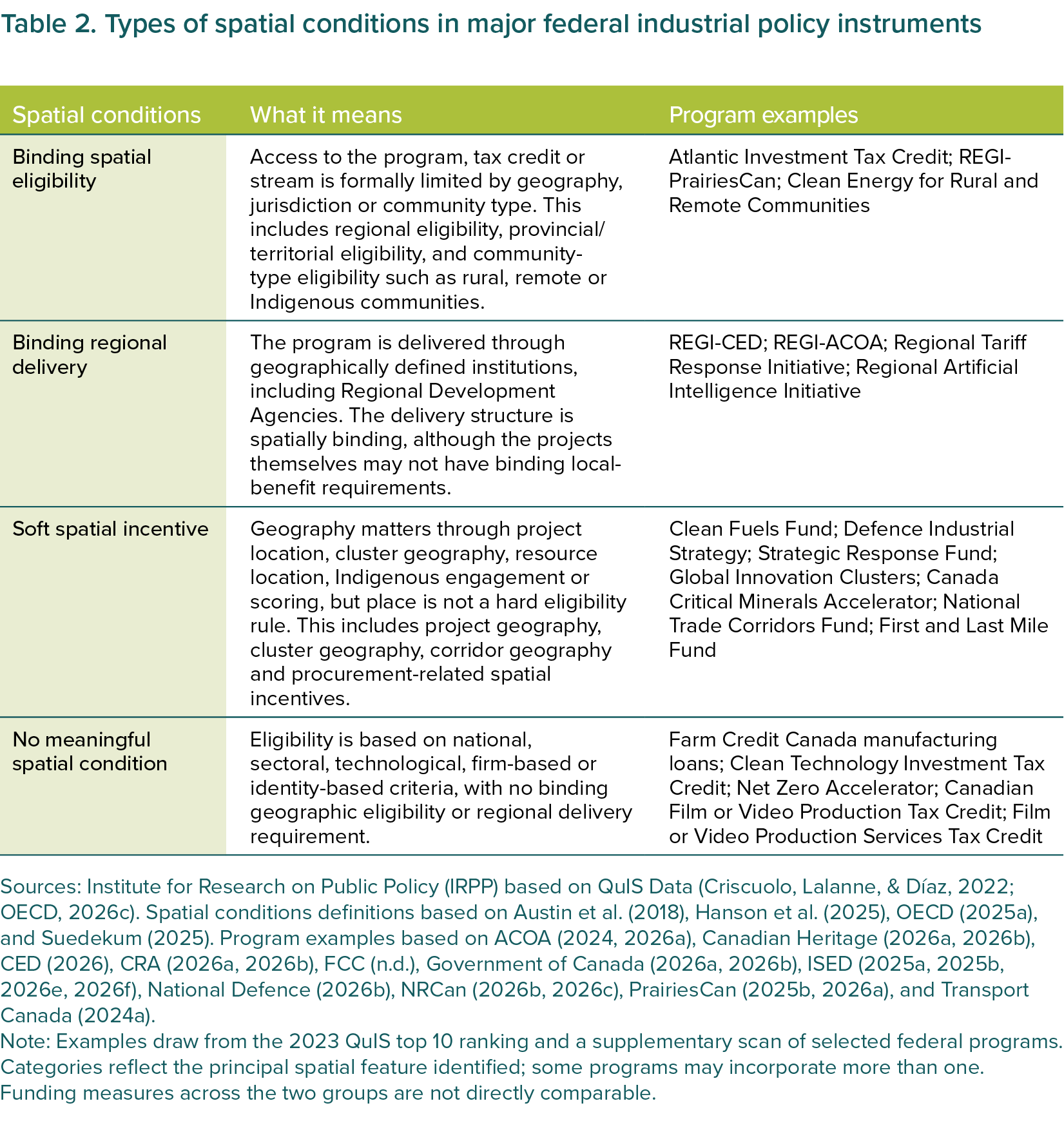
Taken together, these examples show that place is not absent from major industrial policy instruments and institutions, but is incorporated unevenly. Regional and local considerations may enter through project or resource geography, Indigenous or northern priorities, or particular streams of support, without consistently shaping core eligibility rules, financing terms, project-scale thresholds or connections to regional and local economic development institutions.
Recent federal initiatives point toward promising co-ordination across regions, levels of government and mandates:
Canada does not lack the building blocks to better align national industrial priorities and policy with regional and local economic development. It has regional and local development institutions with deep community knowledge and some federal-provincial-territorial co-ordination forums. However, there is a tendency to shift responsibility for accounting for differences across regions and places to Regional Development Agencies rather than integrating place-based approaches into national strategies and policies (Krawchenko & Arcand, 2026).
Existing initiatives do not yet amount to systematic linkages between major industrial commitments and local or regional development plans. They do not consistently provide mechanisms through which community knowledge can shape, from the outset, key industrial decisions with substantial local or regional implications. They also have not yet established consistent formal mechanisms through which regional and local actors can connect locally identified opportunities for large-scale economic development with federal industrial policy programs.
Local organizations — including municipal economic development offices, Indigenous economic development corporations, colleges, workforce development bodies, local unions and community innovation hubs — often hold a deep understanding of local investment opportunities, infrastructure gaps, skills needs and supplier capacity, particularly in areas relevant to their respective roles (ACOA, 2023; Jackson, Samson, & Chejfec, 2025). Having local knowledge, however, is not the same as having the capacity to act on it. Local organizations, particularly in rural and Indigenous communities, also need sufficient staff capacity, planning and governance capabilities, leadership and networking skills, access to finance, and the ability to build partnerships and regional alliances to advance economic development priorities (OECD, 2020b, 2020c).
These capacities are uneven across communities. Smaller firms, rural and northern regions, and Indigenous communities face structural disadvantages in participating in national industrial policy processes — particularly when they lack human or financial capacity, and therefore struggle with grant applications and reporting requirements that are easier for large firms or well-resourced municipalities to manage. In some smaller communities, economic development responsibilities may rest with very limited staff capacity (in some cases, a single staff member). In rural Canada, 85 per cent of firms employed fewer than five people between 2010 and 2019 (OECD, 2024). Indigenous Peoples and communities have also had difficulty accessing many industrial policy programs because of their minimum scale or competition from applicants with greater capacity (IRPP, 2025a).
Federal and provincial innovation policies have also historically emphasized research and development conducted through universities and research clusters, which are disproportionately concentrated in large metropolitan areas (Bramwell et al., 2019; OECD, 2024). In some rural and northern areas, limited access to universities and colleges can reduce the reach of innovation systems built around these institutions (OECD, 2024). Rural and northern communities have fewer post-secondary institutions and local youth may leave to pursue education, training or employment opportunities elsewhere, which can weaken the long-term capacity for innovation and economic diversification (Jackson, Samson, & Chejfec, 2025; OECD, 2020b). Canadian research on university-industry knowledge transfer emphasizes that regional innovation depends on research capacity, firms’ ability to absorb and apply knowledge, and the partnerships and intermediaries connecting them with research institutions (Bramwell et al., 2012).
Large-scale programs and policies designed to strengthen Canada’s industrial competitiveness may inadvertently favour regions that already possess strong industrial ecosystems, infrastructure and access to capital (Nathan & Overman, 2013; OECD, 2025a; OECD, 2025a, 2026a; Pinheiro et al., 2022). Castle and Phillips (2022) observe that many federal technology-focused innovation initiatives target sectors in major cities, while similar provincial and territorial approaches can give less attention to innovation in rural, resource-based industries.
Concentrating additional investment in major urban centres can also intensify local pressures on housing, transportation and infrastructure, creating additional costs and constraints for workers, firms and communities. In Toronto, high housing costs can constrain worker mobility and access to employment opportunities, while congestion can further limit mobility within the city (Canada Mortgage and Housing Corporation, 2025; City of Toronto, 2026). In Vancouver, further expanding trade capacity requires additional industrial land and container-handling and rail capacity, with existing infrastructure constraints risking greater congestion and higher shipping costs (Government of Canada, 2026c).
Similar tensions can arise between nationally significant infrastructure and local urban conditions. In Halifax, port-related truck traffic contributes to traffic congestion, noise pollution, poor air quality and vibration, while also raising pedestrian safety concerns in downtown Halifax (Halifax Regional Municipality, 2023). The Halifax Port Authority is developing an inter-terminal rail project that aims to shift container movements from road to rail, thereby helping to reduce port-related truck traffic through downtown Halifax, and the related congestion and emissions (Port Halifax, 2026).
Regions with weaker institutional innovation capacity may also be less able to attract and absorb public and private investment, while less investment can in turn constrain development of the institutions, networks and expertise needed to support future innovation and investment (OECD, 2024; Oughton et al., 2002; Pinheiro et al., 2022). The regional innovation paradox describes the tension between regions’ greater need for innovation investment and their limited capacity to absorb it (Oughton et al., 2002). Addressing this paradox requires building local capacity alongside other major industrial investments, rather than assuming it will emerge as an outcome of investment alone.
Some existing federal and provincial programs in Canada show promising ways to support different forms of capacity alongside industrial and economic development. These examples remain dispersed across jurisdictions and programs and do not form a systematic approach to building local capacity:
A more place-based approach to industrial policy could help address gaps in the current suite of industrial policies. Place-based policies intentionally target specific locations. Tailored policies provide greater support to a place to improve long-term economic and well-being outcomes (OECD, 2025b). A place-based approach goes beyond directing funding or industrial investments to a particular location. It deliberately takes account of differences in local contexts and opportunities, seeks to mobilize local assets, and co-ordinates across levels of government and policy areas. It can also address local market failures and other barriers that may differ across places (OECD, 2025b).
Italy’s National Strategy for Inner Areas (SNAI), a nationwide, place-based regional development policy targeting functionally peripheral municipalities, illustrates this approach. An evaluation of the strategy finds that it increased the number of local business units by about two per cent on average, while short- to medium-run effects on employment, population and housing prices were limited (Mariani, 2025). Positive business effects were concentrated in municipalities classified as intermediate under Italy’s inner areas framework, particularly those with lower market accessibility, existing industrial specialization and stronger administrative capacity. These findings suggest that the effectiveness of place-based interventions depends on where investment is targeted as well as on pre-existing local conditions (Mariani, 2026).
The OECD (2025a) describes place-based industrial policy as an approach that can support national competitiveness and place transformation — broader changes in a place’s economy, institutions and capacity to pursue new development paths — by aligning national sectoral priorities with local capabilities. Krawchenko and Arcand (2026) identify place-based thinking as one of five key elements of robust industrial policy. They describe it as recognizing and addressing differences in economic conditions, including assets, opportunities and challenges across places and regions.
The balance between national and local direction of place-based industrial policies can vary. In more nationally led (top-down) approaches, governments start by identifying strategic sectors or objectives and direct support toward places with relevant opportunities and capabilities. In more bottom-up approaches, regional and local governments and stakeholders start from the strengths, needs and opportunities of a place and identify economic activities that can contribute to broader national competitiveness and priorities. Increasingly, place-based industrial policy combines national direction with locally driven collaboration. This approach gives regional and local actors greater roles in identifying priorities and shaping implementation within broader national objectives and funding frameworks (OECD, 2025a). Research on regional innovation policy also emphasizes that collaboration should extend beyond initial priority-setting, with governance networks bringing together governments, firms and industry associations, post-secondary institutions, innovation intermediaries and civic organizations to support policy learning, monitoring and adaptation (OECD, 2020d).
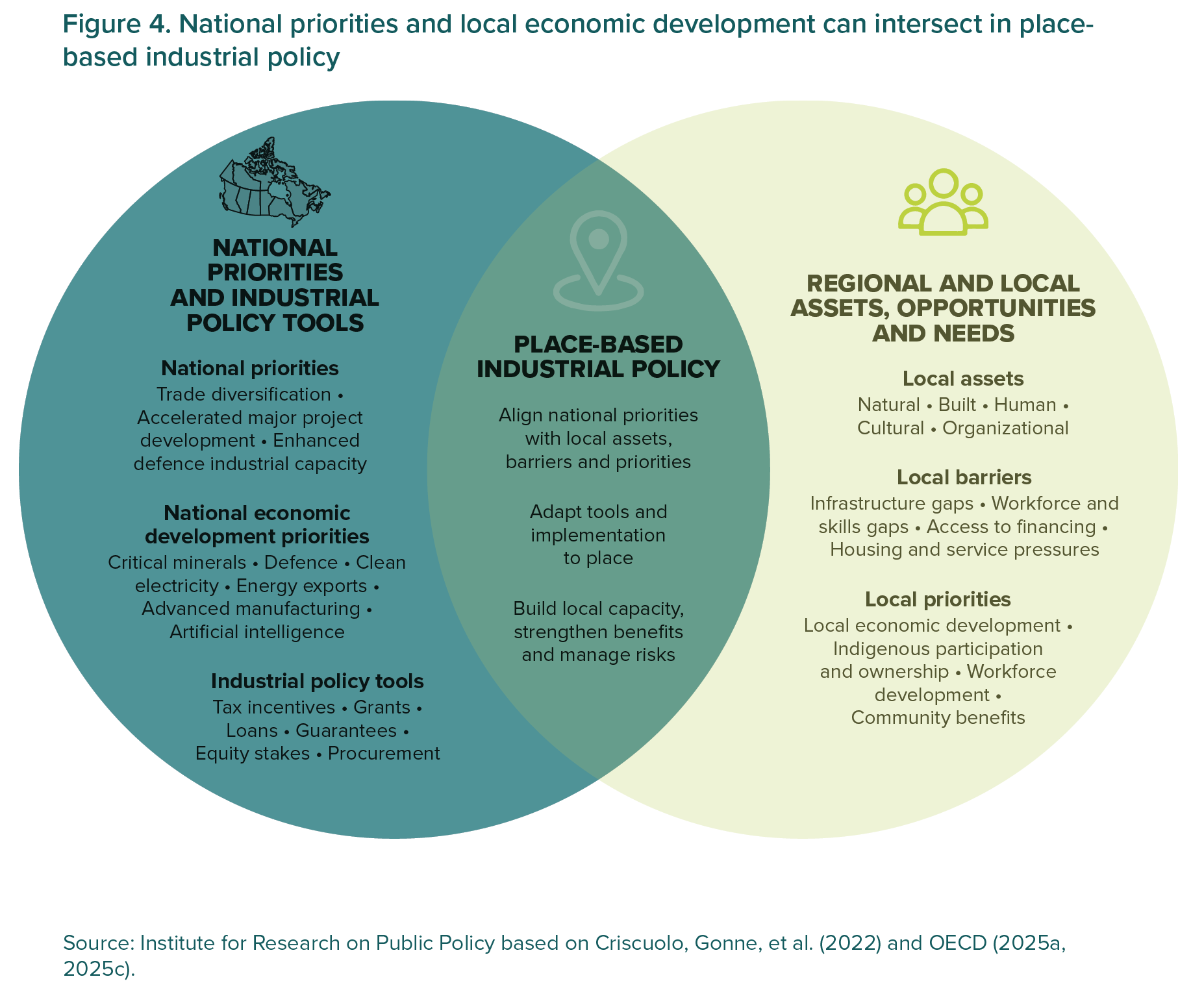
Top-down and bottom-up approaches need not be mutually exclusive. As figure 4 shows, place-based industrial policy sits at the intersection, connecting national strategic priorities, major funding and policy tools with regional and local assets, capabilities, opportunities and priorities (Krawchenko, McCann, et al., 2026; OECD, 2025a). It also gives regional and local actors a role in identifying opportunities that may not be visible through national or sectoral approaches alone. Regional and local actors can also help identify and address barriers that can leave local assets unused or underutilized, limit the effectiveness of investments, or constrain communities’ ability to participate in and benefit from the resulting economic activity (Hoicka et al., 2026; Krawchenko, Earley, & Shaw, 2026; Krawchenko, McCann, et al., 2026; OECD, 2025a, 2025b; Wolfe & Southin, 2026).
The relevance of place varies across industrial policy interventions. Place-based elements are most relevant where local conditions materially shape implementation and outcomes, including in major projects and areas such as infrastructure, skills and innovation. Regional and local considerations are important where industrial activity can carry direct implications for local labour markets and housing, supplier participation, Indigenous partnerships and the extent to which communities retain benefits over time (Krawchenko, Earley, & Shaw, 2026; OECD, 2025a).
International experience reflects a range of place-based approaches in industrial policy. The OECD identifies five broad routes for place-based industrial policy that differ in whether sectoral priorities are set nationally or locally, how places are targeted, and how funding and governance are organized. These routes range from nationally driven approaches to those that are more locally driven. In nationally driven approaches, national priorities are targeted to selected places or opened to competition among places through targeted place-development models like special economic zones. In locally driven approaches, place priorities operate within national frameworks or through decentralized implementation (OECD, 2025a). These routes are not mutually exclusive, and different approaches can coexist within the same national industrial policy system (OECD, 2025a).
To examine how these approaches are structured in practice and what lessons they may offer Canada, we scanned selected international models and positioned them along an illustrative spectrum — from more nationally led models, where central governments set strategic priorities and tailor their implementation to particular places, to more regionally or locally led models, where places identify priorities based on their own capabilities within broader national or supranational policy and funding frameworks (figure 5). Our scan illustrates different ways jurisdictions connect national industrial priorities with regional and local development, including differences in how regional and local actors participate, how funding is connected to local strategies and which institutions co-ordinate implementation. Appendix E summarizes our scan and the evidence used to characterize each model.
These models are not templates for Canada to replicate exactly. Instead, they illustrate different ways to connect national industrial priorities with regional and local development. Across the models, national direction can coexist with regional or local priority-setting. Formal processes can link local priorities to larger funding and policy decisions. And implementation depends on institutions that can co-ordinate across levels of government and adapt support to local conditions (OECD, 2025a). A comparison of Biden-era place-based policy in the United States and EU Smart Specialisation argues that nationally or supranationally (beyond national borders) designed policies depend on regional governance arrangements capable of connecting top-down priorities with bottom-up, place-based processes (Wolfe, 2026b).
Three examples in particular illustrate these different approaches to place-based industrial policy and can provide lessons for addressing the gaps we identified in Canada’s policy system.
The United Kingdom’s Modern Industrial Strategy is a nationally led model that incorporates place into strategy and implementation. The strategy identifies eight growth-driving sectors, while recognizing the clusters and places where relevant capabilities are concentrated. It also gives regional and local institutions a role in shaping place-specific priorities and implementation (Krawchenko, McCann, et al., 2026; U.K. Department for Business and Trade, 2025). This builds on a broader tendency in U.K. industrial strategies to combine place-sensitive strategy design with relatively strong policy instruments (Krawchenko & Arcand, 2026). However, the approach is still evolving, and it is too early to assess the outcomes of the associated governance changes (Krawchenko, McCann, et al., 2026).

The European Union’s Smart Specialisation framework shows a more regionally led model that formally connects national or regional priority-setting with supranational funding (Directorate-General for EU Regional and Urban Policy, n.d.; European Parliament & Council of the European Union, 2021). National or regional strategies identify research and innovation priorities through an entrepreneurial discovery process that brings together stakeholders from the business, academic and research, civil and government spheres (Radovanovic & Bole, 2024). For the 2021-27 period, good governance of a national or regional Smart Specialisation strategy is an enabling condition for funding under two specific objectives of the European Regional Development Fund: research and innovation capacity and skills for smart specialization, industrial transition and entrepreneurship (European Parliament & Council of the European Union, 2021). These governance requirements include having a responsible institution, stakeholder co-operation, monitoring and evaluation and, where relevant, actions to manage industrial transition (OECD, 2025a; Radovanovic & Bole, 2024). The Smart Specialisation framework provides a formal structured route from regionally identified strengths and priorities to larger funding decisions.
France’s Territoires d’industrie is a more locally driven model within a national industrial framework. The program is explicitly framed as a strategy of industrial renewal “by and for territories” (par et pour les territoires) (Agence nationale de la cohésion des territoires [ANCT], n.d.). Its 183 designated industrial territories develop action plans based on local needs through partnerships between elected officials and industry, within broader national reindustrialization priorities. The program supports implementation by co-funding local project managers and regional co-ordinators, providing engineering support and helping identified projects access national investment programs, including France 2030 (ANCT, n.d.; Direction générale des Entreprises [DGE], 2023a; Ministère de l’Économie, des Finances et de la Souveraineté industrielle, énergétique et numérique, 2023; OECD, 2025a). This illustrates how locally developed priorities can connect to national financing and implementation support while building the local capacity needed to develop and co-ordinate projects. Territoires d’industrie operates alongside France’s Pôles de compétitivité, which connect firms, universities and research organizations to support collaborative innovation (OECD, 2026d).
The IRPP’s Community Transformations Project shows how major economic transformations, including the global energy transition and changes in U.S. trade policy, can affect communities differently across Canada (Chejfec, 2025; Chejfec et al., 2025). Our community profiles, based on local interviews, complement statistical analysis with local perspectives on the assets, barriers, capacities and priorities that shape how communities experience economic transformation and their ability to participate in emerging opportunities (IRPP, n.d.).
Viewed through a place-based industrial policy lens, these community profiles can help illustrate how national priorities intersect with local assets, barriers and economic conditions in different ways across communities. A community may have a skilled workforce, natural resources, industrial infrastructure or a strategic location that could contribute to national objectives, while facing constraints related to financing, infrastructure, research capacity, workforce development or access to markets. For example, Estevan, Saskatchewan, has an experienced energy workforce, existing transmission infrastructure and emerging critical mineral potential, but its local research capacity and access to capital are limited (IRPP, 2025b). In Nova Scotia, Cape Breton has offshore wind potential and marine skills, but it also has gaps in deepwater port infrastructure and specialized skills (IRPP, 2025c).
Different assets, opportunities and barriers therefore require different combinations of policy tools (OECD, 2026a). Table 3 provides examples of what these combinations could look like in practice, drawing on insights from the IRPP community profiles published in 2025 and 2026 as part of the Community Transformations Project. These examples are illustrative, not prescriptions for particular communities. They show how place-specific assets and barriers can point to different combinations of investment, policy tools and institutional support that advance national priorities while strengthening regional and local economic development.

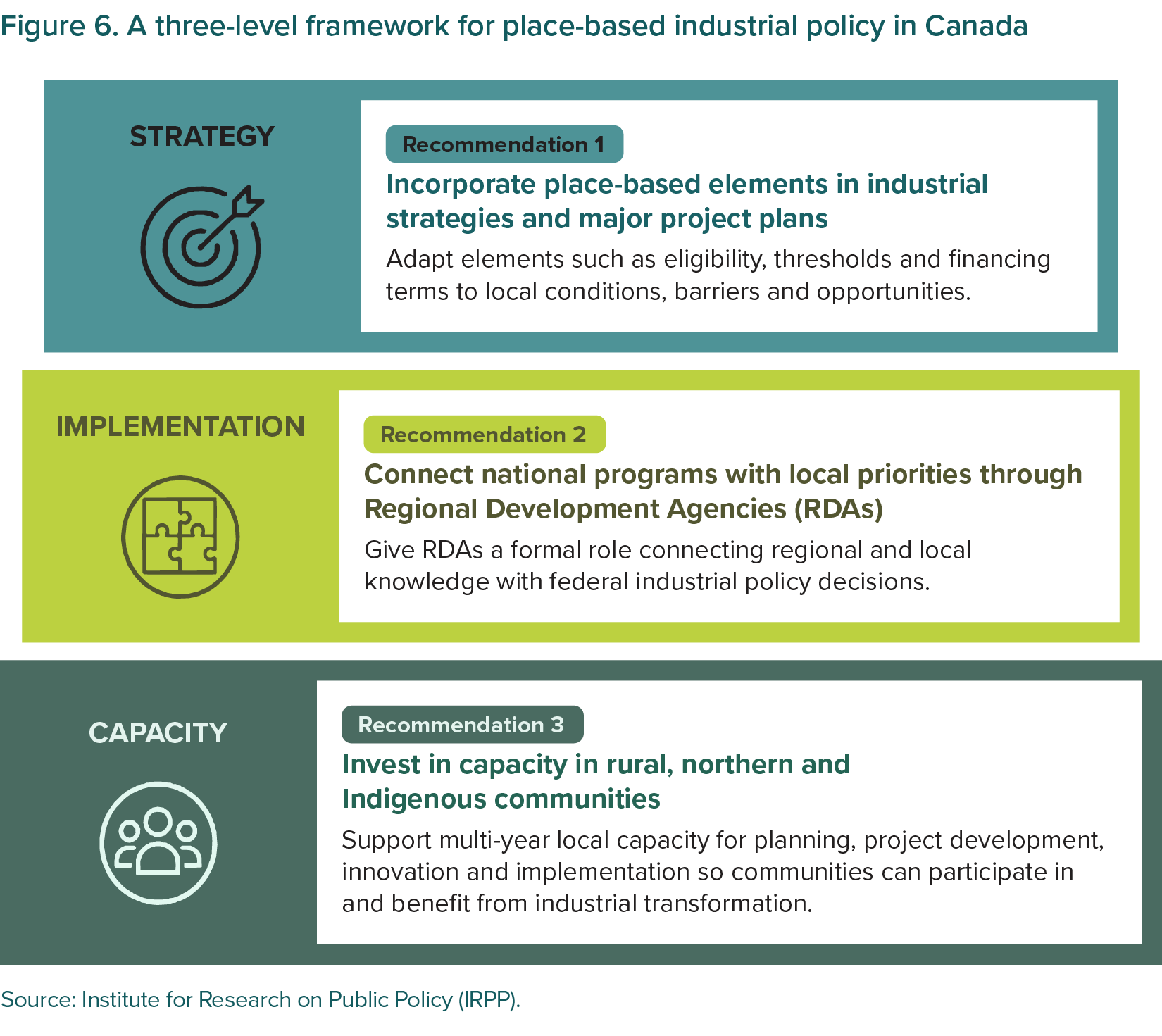
The Institute for Research on Public Policy recommends a comprehensive framework to address the gaps we identified in Canada’s existing industrial policy system at three levels: strategy, implementation and community capacity (figure 6).
These three levels reinforce each other. Place should be built into industrial strategy, carried through the institutions and policy tools that shape implementation, and supported by community capacity to translate national investment into local outcomes.
This collaboration should begin at the planning stage and continue through implementation and evaluation, with clear mechanisms to connect policy and investment decisions to relevant regional and local economic development plans and priorities. Governments should tailor the form and degree of place-based elements in strategy and implementation to the policy objective and the significance of those regional and local implications.
Governments should identify early in policy or project design where place-based elements are needed and which elements are appropriate, drawing on regional and local knowledge to assess relevant opportunities, barriers and risks (OECD, 2025a, 2025b). Federal, provincial and territorial governments should use industrial strategies and sector plans to identify the relevant regions, clusters or local economic systems, the capabilities and barriers that matter for delivery, and where differentiated or complementary policy measures may be needed (OECD, 2025a).
Where warranted, they should incorporate these considerations in industrial policy and major project design by varying program rules, financing terms and funding conditions, making complementary investments and providing supports.
The United Kingdom’s Modern Industrial Strategy (see Appendix E) illustrates this approach by concentrating place-based efforts in city-regions, high-potential clusters and strategic industrial sites, and aligning national industrial priorities with 10-year Local Growth Plans in England (U.K. Department for Business and Trade, 2025).
Governments in Canada should work together to adapt, where necessary and possible, existing industrial policy instruments by varying eligibility rules, project size thresholds, selection criteria, financing and cost-sharing terms, timelines or administrative requirements to reflect differences in project scale, costs and delivery conditions across places. Governments should consider regional economic significance alongside absolute project size when setting program thresholds and terms, including a project’s importance to regional employment and supply chains, role in a strategic cluster or local economic system, and contribution to economic diversification (OECD, 2025a).
Some existing Canadian programs show that differentiation can be feasible:
Capital investment programs
For capital investment programs, governments could lower project size thresholds, offer more favourable financing terms or provide non-repayable support for projects meeting defined place-based criteria. For example:
Infrastructure programs
For infrastructure programs, governments and public financial institutions could build on existing approaches and, where needed, further tailor project size thresholds, financing terms and cost-sharing requirements for rural, northern, Indigenous or other places facing distinct local conditions.
Federal departments should combine industrial policy financing with complementary infrastructure, skills, innovation and demand-side measures to respond to barriers and opportunities in a particular place rather than applying the same package everywhere. Demand-side measures can include procurement, off-take agreements or market-based standards.
For major projects, all levels of government should work together, in collaboration with communities and regional and local economic development actors, early in the planning stage. This early collaboration helps ensure that place-based considerations shape project design and complementary investments, rather than being an afterthought (Krawchenko, Earley, & Shaw, 2026; Wolfe, 2026a).
They should identify expected local and regional benefits, risks and complementary investment needs. Where appropriate, these elements should be reflected in project conditions, funding agreements or implementation plans. Depending on the project and local context, this could include local supplier development and procurement, workforce and training measures, housing or transportation investments, Indigenous participation and ownership, community-benefit mechanisms, and environmental and cumulative-effects governance (Krawchenko, Earley, & Shaw, 2026).
A potentially promising development is the federal government’s Responsible Data Centre Development Principles, which set out expectations for early engagement with host communities and Indigenous rights holders, lasting local benefits, and transparency about electricity, water and infrastructure impacts (ISED, 2026g). The principles recognize important local considerations. However, the key question is whether and how these considerations will systematically inform project design and investment decisions from the outset.
The Major Projects Office (MPO), building on the information it already collects, should add a systematic and more standardized assessment of expected regional and community outcomes, local pressures and complementary investment needs to its project assessment process.
Recent proposals to strengthen MPO assessment similarly emphasize standardized project information, clearer consideration of distributional impacts and better tracking of project interdependencies, including associated transportation infrastructure (Jones & Fariha, 2026).
Governments could also formalize these measures through place-based implementation agreements (Wolfe, 2026a). These agreements could include regional and local objectives, complementary measures and investments, responsibilities across governments and local partners, funding commitments and delivery timelines (Yassin et al., 2026).
The IRPP has previously recommended that governments establish Community Transformation Agreements to co-ordinate roles in highly susceptible communities and align local economic development and workforce, infrastructure and community social supports with locally identified priorities, opportunities, assets and barriers (Yassin et al., 2026). In Spain’s coal-dependent regions, Just Transition Agreements have brought national, regional and local governments together with unions, businesses and other local actors to co-ordinate investment, employment and training, site restoration and economic diversification within a common regional framework (Instituto para la Transición Justa & Ministry for the Ecological Transition and the Demographic Challenge, 2023; Yassin et al., 2025).
The federal government has proposed enabling Regions of National Interest under Bill C-39, building on an earlier proposal for Federal Economic Zones. Under the proposed process, designation would follow regional impact assessments that include consultation with Indigenous Peoples. Certain developments identified through those assessments could be considered pre-approved subject to conditions and mitigation measures (Government of Canada, 2026e, 2026f).
If implemented, regional assessments could identify cumulative environmental, social and economic effects, impacts on Indigenous Peoples and their rights, and broader regional development needs before individual projects advance. Regional assessments under the Impact Assessment Act can examine impacts from multiple projects and activities and cumulative effects within a region. They can also provide early opportunities for Indigenous and public participation and support regional planning and development plans (Impact Assessment Agency of Canada, 2025a, 2025b). Using regional assessments in this way could help decisions about individual projects be informed by the conditions, cumulative pressures and development priorities of the wider region, rather than considering each project in isolation.
Governments should evaluate place-based elements against the regional and local outcomes they are intended to achieve, rather than simply tracking whether funding was allocated or a spatial condition was applied. For industrial strategies, programs and major projects with explicit place-based objectives, performance frameworks should specify the expected outcomes, baseline conditions and a focused set of relevant indicators from the outset. Monitoring, evaluation and continuous learning should be built into the policy cycle so that governments can adjust investments and approaches as evidence emerges (IRPP, 2025e; OECD, 2025b).
Depending on the policy objectives and local context, indicators could include:
These illustrative indicators draw on OECD (2025b, 2025c).
A common core of indicators can support program comparability, while place- and project-specific measures can capture locally relevant outcomes (IRPP, 2025e; OECD, 2025b). Regional and local partners should help develop those indicators. For example, under European Union funding rules, national and regional Smart Specialisation strategies must be supported by monitoring and evaluation tools to measure progress toward their objectives. Having these tools in place is a requirement for fulfilling the EU’s Smart Specialisation enabling condition — a set of criteria that the European Commission must confirm has been met before it can reimburse member states for expenditures under the relevant research, innovation and skills objectives of the European Regional Development Fund (European Parliament & Council of the European Union, 2021).
Governments should also use monitoring and evaluation findings to update and adapt place-based strategies as conditions change. New Zealand provides an example in Taranaki, a region transitioning from a long-standing oil-and-gas base. The Taranaki 2050 Roadmap and its subsequent Action Plan were designed to be updated as local conditions evolved. When oil and gas activity declined faster than anticipated, some medium-term goals were realigned with changing local realities (Jackson, Yassin, & Gu, 2025; Venture Taranaki, 2024).
The federal government should give Regional Development Agencies a more formal role in connecting national industrial policy with provincial, territorial, Indigenous, regional and local economic development priorities. Regional Development Agencies should work with provincial, territorial, Indigenous and municipal governments, communities and local economic actors to identify local opportunities and the barriers that limit them. They can also work together to help connect those priorities to federal programs and policy tools that can support them (OECD, 2025a, 2025b).
A more formal role for Regional Development Agencies would build on functions they already perform. In their current role, these agencies tailor federal programs to regional contexts, develop regional and local knowledge, build relationships with economic development actors and help address gaps left by other programs (ACOA, 2023). Regional Development Agencies also draw on regional networks and sectoral knowledge and play a role in multilevel governance (Bradford, 2017). Some agencies like the Atlantic Canada Opportunities Agency (ACOA) also provide non-financial support through advice, pathfinding and convening (ACOA, 2023). Research on provincial and territorial innovation policy has similarly recommended a stronger role for Regional Development Agencies in co-ordinating and directing strategic investments (Castle & Phillips, 2022).
For major federal industrial policy initiatives with significant regional or local implications, the relevant Regional Development Agency should have a standing role in program design, project assessment or implementation, as appropriate. Federal departments should establish protocols specifying when Regional Development Agency involvement is triggered, what regional evidence and partner input the agency should provide, and how that input is considered in the decision-making process. These protocols should also establish channels through which local economic development organizations, sector and technology associations, and cluster organizations can bring regional knowledge and ongoing initiatives into federal program design and implementation through Regional Development Agencies (Conteh, 2020; OECD, 2020d).
Regional Development Agency input should identify significant regional opportunities, including opportunities for local businesses to supply major projects and develop related economic activities. The input should also identify complementary needs, such as workforce and supplier capacity, enabling infrastructure, housing and community service needs, access to financing or other place-specific constraints, that may materially affect whether an investment succeeds and generates broader regional benefits (OECD, 2025a, 2025b).
Where a regionally significant opportunity requires engagement with several federal programs, departments or institutions, the relevant Regional Development Agency should be able to convene a multi-departmental project table to develop a co-ordinated federal pathway. The federal government could initially link these tables to major federal investment and co-ordination mechanisms with significant regional implications, including the Strategic Response Fund, the Major Projects Office, the Global Innovation Clusters, and future national industrial strategies or funds (ISED, 2026a, 2026e; MPO, 2026a). The Regional Development Agency role would complement these institutions’ mandates by providing regional intelligence, identifying complementary needs, connecting relevant actors and helping co-ordinate federal tools.
The Prairie Project Table provides an emerging Canadian model for this approach. Prairies Economic Development Canada (PrairiesCan) convenes participating federal departments to co-ordinate pathfinding and investment decisions for high-impact regional projects (PrairiesCan, 2025a, 2026b). The broader Prairie Partnership Initiative also provides a single-window mechanism for smaller-scale and more localized projects (PrairiesCan, 2026b).
While international institutional structures differ from those in Canada, they can demonstrate how locally grounded knowledge can connect to national investment and implementation. France’s Territoires d’industrie program, for example, combines locally developed industrial action plans with dedicated project managers who co-ordinate local actors, help advance industrial projects, and connect those projects with engineering support and national financing instruments (ANCT, n.d.; Ministère de l’Économie, des Finances et de la Souveraineté industrielle, énergétique et numérique, 2023).
Where an opportunity spans Regional Development Agency jurisdictions, the relevant agencies should co-ordinate their response. The REGI evaluation identified stronger linkages among Regional Development Agencies and improved cross-jurisdictional collaboration as areas for improvement (ACOA, 2023).
The federal government should provide Regional Development Agencies with sufficient analytical, staffing and co-ordination capacity to take on this expanded role, rather than add it to existing program delivery responsibilities without additional resources.
The federal government should also assess the co-ordination function directly, including timeliness of federal pathfinding, the proportion of qualifying opportunities receiving a co-ordinated federal response, progress in addressing identified complementary investment needs and regional partners’ experience navigating federal supports.
Locally rooted institutions should also play a role in identifying and advancing community-level economic development priorities. The IRPP has previously recommended expanding the mandate and resources of Community Futures Organizations to strengthen community planning and the alignment of economic and skills development (Jackson, Samson, & Chejfec, 2025; Samson et al., 2025). These organizations and other local partners can help identify and develop priorities at the community level, while Regional Development Agencies can connect opportunities across communities and regions and provide a route into federal programs and decisions (Bradford, 2017; Jackson, Samson, & Chejfec, 2025).
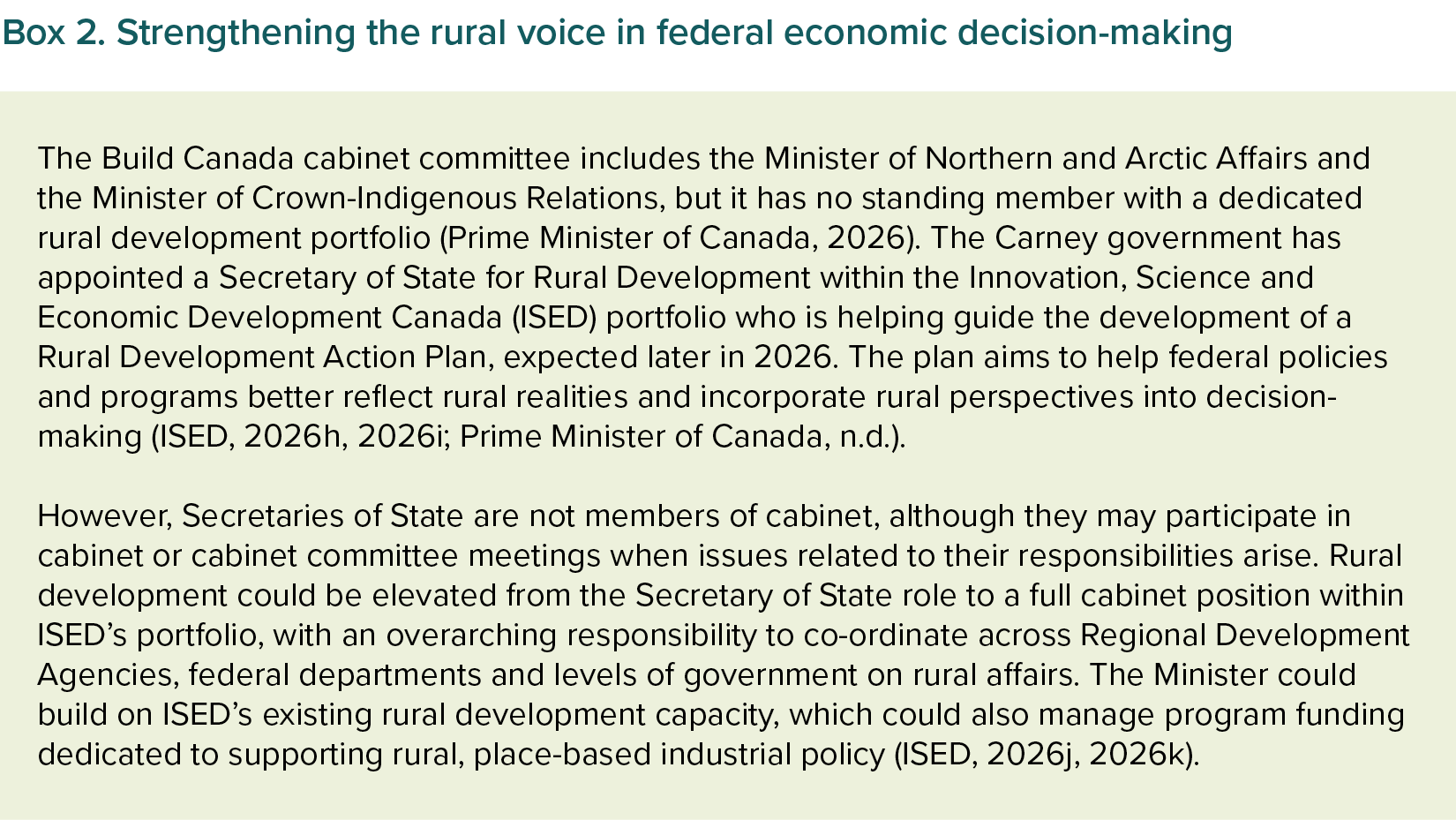
A stronger rural voice in federal economic decision-making could also complement a place-based approach to industrial policy (box 2).
Federal, provincial and territorial governments should allocate a greater share of industrial-policy and economic-development funding to building capacity in communities before opportunities become investment-ready, rather than waiting until major investments or projects arrive (Krawchenko, Earley, & Shaw, 2026). They should support innovation and entrepreneurship that reflect the distinct assets, knowledge and economic opportunities of rural, northern and Indigenous communities (OECD, 2024).
Capacity funding should include multi-year support for economic development staff and strategic planning, funds for feasibility and early project development work, and technical support to prepare proposals and manage implementation. Capacity funding should also support local community institutions dedicated to skill development, innovation and entrepreneurship. Where individual communities cannot sustain these functions on their own, programs should allow them to pool funding and share expertise across a region (OECD, 2024).
Federal and provincial innovation programs should provide multi-year support for locally led innovation hubs and other intermediaries where they serve a broader regional role. They should also help rural and northern firms and entrepreneurs develop, adopt and scale new ideas by connecting them with post-secondary institutions, research networks, financing and markets. Ontario’s experience with successive iterations of its regional innovation programs, including the Ontario Network of Entrepreneurs, shows the role regional intermediaries can play in connecting actors within and across entrepreneurial ecosystems. It also highlights the need for sustained co-ordination across the innovation support system, as well as the challenge of maintaining policy continuity as governments revise existing program structures (Bramwell et al., 2019).
Saskatchewan’s Southeast Techhub (SETH) is an example of a locally led model that could inform similar efforts elsewhere (More, 2025). The community created the hub by leveraging provincial funding allocated to places facing coal plant closures to transform the economy through technology and innovation (More, 2025).
SETH reflects several elements the OECD (2024) identifies as important to rural innovation, including building networks and linkages, connecting rural entrepreneurs with wider innovation supports and expanding local capacity for innovation. It achieves these elements by not just focusing on economic or technology development. It promotes technology literacy and helps build public trust in innovation (More, 2025). It also has partnerships with the local college and the University of Regina. In 2026, Innovation Saskatchewan committed $149,000 over three years to the hub’s Rural Innovation Startup Ecosystem program to expand startup support and strengthen regional innovation (Innovation Saskatchewan, 2026).
Governments should strengthen existing local economic development institutions like Community Futures Organizations and support Indigenous governments and communities in building the capacity to identify, develop and pursue their own economic opportunities.
The federal government should strengthen the mandate and resources of Community Futures Organizations to support strategic planning and capacity-building, connect local businesses with relevant networks and financing, and better align economic and skills development (Jackson, Samson, & Chejfec, 2025; Samson et al., 2025).
The partnership between Business Development Bank of Canada (BDC) and Community Futures/SADC+CAE/CBDC to support rural entrepreneurship is a positive step. In 2025, they launched a $100-million initiative combining BDC financing and advisory services with Community Futures’ local reach (BDC, 2025). Similar partnerships could be explored with other federal financial institutions, such as Export Development Canada and Farm Credit Canada, where their mandates align.
Federal, provincial and territorial governments should support the financial, technical and governance capacity of Indigenous governments and communities to assess economic opportunities, negotiate participation and ownership arrangements, and generate long-term own-source revenues.
Existing Indigenous-led economic development models show different approaches to Indigenous economic participation and ownership:
Federal and provincial/territorial governments should also support sharing lessons learned and models of success to promote greater wealth generation in Indigenous communities. This could be done through Indigenous-led peer learning and access to independent financial, legal and technical advice for communities considering similar opportunities (OECD, 2020b, 2025c).
For example, the federal Indigenous Loan Guarantee Program pairs access to capital with funding for investment analysis and due diligence (NRCan, 2025c). Similar capacity support should accompany other efforts to expand Indigenous ownership and participation in major industrial opportunities (OECD, 2025c).
Communities that host or are affected by major projects should receive funding for capacity-building to help develop local benefit frameworks, including community benefit agreements, Indigenous equity participation, and local procurement and employment plans (Krawchenko, Earley, & Shaw, 2026; OECD, 2025c). This support should be available early in project planning so that communities have the capacity to identify priorities, assess options and negotiate benefit arrangements before key project and funding decisions are finalized.
The MPO’s dedicated funding for Indigenous capacity to engage early and consistently on major projects provides one example of this approach (MPO, 2026f). Similar attention to capacity should accompany the development of local and regional benefit frameworks.
This approach should align with federal commitments under the 2026-2030 Sustainable Jobs Action Plan, particularly the use of community benefit agreements and commitments to skills development and Indigenous-led solutions (NRCan, 2026e). Local supplier development efforts could also complement the plan’s Buy Canadian policies (NRCan, 2026e).
Canada’s national industrial priorities take shape in diverse communities and regions — from urban neighbourhoods and industrial clusters to smaller towns, rural and northern communities, and Indigenous territories. These places each have a unique set of assets, barriers and priorities, and their economic relationships often extend beyond administrative boundaries.
Local conditions shape whether industrial strategies and major projects achieve national objectives, who benefits from the projects and who bears the associated pressures. Developing critical minerals projects, for example, depends in part on suitable energy and transport infrastructure, workers with the appropriate skills, and firms’ capacity to supply mining equipment, materials and specialized services. Major investments can also increase demand for housing, transportation and public services in host communities, creating pressures when complementary investments lag.
Place-neutral policy is not necessarily neutral in effect: programs with uniform rules can disproportionately benefit regions that already have stronger industrial ecosystems, infrastructure and capacity to access funding.
Gaps between national industrial priorities and local economic development persist at the strategy, implementation and capacity levels: federal industrial strategies give uneven and limited attention to regional and local conditions; federal institutions and programs do not consistently connect major investment decisions with regional and local economic development; and federal support for community capacity is limited.
In practice, Regional Development Agencies and subnational governments often carry much of the responsibility for responding to regional differences, while major federal strategies and programs do not consistently incorporate place-based considerations from the outset. These federal strategies and programs also do not systematically include Regional Development Agencies in decision-making or establish clear mechanisms for regional and local actors to inform key decisions.
To address these gaps, the IRPP recommends a comprehensive three-level framework:
Canada has the building blocks to advance this approach. Governments can draw inspiration from existing Canadian initiatives with strong place-based elements like Quebec’s Green Hydrogen and Bioenergy Strategy, the Regional Economic Growth through Innovation (REGI) program delivered by Regional Development Agencies, and BDC’s partnership with the Community Futures network to support rural entrepreneurship. International approaches, including those in the United Kingdom, European Union and France, also offer lessons on connecting national industrial priorities with regional and local development.
In a pivotal moment of geopolitical and economic change, Canada is embarking on an ambitious nation-building agenda. A smarter industrial strategy — one that takes a place-based approach — can strengthen both national economic performance and outcomes for the communities and regions where investments take shape.
Agence nationale de la cohésion des territoires (ANCT). (n.d.). Territoires d’industrie [“Industrial Territories”]. Government of France. https://anct.gouv.fr/programmes-dispositifs/territoires-d-industrie?t1=chaise__2F
Agriculture and Agri-Food Canada (AAFC). (2026). Book 1 — Departmental overview: Minister’s transition book 2025, AAFC. Government of Canada. https://agriculture.canada.ca/en/department/transparency/briefing-documents/aafc-transition-books/book-1-departmental-overview-ministers-transition-book-2025-aafc
Atlantic Canada Opportunities Agency (ACOA). (2023). Regional Economic Growth through Innovation — National Evaluation. Government of Canada. https://www.canada.ca/en/atlantic-canada-opportunities/corporate/transparency/national-regi-evaluation-2023.html
Atlantic Canada Opportunities Agency (ACOA). (2024). Regional Economic Growth through Innovation. Government of Canada. https://www.canada.ca/en/atlantic-canada-opportunities/services/regional-economic-growth-through-innovation.html
Atlantic Canada Opportunities Agency (ACOA). (2025). Northern Isolated Community Initiatives Fund. Government of Canada. https://www.canada.ca/en/atlantic-canada-opportunities/services/northern-isolated-community-initiatives-fund.html
Atlantic Canada Opportunities Agency (ACOA). (2026a). Regional Artificial Intelligence Initiative in Atlantic Canada. Government of Canada. https://www.canada.ca/en/atlantic-canada-opportunities/services/regional-artificial-intelligence-initiative.html
Atlantic Canada Opportunities Agency (ACOA). (2026b). How to apply for financial assistance. Government of Canada. https://www.canada.ca/en/atlantic-canada-opportunities/services/financial-assistance.html
Austin, B., Glaeser, E. L., & Summers, L. H. (2018). Jobs for the heartland: Place-based policies in 21st-century America. Brookings Papers on Economic Activity, 2018(1), 151-255.
https://www.nber.org/system/files/working_papers/w24548/w24548.pdf
Australian Treasury. (2024). Future Made in Australia — National Interest Framework supporting paper. Government of Australia. https://treasury.gov.au/publication/p2024-526942
Autor, D. H., Dorn, D., Hanson, G. H., & Majlesi, K. (2020). Importing political polarization? The electoral consequences of rising trade exposure. American Economic Review, 110(10), 3139-3183. https://doi.org/10.1257/aer.20170011
Bailey, D., De Propris, L., Dimos, C., Fai, F. M., Hardy, S., & Tomlinson, P. R. (2026). A critical review of the UK’s Modern Industrial Strategy: Lessons for ‘place-based’ policy. Regional Studies, 60(1), Article 2597466. https://doi.org/10.1080/00343404.2025.2597466
Barca, F., McCann, P., & Rodríguez-Pose, A. (2012). The case for regional development intervention: Place-based versus place-neutral approaches. Journal of Regional Science, 52(1), 134-152. https://doi.org/10.1111/j.1467-9787.2011.00756.x
Bioindustrial Innovation Canada. (2025, March 10). 2025 pre-budget consultation submission for Bioindustrial Innovation Canada. Senate of Canada. https://sencanada.ca/Content/Sen/Committee/451/AGFO/briefs/BioindustrialInnovationCanada_e.pdf
Bradford, N. (2017). Canadian regional development policy: Flexible governance and adaptive implementation. OECD Regional Development Papers, No. 82. OECD Publishing.
https://www.oecd.org/en/publications/canadian-regional-development-policy_99622d65-en.html
Bramwell, A., Hepburn, N., & Wolfe, D. A. (2012). Growing innovation ecosystems: University-industry knowledge transfer and regional economic development in Canada. Knowledge synthesis report to the Social Sciences and Humanities Research Council of Canada. University of Toronto. http://hdl.handle.net/1807/80099
Bramwell, A., Hepburn, N., & Wolfe, D. A. (2019). Growing entrepreneurial ecosystems: Public intermediaries, policy learning, and regional innovation. Journal of Entrepreneurship and Public Policy, 8(2), 272-292. https://doi.org/10.1108/JEPP-04-2019-0034
Bundesministerium für Wirtschaft und Energie (BMWE). (n.d.). Strukturstärkungsgesetz Kohleregionen [“Structural Strengthening Act for Coal Regions”].
https://www.bundeswirtschaftsministerium.de/Redaktion/DE/Textsammlungen/Wirtschaft/strukturstaerkungsgesetz-kohleregionen.html
Bundesministerium für Wirtschaft und Energie (BMWE). (2021). Maßnahmen des BMWi für eine nachhaltige und digitale Mobilität: Update anlässlich des 6. Spitzentreffens der Konzertierten Aktion Mobilität [“Measures taken by the BMWi to promote sustainable and digital mobility”]. https://www.bundeswirtschaftsministerium.de/Redaktion/DE/Downloads/I/infopapier-massnahmen-des-bmwi-fur-eine-nachhaltige-und-digitale-mobilitaet.pdf?__blob=publicationFile&v=6
Bundesministerium für Wirtschaft und Energie (BMWE). (2026a, January 6). Regionale Wirtschaftshilfen weiterentwickelt: Bund und Länder beschließen Neuaufstellung der regionalen Förderung „Gemeinschaftsaufgabe Verbesserung der regionalen Wirtschaftsstruktur“ (GRW) [“Regional economic aid further developed: Federal and state governments agree on a new structure for regional funding under the ‘Joint Task for Improving the Regional Economic Structure’ (GRW) program”] [Press release]. https://www.bundeswirtschaftsministerium.de/Redaktion/DE/Pressemitteilungen/2026/01/20260106-regionale-wirtschaftshilfen-weiterentwickelt-bund-und-laender-beschliessen-neuaufstellung-der-regionalen-foerderung.html
Bundesministerium für Wirtschaft und Energie (BMWE). (2026b). Neuaufstellung der Gemeinschaftsaufgabe „Verbesserung der regionalen Wirtschaftsstruktur“ (GRW) [“Reorganization of the joint task ‘Improvement of the regional economic structure’ (GRW)”]. https://www.bundeswirtschaftsministerium.de/Redaktion/DE/Schlaglichter-der-Wirtschaftspolitik/2026/02/04-gemeinschaftsaufgabe-grw.html
Bundesministerium für Wirtschaft und Energie (BMWE). (2026c, January 21). Neuer Förderzeitraum der Transformations-Netzwerke und Transformations-Hubs für die Jahre 2027 bis 2029 [“New funding period for transformation networks and transformation hubs for the years 2027 to 2029”] [Press release]. https://www.bundeswirtschaftsministerium.de/Redaktion/DE/Pressemitteilungen/2026/01/20260121-neuer-foerderzeitraum-der-transformations-netzwerke-und-hubs-2027-bis-2029.html
Business Development Bank of Canada (BDC). (2025, October 15). Reaching further: A new $100M boost for the 520,000 entrepreneurs in rural and remote communities [Press release]. https://www.bdc.ca/en/about/mediaroom/news-releases/reaching-further-new-100mboost-520000-entrepreneurs-rural-remote-communities
Canada Development Investment Corporation (CDEV). (n.d.). Canada Growth Fund Inc.
https://cdev.gc.ca/canada-growth-fund/
Canada Economic Development for Quebec Regions (CED). (2024). 2023-24 Departmental Results Report. Government of Canada. https://www.canada.ca/en/economic-development-quebec-regions/corporate/departmental-publications/2023-24-departmental-results-report.html
Canada Economic Development for Quebec Regions (CED). (2026). Regional Economic Growth through Innovation (REGI). Government of Canada. https://www.canada.ca/en/economic-development-quebec-regions/financing-services/regi.html
Canada Growth Fund (CGF). (n.d.-a). Our investment strategy. https://www.cgf-fcc.ca/en/investment-strategy/#criteria
Canada Growth Fund (CGF). (n.d.-b). About CGF. https://www.cgf-fcc.ca/en/who-we-are/
Canada Growth Fund (CGF). (2026a). Canada Growth Fund: 2025 Annual Report.
https://medias.cgf-fcc.ca/images/cgf-2025-annual-report.pdf
Canada Growth Fund (CGF). (2026b). Canada Growth Fund: Fund presentation.
https://medias.cgf-fcc.ca/images/2026-07-05-CGF-Fund-Presentation.pdf
Canada Infrastructure Bank Act, S.C. 2017, c. 20, s. 403. https://laws-lois.justice.gc.ca/eng/acts/C-6.18/page-1.html
Canada Infrastructure Bank (CIB). (n.d.-a). Priority sectors. https://cib-bic.ca/en/sectors/priority-sectors/
Canada Infrastructure Bank (CIB). (n.d.-b). Corporate plan summary 2025-2026.
https://cdn.cib-bic.ca/files/documents/reports/en/CIB-25-26-Corporate-Plan-Summary.pdf
Canada Mortgage and Housing Corporation (CMHC). (2025, January 30). High housing costs making it harder to move for jobs many are seeking. The Housing Observer. https://www.cmhc-schl.gc.ca/observer/2025/high-housing-costs-making-harder-move-jobs-many-seeking
Canada Revenue Agency (CRA). (2026a). Atlantic investment tax credit. Government of Canada. https://www.canada.ca/en/revenue-agency/services/tax/individuals/topics/about-your-tax-return/tax-return/completing-a-tax-return/deductions-credits-expenses/line-41200-investment-tax-credit/atlantic-investment-tax-credit.html
Canada Revenue Agency (CRA). (2026b). Clean Technology Investment Tax Credit (ITC). Government of Canada. https://www.canada.ca/en/revenue-agency/services/tax/businesses/topics/corporations/business-tax-credits/clean-economy-itc/clean-technology-itc.html
Canada Revenue Agency (CRA). (2026c). Clean Technology Investment Tax Credit (ITC): What property qualifies. Government of Canada. https://www.canada.ca/en/revenue-agency/services/tax/businesses/topics/corporations/business-tax-credits/clean-economy-itc/clean-technology-itc/property-qualifies-ct-itc.html
Canadian Heritage. (2026a). Canadian Film or Video Production Tax Credit. Government of Canada. https://www.canada.ca/en/canadian-heritage/services/funding/cavco-tax-credits/canadian-film-video-production.html
Canadian Heritage. (2026b). Film or Video Production Services Tax Credit. Government of Canada. https://www.canada.ca/en/canadian-heritage/services/funding/cavco-tax-credits/film-video-production-services.html
Canadian Northern Economic Development Agency (CanNor). (2018). CanNor program guidelines: IDEANorth. Government of Canada.
https://www.cannor.gc.ca/eng/1464199651173/1464199702530
Canadian Northern Economic Development Agency (CanNor). (2021). What we do. Government of Canada. https://www.cannor.gc.ca/eng/1385994265192/1385994315067
Canadian Northern Economic Development Agency (CanNor). (2025a). Canadian Northern Economic Development Agency’s 2023-24 Departmental Results Report. Government of Canada. https://www.north.gc.ca/eng/1725567377522/1725567409300
Canadian Northern Economic Development Agency (CanNor). (2025b). Northern Isolated Community Initiatives (NICI) Fund. Government of Canada. https://www.cannor.gc.ca/eng/1608663726079/1608663750441
Canadian Northern Economic Development Agency (CanNor). (2026a). Inclusive diversification and economic advancement in the north (IDEANorth). Government of Canada.
https://www.cannor.gc.ca/eng/1385477070180/1385477215760
Canadian Northern Economic Development Agency (CanNor). (2026b). Northern Projects Management Office (NPMO). Government of Canada. https://www.cannor.gc.ca/eng/1370267347392/1370267428255
Castle, D., & Phillips, P. W. B. (2022). Conclusions and lessons learned. In P. W. B. Phillips & D. Castle (Eds.), Ideas, institutions, and interests: The drivers of Canadian provincial science, technology, and innovation policy (pp. 353-383). University of Toronto Press.
Chejfec, R. (2025, March 13). Measuring community workforce exposure to U.S. exports. Institute for Research on Public Policy. https://irpp.org/research-studies/measuring-community-workforce-exposure-to-us-exports/
Chejfec, R., Samson, R., & Jackson, A. (2025, January 14). Supporting workers and communities on the road to net zero: A methodology for measuring community susceptibility. Institute for Research on Public Policy. https://irpp.org/research-studies/community-transformations-project-methodology/
CHIPS and Science Act, Pub. L. No. 117-167, 136 Stat. 1366 (2022).
https://www.congress.gov/bill/117th-congress/house-bill/4346
City of Toronto. (2026). Congestion Management Plan — 2026 spring update.
https://www.toronto.ca/legdocs/mmis/2026/ie/bgrd/backgroundfile-285482.pdf
Cleveland, C. (2025). Caitlin Cleveland: Northwest Territories critical minerals priorities and advanced projects update. Government of the Northwest Territories. https://www.gov.nt.ca/en/newsroom/caitlin-cleveland-northwest-territories-critical-minerals-priorities-and-advanced-projects
Conteh, C. (2020). Multilevel governance through a strategic lens: Innovation policy delivery in Ontario. Canadian Public Administration, 63(3), 429-449. https://doi.org/10.1111/capa.12383
Corporation of the City of Sault Ste. Marie. (2026, September 2). Community asked to support the Port of Sault Ste. Marie project. https://saultstemarie.ca/community-asked-to-support-the-port-of-sault-ste-marie-project/
Creutzberg, T., Ornston, D., & Wolfe, D. A. (2024). Sector connectors, specialists and scrappers: How cities use civic capital to compete in high-technology markets. Urban Studies, 61(3), 549-566. https://doi.org/10.1177/00420980231186234
Criscuolo, C., Gonne, N., Kitazawa, K., & Lalanne, G. (2022). An industrial policy framework for OECD countries: Old debates, new perspectives. OECD Science, Technology and Industry Policy Papers, No. 127. https://doi.org/10.1787/0002217c-en
Criscuolo, C., Lalanne, G., & Díaz, L. (2022). Quantifying industrial strategies (QuIS): Measuring industrial policy expenditures. OECD Science, Technology and Industry Working Papers, No. 2022/05. https://doi.org/10.1787/ae351abf-en
Crown-Indigenous Relations and Northern Affairs Canada. (2024). Appearance before the Standing Committee on Indigenous and Northern Affairs (INAN) — Nutrition North Canada (May 8, 2024). Government of Canada. https://www.rcaanc-cirnac.gc.ca/eng/1720701604986/1720701622694#chp7
Crown-Indigenous Relations and Northern Affairs Canada. (2025). Appearance before Standing Committee on Indigenous and Northern Affairs — Budget 2025 — The Honourable Rebecca Chartrand (November 17, 2025). Government of Canada.
https://www.rcaanc-cirnac.gc.ca/eng/1764165698047/1764165731950
Defence Investment Agency (DIA). (2026). About us. Government of Canada.
https://www.canada.ca/en/defence-investment-agency/corporate/about.html
Department of Finance Canada. (2025a). Chapter 1: Building a stronger Canadian economy. Government of Canada. https://www.budget.canada.ca/2025/report-rapport/chap1-en.html
Department of Finance Canada. (2025b). Economic and fiscal overview. Government of Canada. https://budget.canada.ca/2025/report-rapport/overview-apercu-en.html
Department of Finance Canada. (2025c). Canada strong: Budget 2025. Government of Canada. https://budget.canada.ca/2025/report-rapport/pdf/budget-2025.pdf
Department of Finance Canada. (2025d). Chapter 2: Shifting from reliance to resilience. Government of Canada. https://budget.canada.ca/2025/report-rapport/chap2-en.html
Department of Finance Canada. (2026, May 12). Government welcomes Canada Growth Fund investment to support the expansion of Canada’s largest operating lithium mine [Press release]. Government of Canada. https://www.canada.ca/en/department-finance/news/2026/05/government-welcomes-canada-growth-fund-investment-to-support-the-expansion-of-canadas-largest-operating-lithium-mine.html
Department of Finance of Newfoundland & Labrador. (n.d.). Manufacturing and Processing Investment Tax Credit. Government of Newfoundland & Labrador. https://www.gov.nl.ca/fin/tax-programs-incentives/business/manufacturing-and-processing-investment-tax-credit/
Department of Industry, Science and Resources. (n.d.). Future Made in Australia. Government of Australia. https://www.industry.gov.au/future-made-in-australia
Department of the Prime Minister and Cabinet. (n.d.). Net Zero Economy Authority.
https://www.pmc.gov.au/domestic-policy/net-zero-economy-authority
Dipartimento per le politiche di coesione e per il Sud. (2025). Piano Strategico Nazionale delle Aree Interne (PSNAI) [“National Strategic Plan for Inland Areas (NSPIA)”].
https://politichecoesione.governo.it/media/jhld12qn/psnai_finale_30072025_clean_ministro.pdf
Dipartimento per le politiche di coesione e per il Sud. (n.d.). Le Aree Interne 2021-2027 [“The Internal Areas 2021-2027”]. https://politichecoesione.governo.it/it/politica-di-coesione/strategie-tematiche-e-territoriali/strategie-territoriali/strategia-nazionale-aree-interne-snai/le-aree-interne-2021-2027/
Direction générale des Entreprises (DGE). (2023a, November 10). Territoires d’industrie : lancement du temps II 2023-2027 [“Industrial Territories: Launch of Phase II 2023-2027”]. Government of France. https://www.entreprises.gouv.fr/la-dge/actualites/territoires-dindustrie-lancement-du-temps-ii-2023-2027
Direction générale des Entreprises (DGE). (2023b, June 23). Nouvelle phase de sélection pour Territoires d’industrie 2023-2027 [“New selection phase for industrial territories 2023-2027”]. Government of France. https://www.entreprises.gouv.fr/la-dge/actualites/nouvelle-phase-de-selection-pour-territoires-dindustrie-2023-2027
Direction générale des Entreprises (DGE). (2026, June 9). Territoires d’industrie [“Industrial Territories”]. Government of France. https://www.entreprises.gouv.fr/priorites-et-actions/proximite-et-territoires/reindustrialiser-nos-territoires/territoires
Directorate-General for EU Regional and Urban Policy. (n.d.). European Regional Development Fund. European Commission. https://ec.europa.eu/regional_policy/funding/erdf_en
Elsibai, K., Montsion, J. M., De Fuentes, C., Hall, P. V., & Brunelle, D. (2023, October 9). Economic development and Canada’s gateways: A tale of two regional development agencies. Canadian Journal of Regional Science / Revue canadienne des sciences régionales, 46(3), 29-36. https://doi.org/10.7202/1108480ar
Environment and Climate Change Canada (ECCC). (2026). Wah-ila-toos: Funding opportunities. Government of Canada. https://www.canada.ca/en/services/environment/weather/climatechange/climate-plan/reduce-emissions/reducing-reliance-diesel/wah-ila-toos-funding-opportunities.html
European Court of Auditors. (2025). Review 05/2025: Smart specialisation strategies in the EU. https://www.eca.europa.eu/en/publications/RV-2025-05
European Parliament & Council of the European Union. (2021). Regulation (EU) 2021/1060 of the European Parliament and of the Council of 24 June 2021 laying down common provisions on the European Regional Development Fund, the European Social Fund Plus, the Cohesion Fund, the Just Transition Fund and the European Maritime, Fisheries and Aquaculture Fund and financial rules for those and for the Asylum, Migration and Integration Fund, the Internal Security Fund and the Instrument for Financial Support for Border Management and Visa Policy. Official Journal of the European Union, L 231, 159-706. https://eur-lex.europa.eu/eli/reg/2021/1060/oj
Eusko Jaurlaritza. (2020). Análisis de la evolución de los ámbitos de especialización RIS3, 2014-2018 [“Analysis of Trends in RIS3 Areas of Specialization from 2014 to 2018”].
https://www.euskadi.eus/contenidos/informacion/monitorizacion_evaluacion_pcti/es_def/adjuntos/Informe_RIS3_2014-2018.pdf
Eusko Jaurlaritza. (2021, February 23). Euskadi sienta las bases para situarse entre las regiones europeas más avanzadas en innovación (Consejo de Gobierno 23-2-2021) [“The Basque Country lays the foundations to position itself among the most advanced European regions in innovation (Government Council 23-2-2021)”]. https://www.euskadi.eus/gobierno-vasco/-/noticia/2021/euskadi-sienta-bases-situarse-regiones-europeas-mas-avanzadas-innovacion-consejo-gobierno-23-2-2021/
EverWind Fuels. (2026, March 3). EverWind secures US$175 million strategic investment from Nuveen to advance largest Atlantic Canadian clean energy platform [Press release]. https://everwindfuels.com/2026/03/everwind-secures-us175-million-strategic-investment-from-nuveen-to-advance-largest-atlantic-canadian-clean-energy-platform/
Export Development Canada (EDC). (2026). 2026-2030 corporate plan summary. Government of Canada. https://www.edc.ca/content/dam/edc/en/corporate/corporate-plan-summaries/corporate-plan-summary-2026-2030.pdf
Farm Credit Canada (FCC). (n.d.). Food and beverage. https://www.fcc-fac.ca/en/financing/food
Farm Credit Canada (FCC). (2026, June 11). FCC to support National Food Security Strategy [Press release]. https://www.fcc-fac.ca/en/about-fcc/media-centre/news-releases/2026/support-canadas-food-security-strategy
Federal Economic Development Agency for Northern Ontario (FedNor). (2024, April 22). FedNor regional assessment — Regional Economic Growth through Innovation. Government of Canada. https://fednor.canada.ca/en/transparency/fednor-regional-assessment-regional-economic-growth-through-innovation
Federal Economic Development Agency for Northern Ontario (FedNor). (2025, December 18). Government of Canada investing over $200,000 in Sault Ste. Marie deep water port development [Press release]. Government of Canada. https://www.canada.ca/en/fednor/news/2026/01/government-of-canada-investing-over-200000-in-sault-ste-marie-deep-water-port-development.html
Federal Economic Development Agency for Southern Ontario (FedDev Ontario). (2025). 2024-25 Departmental Results Report — Additional sections. Government of Canada. https://feddev-ontario.canada.ca/en/transparency/departmental-results-report/2024-25-departmental-results-report-additional-sections#toc2-2
Federal Economic Development Agency for Southern Ontario (FedDev Ontario). (2026a). Regional Tariff Response Initiative in southern Ontario. Government of Canada. https://feddev-ontario.canada.ca/en/funding-southern-ontario/regional-tariff-response-initiative-southern-ontario
Federal Economic Development Agency for Southern Ontario (FedDev Ontario). (2026b). Horizontal evaluation of the Community Futures Program (CFP). Government of Canada.
https://feddev-ontario.canada.ca/en/transparency/audits-and-evaluations/horizontal-evaluation-community-futures-program-cfp#1_2
Federal Ministry for Economic Affairs and Energy. (2026). Excerpt from the Framework for the Coordination of the Joint Federal/Länder Task for the Improvement of Regional Economic Structures (GRW) from 1 January 2026. Federal Government of Germany.
https://www.bundeswirtschaftsministerium.de/Redaktion/EN/Downloads/F/framework-for-the-coordination-of-the-joint-federal-laender-task-for-the-improvement-of-regional-economic-structures-2026.html
Fort McKay First Nation. (2025). Doing business: Nation-owned companies 2025.
https://www.fortmckay.com/app/uploads/2025/12/Doing-Business-Booklet-2025_FINAL.pdf
Fort McKay Group of Companies. (2022, July 6). Imperial signs its largest ever contracts with Indigenous-owned companies. https://fortmckaygroup.com/newsroom/posts/imperial-signs-its-largest-ever-contracts-with-indigenous-owned-companies/
Gouvernement du Québec. (2022). Decarbonize, innovate, shine: 2030 Québec Green Hydrogen and Bioenergy Strategy. https://cdn-contenu.quebec.ca/cdn-contenu/adm/min/economie/publications-adm/politique/PO_strategy_green-hydrogen-bioenergies_screen-version_MEIE.pdf
Gouvernement du Québec. (2025, September 26). Québec Green Hydrogen and Bioenergy Strategy. https://www.quebec.ca/en/gouvernement/ministeres-organismes/economie/publications/strategy-green-hydrogen-bioenergy
Gouvernement du Québec. (2026, June 25). 2030 Plan for a Green Economy and its implementation plan. https://www.quebec.ca/en/government/policies-orientations/plan-green-economy/implementation
Government of British Columbia. (2023a, May 16). B.C. Maritime Industries Strategy. https://www2.gov.bc.ca/assets/gov/employment-business-and-economic-development/economic-development/develop-economic-sectors/maritime/bc_maritime_industries_strategy.pdf
Government of British Columbia. (2023b, June 28). First regional energy and resource tables collaboration framework for accelerating a low-carbon economy released.
https://news.gov.bc.ca/stories/first-regional-energy-and-resource-tables-collaboration-framework-for-accelerating-a-low-carbon-econ
Government of British Columbia. (2025a). Program guide: Rural economic diversification and infrastructure program (REDIP). https://www2.gov.bc.ca/assets/gov/employment-business-and-economic-development/economic-development/find-support-organizations/rural-economic-development/redip_program_guide_2025-26.pdf
Government of British Columbia. (2025b). Rural economic diversification and infrastructure program (REDIP). https://www2.gov.bc.ca/gov/content/employment-business/economic-development/support-organizations-community-partners/rural-economic-development/redip
Government of British Columbia. (2025c). Strategic Innovation Fund. https://www2.gov.bc.ca/gov/content/employment-business/economic-development/funding-and-grants/strategic-innovation-fund
Government of Canada. (2023a). The Canadian Critical Minerals Strategy. https://www.canada.ca/en/campaign/critical-minerals-in-canada/canadian-critical-minerals-strategy.html
Government of Canada. (2023b). Question Period note: Canadian Northern Economic Development Agency — Budget 2023 funding. https://search.open.canada.ca/qpnotes/record/cannor%2C2023-1
Government of Canada. (2026a). Canada Critical Minerals Accelerator. https://www.canada.ca/en/campaign/critical-minerals-in-canada/federal-support-for-critical-mineral-projects-and-value-chains/canada-critical-minerals-accelerator.html
Government of Canada. (2026b). First and Last Mile Fund. https://www.canada.ca/en/campaign/critical-minerals-in-canada/federal-support-for-critical-mineral-projects-and-value-chains/first-and-last-mile-fund.html
Government of Canada. (2026c). Backgrounder: Port of Vancouver Gateway Strategy.
https://www.canada.ca/en/one-canadian-economy/news/2026/07/port-of-vancouver-gateway-strategy.html
Government of Canada. (2026d). About the Canadian Coast Guard Academy.
https://www.canada.ca/en/canadian-coast-guard/services/academy/about.html
Government of Canada. (2026e). Bill C-39 introduction. https://www.canada.ca/en/one-canadian-economy/news/2026/09/cabinet-directive.html
Government of Canada. (2026f). Getting major projects built in Canada — Discussion paper on proposed legislative, regulatory, and policy reforms. https://www.canada.ca/en/one-canadian-economy/services/simplifying-canada-process/engagement-supporting-timely-decision-making/getting-major-projects-built-canada-discussion-paper-proposed-legislative-regulatory-policy-reforms.html
Government of Northwest Territories. (2025). Minister Cleveland welcomes federal extension of Mineral Exploration Tax Credit, renews call for a north of 60 incentive [Media statement]. https://www.gov.nt.ca/en/newsroom/minister-cleveland-welcomes-federal-extension-mineral-exploration-tax-credit-renews-call
Government of Northwest Territories. (2026, March 26). Premier, ministers respond as Diavik closure signals next chapter for NWT economy [Media statement]. https://www.gov.nt.ca/en/newsroom/premier-ministers-respond-diavik-closure-signals-next-chapter-nwt-economy
Government of Saskatchewan. (2025, October 20). Government releases the Saskatchewan First Energy Security Strategy and Supply Plan [Press release]. https://www.saskatchewan.ca/government/news-and-media/2025/october/20/government-releases-the-saskatchewan-first-energy-security-strategy-supply-plan
Halifax Regional Municipality (HRM). (2023, June 16). Case 22257: Regional plan review: Phase 4 draft plan release. https://www.halifax.ca/sites/default/files/documents/city-hall/regional-council/230620cow4.pdf
Hanson, G. H., Rodrik, D., & Sandhu, R. (2025). The U.S. place-based policy supply chain. NBER Working Paper, No. 33511. National Bureau of Economic Research. https://doi.org/10.3386/w33511
Hoicka, C. E., Berka, A., Chitsaz, S., Klym, K., Regier, A., & Macdonald, M. (2026). Impacts and place-based approaches to transformative energy justice for First Nations. Environmental Research: Energy, 3(1), Article 015010. https://doi.org/10.1088/2753-3751/ae3c15
Housing, Infrastructure and Communities Canada (HICC). (2026, June 5). Building local infrastructure projects through Canada’s regional development agencies. Government of Canada.
https://www.canada.ca/en/housing-infrastructure-communities/news/2026/06/building-local-infrastructure-projects-through-canadas-regional-development-agencies.html
Impact Assessment Agency of Canada. (2025a). Policy framework for regional assessment under the Impact Assessment Act. Government of Canada. https://www.canada.ca/en/impact-assessment-agency/programs/impact-assessments-101/policy-framework-regional-assessment-impact-assessment-act.html
Impact Assessment Agency of Canada. (2025b). Regional assessments. Government of Canada. https://www.canada.ca/en/impact-assessment-agency/programs/impact-assessments-101/regional-assessments.html
Industrial Strategy Advisory Council. (n.d.). About us – Industrial Strategy Advisory Council.
https://www.gov.uk/government/organisations/industrial-strategy-advisory-council/about
Innovation Saskatchewan. (2026, May 25). Innovation Saskatchewan invests nearly $150,000 to expand rural tech opportunities [Press release]. Government of Saskatchewan.
https://www.saskatchewan.ca/government/news-and-media/2026/may/25/innovation-saskatchewan-invests-nearly-150000-to-expand-rural-tech-opportunities
Innovation, Science and Economic Development Canada (ISED). (2021a). Evaluation of the Strategic Innovation Fund (SIF). Government of Canada. https://ised-isde.canada.ca/site/audits-evaluations/en/evaluation/evaluation-strategic-innovation-fund
Innovation, Science and Economic Development Canada (ISED). (2021b). Frequently asked questions. Government of Canada. https://ised-isde.canada.ca/site/global-innovation-clusters/en/frequently-asked-questions
Innovation, Science and Economic Development Canada (ISED). (2025a). Program guide: Strategic Response Fund. Government of Canada. https://ised-isde.canada.ca/site/ised/en/programs-and-initiatives/strategic-response-fund/program-guide
Innovation, Science and Economic Development Canada (ISED). (2025b). Net Zero Accelerator Initiative – Strategic Response Fund. Government of Canada. https://ised-isde.canada.ca/site/ised/en/programs-and-initiatives/strategic-response-fund/net-zero-accelerator-initiative
Innovation, Science and Economic Development Canada (ISED). (2025c). 2010-2022 Business Development Bank of Canada legislative review report. Government of Canada.
https://ised-isde.canada.ca/site/ised/en/public-consultations/business-development-bank-canada-legislative-review/2010-2022-business-development-bank-canada-legislative-review-report
Innovation, Science and Economic Development Canada (ISED). (2025d, March 21). Government of Canada announces support for Cedar LNG [Press release]. Government of Canada. https://www.canada.ca/en/innovation-science-economic-development/news/2025/03/government-of-canada-announces-support-for-cedar-lng.html
Innovation, Science and Economic Development Canada (ISED). (2025e). Frequently asked questions – Strategic Response Fund. Government of Canada. https://ised-isde.canada.ca/site/ised/en/programs-and-initiatives/strategic-response-fund/frequently-asked-questions
Innovation, Science and Economic Development Canada (ISED). (2026a). Programs and initiatives. Government of Canada. https://ised-isde.canada.ca/site/ised/en/programs-and-initiatives
Innovation, Science and Economic Development Canada (ISED). (2026b). Canada’s regional development agencies. Government of Canada. https://ised-isde.canada.ca/site/ised/en/canadas-regional-development-agencies
Innovation, Science and Economic Development Canada (ISED). (2026c). Government of Canada announces a new $1 billion Business Development Bank of Canada program and $500 million in additional funding for the Regional Tariff Response Initiative. Government of Canada. https://www.canada.ca/en/innovation-science-economic-development/news/2026/05/government-of-canada-announces-a-new-1-billion-business-development-bank-of-canada-program-and-500-million-in-additional-funding-for-the-regional-t0.html
Innovation, Science and Economic Development Canada (ISED). (2026d). Regional Defence Investment Initiative. Government of Canada. https://ised-isde.canada.ca/site/ised/en/regional-defence-investment-initiative
Innovation, Science and Economic Development Canada (ISED). (2026e). About Canada’s Global Innovation Clusters. Government of Canada. https://ised-isde.canada.ca/site/global-innovation-clusters/en/about-canadas-innovation-clusters-initiative
Innovation, Science and Economic Development Canada (ISED). (2026f). Regional Artificial Intelligence Initiative. Government of Canada. https://ised-isde.canada.ca/site/ised/en/regional-artificial-intelligence-initiative
Innovation, Science and Economic Development Canada (ISED). (2026g, September 3). Government of Canada launches Canada’s Responsible Data Centre Development Principles [Press release]. Government of Canada. https://www.canada.ca/en/innovation-science-economic-development/news/2026/09/government-of-canada-launches-canadas-responsible-data-centre-development-principles.html
Innovation, Science and Economic Development Canada (ISED). (2026h, July 27). Government of Canada highlights key themes from Rural Development Action Plan consultation [Press release]. Government of Canada. https://www.canada.ca/en/innovation-science-economic- development/news/2026/07/government-of-canada-highlights-key-themes-from-rural-development-action-plan-consultation.html
Innovation, Science and Economic Development Canada (ISED). (2026i). Ministers, secretaries of state, parliamentary secretaries, and management. Government of Canada.
https://ised-isde.canada.ca/site/ised/en/our-ministers
Innovation, Science and Economic Development Canada (ISED). (2026j). Rural economic development. Government of Canada. https://ised-isde.canada.ca/site/rural/en
Innovation, Science and Economic Development Canada (ISED). (2026k). Transition book — Deputy Minister Sony Perron Economic Development May 2024. Government of Canada.
https://ised-isde.canada.ca/site/ised/en/transition-materials/transition-book-deputy-minister-sony-perron-economic-development-may-2024
Innovation, Science and Economic Development Canada (ISED). (2026l). Regional Tariff Response Initiative. Government of Canada. https://ised-isde.canada.ca/site/ised/en/regional-tariff-response-initiative
Institute for Research on Public Policy (IRPP). (n.d.). The Community Transformations Project: Supporting workers and communities on the road to net zero.
https://irpp.org/community-transformations/
Institute for Research on Public Policy (IRPP). (2025a). Building for the future: How industrial policy can strengthen Canada’s economy and sovereignty. https://irpp.org/research-studies/how-industrial-policy-can-strengthen-canada/
Institute for Research on Public Policy (IRPP). (2025b). Estevan: Saskatchewan’s energy city seeks to chart its own course. https://irpp.org/research-studies/saskatchewan-energy-city-chart-own-course/
Institute for Research on Public Policy (IRPP). (2025c). Cape Breton: Region built on coal looks to renewable energy. https://irpp.org/research-studies/region-built-on-coal-looks-to-renewable-energy/
Institute for Research on Public Policy (IRPP). (2025d). Yellowknife: Riding the resource waves. https://irpp.org/research-studies/yellowknife-riding-the-resource-waves/
Institute for Research on Public Policy (IRPP). (2025e). People and places should be at the centre of the Sustainable Jobs Action Plan. https://irpp.org/research-studies/sustainable-jobs-action-plan/
Institute for Research on Public Policy (IRPP). (2026a). Neepawa: Manitoba’s fast-growing “land of plenty.” https://irpp.org/research-studies/neepawa/
Institute for Research on Public Policy (IRPP). (2026b). Sault Ste. Marie: Ontario steel city looks to forge new path. https://irpp.org/research-studies/sault-ste-marie/
Instituto para la Transición Justa. (n.d.). Zonas de transición justa [“Just transition zones”].
https://www.transicionjusta.gob.es/es/convenios-transicion-justa/zonastj.html
Instituto para la Transición Justa & Ministry for the Ecological Transition and the Demographic Challenge. (2023). Spain, four years towards a just energy transition. Government of Spain. https://www.transicionjusta.gob.es/content/dam/itj/files-1/Documents/Publicaciones%20ES%20y%20EN/Spain_4%20years%20towards%20a%20just%20energy%20transition.pdf
Investissement Québec. (2026). Programme développement économique pour l’aide à la redynamisation des territoires [“Economic development program to help revitalize territories”]. https://www.investquebec.com/fr/financement/programmes-gouvernementaux/depart
Jackson, A., Samson, R., & Chejfec, R. (2025). Resilient workers, resilient communities: The need for place-based skills development. Institute for Research on Public Policy.
https://irpp.org/research-studies/resilient-workers-resilient-communities/
Jackson, A., Yassin, S., & Gu, J. (2025). From oil and gas to a diversified economy: Taranaki’s Just Transition Roadmap in New Zealand. Institute for Research on Public Policy and Future Skills Centre. https://irpp.org/research-studies/oil-gas-diversified-economy/
Jones, D., & Fariha, T. (2026). Nation-building in practice: A framework for prioritizing major projects in Canada. Commentary 705. C.D. Howe Institute. https://cdhowe.org/publication/nation-building-in-practice-a-framework-for-prioritizing-major-projects-in-canada/
Karpinski, M., & Carré, E. (2026). Canada is set to play a leading role in supplying the world with responsibly produced critical minerals. International Energy Agency. https://www.iea.org/commentaries/canada-is-set-to-play-a-leading-role-in-supplying-the-world-with-responsibly-produced-critical-minerals
Krawchenko, T., & Arcand, B. (2026, July 28). Five steps to advance robust industrial policy in Canada. Institute for Research on Public Policy. https://irpp.org/research-studies/robust-industrial-policy-canada/
Krawchenko, T., Earley, S., & Shaw, K. (2026, March 26). Megaprojects, industrial policy and the real test of ‘Building Canada Strong’: Community transformation or a new staples trap? Institute for Research on Public Policy. https://irpp.org/research-studies/test-of-building-canada-strong/
Krawchenko, T., & Gordon, M. (2021). How do we manage a just transition? A comparative review of national and regional just transition initiatives. Sustainability, 13(11), Article 6070.
https://doi.org/10.3390/su13116070
Krawchenko, T., McCann, P., Arcand, B., & Hsu, M.W. (2026). The governance of new industrial
strategy: An inclusive and green agenda for economic transformation. University of Victoria. https://doi.org/10.18357/1828/23746
Lucas, M., Sands, A., & Wolfe, D. A. (2009). Regional clusters in a global industry: ICT clusters in Canada. European Planning Studies, 17(2), 189-209.
https://doi.org/10.1080/09654310802553415
Major Projects Office (MPO). (2026a). Projects and transformative strategies. Government of Canada. https://www.canada.ca/en/privy-council/major-projects-office/our-priorities/projects-transformative-strategies.html
Major Projects Office (MPO). (2026b). Indigenous Advisory Council. Government of Canada.
https://www.canada.ca/en/privy-council/major-projects-office/partnering-indigenous-peoples/council.html
Major Projects Office (MPO). (2026c). Transformative strategies. Government of Canada.
https://www.canada.ca/en/privy-council/major-projects-office/projects/other/referred.html
Major Projects Office (MPO). (2026d). Identifying projects of national interest. Government of Canada. https://www.canada.ca/en/privy-council/major-projects-office/advancing-nation-building-projects.html
Major Projects Office (MPO). (2026e). Project intake form. Government of Canada.
https://www.canada.ca/en/privy-council/major-projects-office/proponent-intake-form.html
Major Projects Office (MPO). (2026f). Partnering with Indigenous Peoples. Government of Canada. https://www.canada.ca/en/privy-council/major-projects-office/partnering-indigenous-peoples.html
Major Projects Office (MPO). (2026g). About us. Government of Canada.
https://www.canada.ca/en/privy-council/major-projects-office/about-us.html
Mariani, M. (2025). Ten years on: Has Italy’s inner areas strategy paid off? Questioni di Economia e Finanza (Occasional Papers), No. 992. Banca d’Italia. https://www.bancaditalia.it/pubblicazioni/qef/2025-0992/QEF_992_25.pdf?language_id=1
Mariani, M. (2026). Where do place-based policies work? Evidence from Italy’s Inner Areas Strategy. Regional Science and Urban Economics, 121, Article 104252. https://doi.org/10.1016/j.regsciurbeco.2026.104252
McCann, P. (2023, April 14). Place-based policies for the future: How have place-based policies evolved to date and what are they for now? OECD Regional Development Papers.
https://doi.org/10.1787/9b0b0107-en
McCann, P., & Ortega-Argilés, R. (2015). Smart specialization, regional growth and applications to European Union cohesion policy. Regional Studies, 49(8), 1291-1302. https://doi.org/10.1080/00343404.2013.799769
Membertou First Nation. (2020). Membertou’s investment in Clearwater Seafoods.
https://membertou.ca/wp-content/uploads/2020/11/QA_MembertouInvestment.pdf
Ministère de l’Économie, des Finances et de la Souveraineté industrielle, énergétique et numérique. (2023, June 26). Lancement de la nouvelle phase du programme Territoires d’industrie [“Launch of the new phase of the Industrial Territories program”]. Government of France. https://www.economie.gouv.fr/actualites/lancement-de-la-nouvelle-phase-du-programme-territoires-dindustrie
Ministerio para la Transición Ecológica y el Reto Demográfico. (2019, February 22). La Estrategia de Transición Justa será el marco de actuación para optimizar las oportunidades de la transición ecológica [“The Just Transition Strategy will be the framework for action to optimize the opportunities of the ecological transition”]. https://www.miteco.gob.es/es/prensa/ultimas-noticias/2019/02/la_estrategia_detransicionjustaseraelmarcodeactuacionparaoptimiz.html
Ministerio para la Transición Ecológica y el Reto Demográfico. (2026, July 21). El MITECO ha destinado 2.000 millones a construir el futuro de las comarcas mineras desde 2019 [“The Ministry for Ecological Transition and the Demographic Challenge (MITECO) has allocated 2 billion euros to building the future of mining regions since 2019”]. https://www.miteco.gob.es/es/prensa/ultimas-noticias/2026/julio/el-miteco-ha-destinado-2-000-millones-a-construir-el-futuro-de-l.html
Ministry of Business, Innovation and Employment. (n.d.). Designing and implementing solutions. New Zealand Government. https://www.mbie.govt.nz/business-and-employment/economic-growth/previous-economic-development-work/just-transition/just-transitions-guide/acting/designing-and-implementing-solutions
More, G. (2025). Big innovation in small places: Southeast Saskatchewan demonstrates how rural innovators can lead Canada’s economic transformation. Institute for Research on Public Policy. https://irpp.org/research-studies/saskatchewan-rural-innovators/
Nathan, M., & Overman, H. G. (2013). Agglomeration, clusters, and industrial policy. Oxford Review of Economic Policy, 29(2), 383-404. https://doi.org/10.1093/oxrep/grt019
National Defence. (2026a). Canada’s Defence Industrial Strategy. Government of Canada.
https://www.canada.ca/en/department-national-defence/corporate/reports-publications/industrial-strategy/security-sovereignty-prosperity.html
National Defence. (2026b). Security, sovereignty and prosperity: Canada’s Defence Industrial Strategy. Government of Canada. https://www.canada.ca/en/department-national-defence/corporate/reports-publications/industrial-strategy.html
National Defence. (2026c). Transition of the Canadian Coast Guard to National Defence. Government of Canada. https://www.canada.ca/en/department-national-defence/campaigns/transition-of-the-canadian-coast-guard-into-national-defence.html
National People’s Congress. (2021). Law of the People’s Republic of China on the promotion of rural revitalization. Supreme People’s Procuratorate of the People’s Republic of China.
https://en.spp.gov.cn/2021-04/29/c_948431.htm
Natural Resources Canada (NRCan). (2022a). Regional Energy and Resource Tables. Government of Canada. https://www.canada.ca/en/natural-resources-canada/news/2022/06/regional-energy-and-resource-tables.html
Natural Resources Canada (NRCan). (2022b, October 13). Minister Wilkinson launches phase 2 of the Regional Energy and Resource Tables [Press release]. Government of Canada.
https://www.canada.ca/en/natural-resources-canada/news/2022/10/minister-wilkinson-launches-phase-2-of-the-regional-energy-and-resource-tables.html
Natural Resources Canada (NRCan). (2025a). 2024 to 2025 Departmental Sustainable Development Strategy Report. Government of Canada. https://natural-resources.canada.ca/corporate/planning-reporting/2024-2025-departmental-sustainable-development-strategy-report
Natural Resources Canada (NRCan). (2025b, July 29). Canada’s first four offshore wind energy areas have been designated on Nova Scotia’s offshore [Press release]. Government of Canada. https://www.canada.ca/en/natural-resources-canada/news/2025/07/canadas-first-four-offshore-wind-energy-areas-have-been-designated-on-nova-scotias-offshore.html
Natural Resources Canada (NRCan). (2025c). Funding to implement Natural Resources Canada’s functions under the Indigenous Loan Guarantee Program. Government of Canada.
https://natural-resources.canada.ca/corporate/transparency/funding-implement-natural-resources-canada-s-functions-under-indigenous-loan-guarantee-program
Natural Resources Canada (NRCan). (2025d, February 24). Canada invests in Phase 2 of the Global Initiative on Transitioning Remote Communities to Renewable Energy [Press release]. Government of Canada. https://www.canada.ca/en/natural-resources-canada/news/2025/02/canada-invests-in-phase-2-of-the-global-initiative-on-transitioning-remote-communities-to-renewable-energy.html
Natural Resources Canada (NRCan). (2025e). Clean Fuels Fund — Building new domestic production capacity. Government of Canada. https://natural-resources.canada.ca/energy-sources/clean-fuels/clean-fuels-fund-building-new-domestic-production-capacity
Natural Resources Canada (NRCan). (2026a). Powering Canada strong: A national strategy for an electrified Canadian economy. Government of Canada. https://natural-resources.canada.ca/energy-sources/electricity-infrastructure/powering-canada-strong-national-strategy-electrified-canadian-economy
Natural Resources Canada (NRCan). (2026b). Clean Fuels Fund. Government of Canada.
https://natural-resources.canada.ca/energy-sources/clean-fuels/clean-fuels-fund
Natural Resources Canada (NRCan). (2026c). Evaluation of the Clean Energy for Rural and Remote Communities Program (CERRC). Government of Canada. https://natural-resources.canada.ca/corporate/planning-reporting/audit-evaluation/evaluation-clean-energy-rural-remote-communities-program-cerrc
Natural Resources Canada (NRCan). (2026d). Offshore wind energy: Regional assessments of offshore wind development in Nova Scotia and Newfoundland and Labrador. Government of Canada. https://natural-resources.canada.ca/energy-sources/renewable-energy/regional-assessments-offshore-wind-development-nova-scotia-newfoundland-labrador
Natural Resources Canada (NRCan). (2026e). Building a prosperous future for workers and communities: Canada’s 2026-2030 Sustainable Jobs Action Plan. Government of Canada. https://www.canada.ca/en/employment-social-development/programs/sustainable-jobs/action-plans/2026-2030.html
Natural Resources Canada (NRCan). (2026f). Clean Energy for Rural and Remote Communities Program. Government of Canada. https://natural-resources.canada.ca/funding-partnerships/clean-energy-rural-remote-communities-program
Nelles, J., & Wolfe, D. A. (2024). Urban governance and civic capital: Analysis of an evolving concept. Territory, Politics, Governance, 12(9), 1315-1332. https://doi.org/10.1080/21622671.2022.2123031
Net Zero Economy Authority. (2025). Net Zero Economy Authority annual report 2024-25. Government of Australia. https://www.netzero.gov.au/sites/default/files/documents/2025-10/NZEA_Annual_Report_v20ACC.pdf
Novaporte. (n.d.). Novaporte. https://novaporte.ca/
Office of the Auditor General of Canada. (2021). Report 14—Regional Relief and Recovery Fund.
https://www.canada.ca/en/auditor-general/our-work/audit-reports/parl-oag-202112-03-e.html
Organisation for Economic Co-operation and Development (OECD). (n.d.). Quantifying industrial strategies. https://www.oecd.org/en/topics/quantifying-industrial-strategies.html
Organisation for Economic Co-operation and Development (OECD). (2020a). Delineating functional areas in all territories. OECD Territorial Reviews. https://doi.org/10.1787/07970966-en
Organisation for Economic Co-operation and Development (OECD). (2020b). Linking Indigenous communities with regional development in Canada. OECD Rural Policy Reviews.
https://doi.org/10.1787/fa0f60c6-en
Organisation for Economic Co-operation and Development (OECD). (2020c). Rural well-being: Geography of opportunities. OECD Rural Studies. https://doi.org/10.1787/d25cef80-en
Organisation for Economic Co-operation and Development (OECD). (2020d). Broad-based innovation policy for all regions and cities. OECD Regional Development Studies.
https://doi.org/10.1787/299731d2-en
Organisation for Economic Co-operation and Development (OECD). (2024). Enhancing rural innovation in Canada. OECD Rural Studies. https://doi.org/10.1787/a9919c66-en
Organisation for Economic Co-operation and Development (OECD). (2025a). Place-based industrial policy: Lessons for place transformation. OECD Local Economic and Employment Development (LEED) Papers, No. 2025/03. https://doi.org/10.1787/43edc0df-en
Organisation for Economic Co-operation and Development (OECD). (2025b). Place-based policies for the future. OECD Regional Development Studies. https://doi.org/10.1787/e5ff6716-en
Organisation for Economic Co-operation and Development (OECD). (2025c). Mining regions and cities in northern Ontario, Canada. OECD Rural Studies. https://www.oecd.org/en/publications/mining-regions-and-cities-in-northern-ontario-canada_d3676159-en.html
Organisation for Economic Co-operation and Development (OECD). (2026a). Targeting places in national industrial strategies. OECD Regional Development Papers, No. 184.
https://doi.org/10.1787/284fcc80-en
Organisation for Economic Co-operation and Development (OECD). (2026b). Industrial policies in Canada. OECD Science, Technology and Industry Policy Papers, No. 189.
https://doi.org/10.1787/3887025f-en
Organisation for Economic Co-operation and Development (OECD). (2026c). Quantifying industrial strategies across 20 OECD countries: Trends and priorities, 2019-2023. OECD Science, Technology and Industry Policy Papers, No. 192. https://doi.org/10.1787/0e3ab6dd-en
Organisation for Economic Co-operation and Development (OECD). (2026d). France’s national cluster competitiveness (Pôles de compétitivité). SME Technology Adoption in the United Kingdom. https://www.oecd.org/en/publications/sme-technology-adoption-in-the-united-kingdom_cecfb794-en/france-s-national-cluster-competitiveness-poles-de-competitivite_b9698090-en.html
Oughton, C., Landabaso, M., & Morgan, K. (2002). The regional innovation paradox: Innovation policy and industrial policy. Journal of Technology Transfer, 27(1), 97-110.
https://doi.org/10.1023/A:1013104805703
Perianez-Forte, I., & Wilson, J. R. (2021). Assessing smart specialisation: The entrepreneurial discovery process. Publications Office of the European Union.
https://doi.org/10.2760/559139
Pinheiro, F. L., Balland, P. A., Boschma, R., & Hartmann, D. (2022). The dark side of the geography of innovation: Relatedness, complexity and regional inequality in Europe. Regional Studies, 59(1), Article 2106362. https://doi.org/10.1080/00343404.2022.2106362
Port Halifax. (2026). Inter-Terminal Rail Solution Project. https://www.porthalifax.ca/about-us/planning/inter-terminal-rail-solution-project/
Prairies Economic Development Canada (PrairiesCan). (2025a). Progress report on the Building a Green Prairie Economy Act. Government of Canada. https://www.canada.ca/en/prairies-economic-development/programs/prairie-partnership-initiative/progress-report.html
Prairies Economic Development Canada (PrairiesCan). (2025b). Regional Economic Growth through Innovation (REGI) in the Prairie provinces. Government of Canada. https://www.canada.ca/en/prairies-economic-development/services/funding/regional-economic-growth-innovation.html
Prairies Economic Development Canada (PrairiesCan). (2025c). Regional Innovation Ecosystems (RIE) program applicant guide. Government of Canada. https://www.canada.ca/en/prairies-economic-development/services/funding/regional-innovation-ecosystems/program-applicant-guide.html
Prairies Economic Development Canada (PrairiesCan). (2025d, December 9). Government of Canada launches Prairie Partnership Initiative to drive collaboration, unlock regional potential, and strengthen Canada’s economy [Press release]. Government of Canada. https://www.canada.ca/en/prairies-economic-development/news/2025/12/government-of-canada-launches-prairie-partnership-initiative-to-drive-collaboration-unlock-regional-potential-and-strengthen-canadas-economy.html
Prairies Economic Development Canada (PrairiesCan). (2026b). Building a strong Prairie economy: The Prairie Partnership Initiative (PPI). Government of Canada. https://www.canada.ca/en/prairies-economic-development/programs/prairie-partnership-initiative.html
Prairies Economic Development Canada (PrairiesCan). (2026c). Regional Artificial Intelligence Initiative (RAII) in the Prairie provinces. Government of Canada. https://www.canada.ca/en/prairies-economic-development/services/funding/regional-artificial-intelligence-initiative.html
Prairies Economic Development Canada (PrairiesCan). (2026d). Regional Artificial Intelligence Initiative (RAII) program applicant guide. Government of Canada. https://www.canada.ca/en/prairies-economic-development/services/funding/regional-artificial-intelligence-initiative/program-applicant-guide.html
Prairies Economic Development Canada (PrairiesCan). (2026e). Business Scale-up and Productivity (BSP) program applicant guide. Government of Canada. https://www.canada.ca/en/prairies-economic-development/services/funding/business-scale-up-productivity/program-applicant-guide.html
Prime Minister of Canada. (n.d.). Secretaries of State. Government of Canada. https://www.pm.gc.ca/en/secretaries-state
Prime Minister of Canada. (2025, May 21). Mandate letter.
https://www.pm.gc.ca/en/mandate-letters/2025/05/21/mandate-letter
Prime Minister of Canada. (2026, May 29). Cabinet committee mandate and membership. Government of Canada. https://www.pm.gc.ca/en/cabinet-committee-mandate-and-membership
Radovanovic, N., & Bole, D. (2024). Guidelines for the stakeholder dialogue in the process of designing and implementing smart specialisation strategies in the EU enlargement and neighbourhood region. Publications Office of the European Union, Joint Research Centre. https://dx.doi.org/10.2760/498191
Samson, R., Jackson, A., & Chejfec, R. (2025). Empowering community-led transformation strategies: Government-backed community development plans are most likely to succeed. Institute for Research on Public Policy. https://irpp.org/research-studies/empowering-community-led-transformation-strategies/
Söderholm, P., & Svahn, N. (2015). Mining, regional development and benefit-sharing in developed countries. Resources Policy, 45, 78-91. https://doi.org/10.1016/j.resourpol.2015.03.003
Spencer, G. M., Vinodrai, T., Gertler, M. S., & Wolfe, D. A. (2010). Do clusters make a difference? Defining and assessing their economic performance. Regional Studies, 44(6), 697-715. https://doi.org/10.1080/00343400903107736
Stanford, J. (2025). Future Made in Australia and Net Zero Economy Authority: Transitioning carbon-intensive communities and charting a place-based low-carbon course. Institute for Research on Public Policy. https://irpp.org/research-studies/australia-net-zero-economy/
Suedekum, J. (2025). Place-based policies – How to do them and why. Global Challenges & Regional Science, 1, Article 100003. https://doi.org/10.1016/j.gcrs.2024.100003
Transport Canada. (n.d.). Transport Canada’s National Trade Corridors Fund (NTCF). Government of Canada. https://tc.canada.ca/en/corporate-services/transparency/briefing-documents-transport-canada/2023/current-topics/transport-canada-s-national-trade-corridors-fund-ntcf#wb-cont
Transport Canada. (2023). Projects funded by the National Trade Corridors Fund. Government of Canada. https://tc.canada.ca/en/programs/national-trade-corridors-fund/projects-funded-national-trade-corridors-fund
Transport Canada. (2024a). National Trade Corridors Fund. Government of Canada.
https://tc.canada.ca/en/programs/national-trade-corridors-fund
Transport Canada. (2024b). Green Shipping Corridor Program — Clean Ports stream contribution funding in Ontario. Government of Canada. https://www.canada.ca/en/transport-canada/news/2024/11/green-shipping-corridor-program—clean-ports-stream-contribution-funding-in-ontario.html
Transport Canada. (2026). 2026-2027 details on transfer payment programs over $5 million. Government of Canada. https://tc.canada.ca/en/corporate-services/transparency/corporate-management-reporting/departmental-plans-dp/transport-canada-2026-2027-departmental-plan/2026-2027-details-transfer-payment-programs-over-5-million
U.K. Department for Business and Trade. (2025). The UK’s Modern Industrial Strategy.
https://www.gov.uk/government/publications/industrial-strategy
U.S. Economic Development Administration. (n.d.). Regional Technology and Innovation Hubs (Tech Hubs). https://www.eda.gov/funding/programs/regional-technology-and-innovation-hubs
U.S. Economic Development Administration. (2023, October 23). Biden-Harris Administration designates 31 Tech Hubs across America [Press release]. https://www.eda.gov/news/press-release/2023/10/23/biden-harris-administration-designates-31-tech-hubs-across-america
U.S. Economic Development Administration. (2024, July 2). Biden-Harris Administration announces next funding round of $504 million for 12 Tech Hubs across America [Press release].
https://www.eda.gov/news/press-release/2024/07/02/biden-harris-administration-announces-next-funding-round-504-million
U.S. Economic Development Administration. (2026, July 20). U.S. Department of Commerce intends to invest $169 million in Tech Hubs funding to enhance economic competitiveness and national security [Press release]. https://www.eda.gov/news/press-release/2026/07/20/us-department-commerce-intends-invest-169-million-tech-hubs-funding
Venture Taranaki. (2019). Taranaki 2050 Roadmap: Our just transition to a low-emissions economy. https://www.venture.org.nz/assets/Uploads/Like-No-Other/Taranaki-2050-Roadmap.pdf
Venture Taranaki. (2024). Tapuae Roa 2025/26 action plan update.
https://www.venture.org.nz/assets/Tapuae-Roa-Action-Plan.pdf
Wolfe, D. A. (2026a). The governance of innovation spaces: How civic capital and collaborative governance shape urban and regional development. Edward Elgar Publishing.
https://doi.org/10.4337/9781035320790
Wolfe, D. A. (2026b). Transformative innovation policy and collaborative governance in regions and cities. Regional Studies, 60(1), Article 2688966. https://doi.org/10.1080/00343404.2026.2688966
Wolfe, D. A., & Southin, T. (2026). Policy learning and policy development in innovation policy: Canada’s Global Innovation Clusters Initiative. Canadian Public Administration, (69)2, 167-188. https://doi.org/10.1111/capa.70060
Xinhua. (2018). Policies released on China’s rural vitalization. State Council of the People’s Republic of China. https://english.www.gov.cn/policies/latest_releases/2018/02/04/content_281476035954734.htm
Xinhua. (2021). China unveils guideline for poverty alleviation outcomes. State Council of the People’s Republic of China. https://english.www.gov.cn/policies/latestreleases/202103/23/content_WS605926e8c6d0719374afb365.html
Xinhua. (2024). Xi highlights developing new quality productive forces according to local conditions. The State Council of the People’s Republic of China. https://english.www.gov.cn/news/202403/06/content_WS65e86adac6d0868f4e8e4c39.html
Xinhua. (2026). China issues 5-year plan for agricultural, rural modernization. The State Council of the People’s Republic of China. https://english.www.gov.cn/policies/latestreleases/202606/02/content_WS6a1ecf59c6d00ca5f9a0b5dc.html
Yassin, S., Jackson, A., Abtahi, D., & Chejfec, R. (2026). Supporting communities through layoffs and business closures: A comprehensive framework. Institute for Research on Public Policy. https://irpp.org/research-studies/supporting-communities-through-layoffs/
Yassin, S., Jackson, A., & Male, H. (2025). Spain’s Just Transition Strategy, Urgent Action Plan and Just Transition Agreements: Guiding coal-dependent regions through decarbonization. Institute for Research on Public Policy and Future Skills Centre. https://irpp.org/research-studies/spain-transition-strategy/
Sectoral patterns also reveal differences in the extent to which place is incorporated into industrial strategies. Our discussion below focuses on sectors with at least three strategies.
In agri-food and forestry, hydrogen, and advanced manufacturing, transportation and defence, strategies tend to score higher on place-based orientation. These sectors often depend on geographically specific clusters, supply chains and production systems (see figure A1). By contrast, fossil fuel, innovation and digital sector strategies tend to score lower on place-based orientation, with more sector-wide approaches that are less differentiated by local conditions (Krawchenko & Arcand, 2026).

Appendix B provides an inventory of selected federal industrial policy strategies, programs, funds, investment vehicles and delivery mechanisms examined in this brief. It summarizes their scope, purpose, timing, lead federal organization and funding. Appendices C and D build on this inventory to examine the role of Regional Development Agencies and how place is incorporated into federal industrial policy instruments.


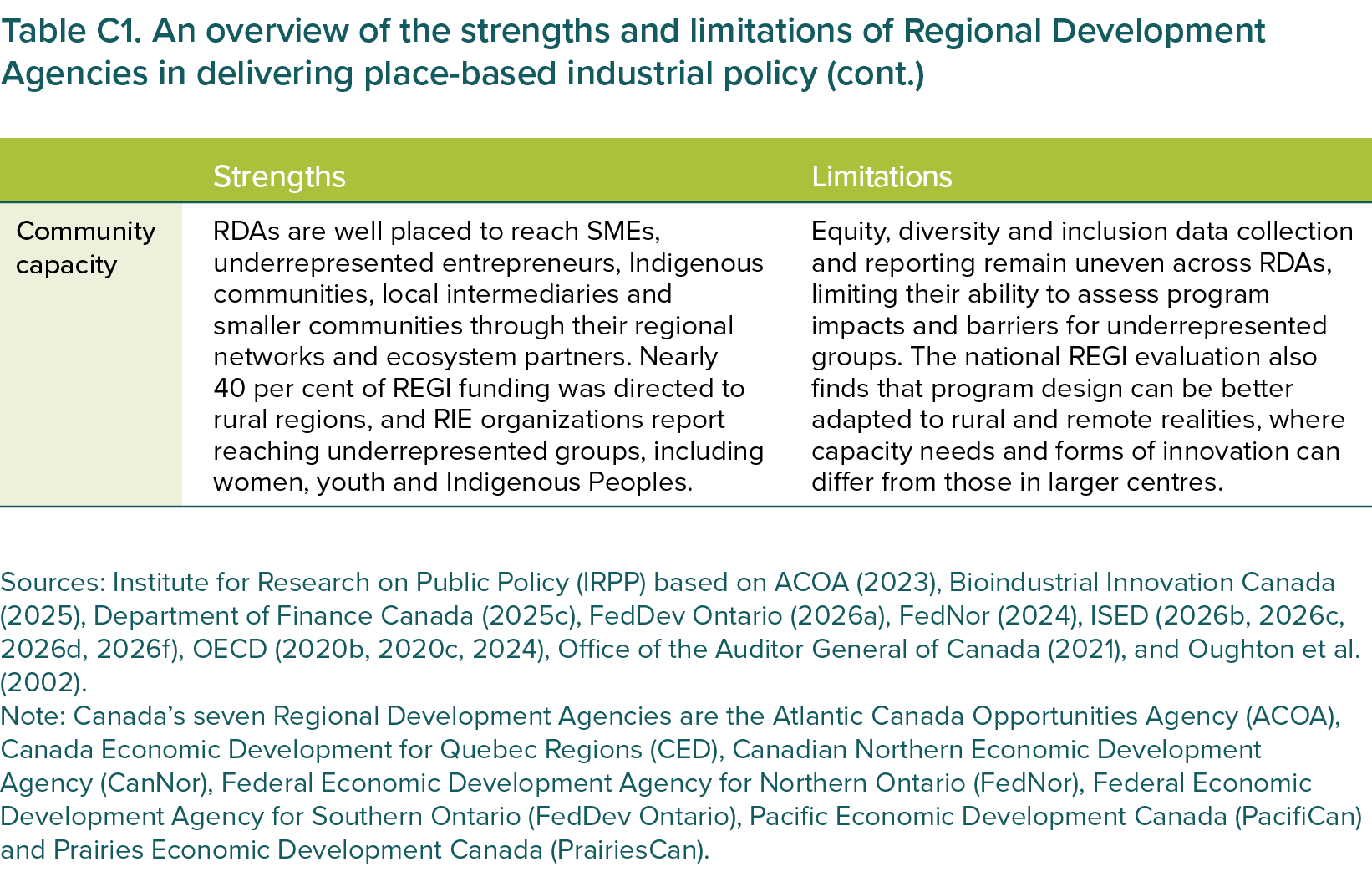
This appendix examines spatial conditions in two groups of federal industrial policy instruments. Box D1 defines spatial conditions. Table D1 presents the 10 largest targeted federal instruments in the OECD’s 2023 Quantifying Industrial Strategies (QuIS) database. Table D2 supplements this snapshot with selected federal industrial policy instruments introduced after 2023 or otherwise not captured in the QuIS top 10 ranking.
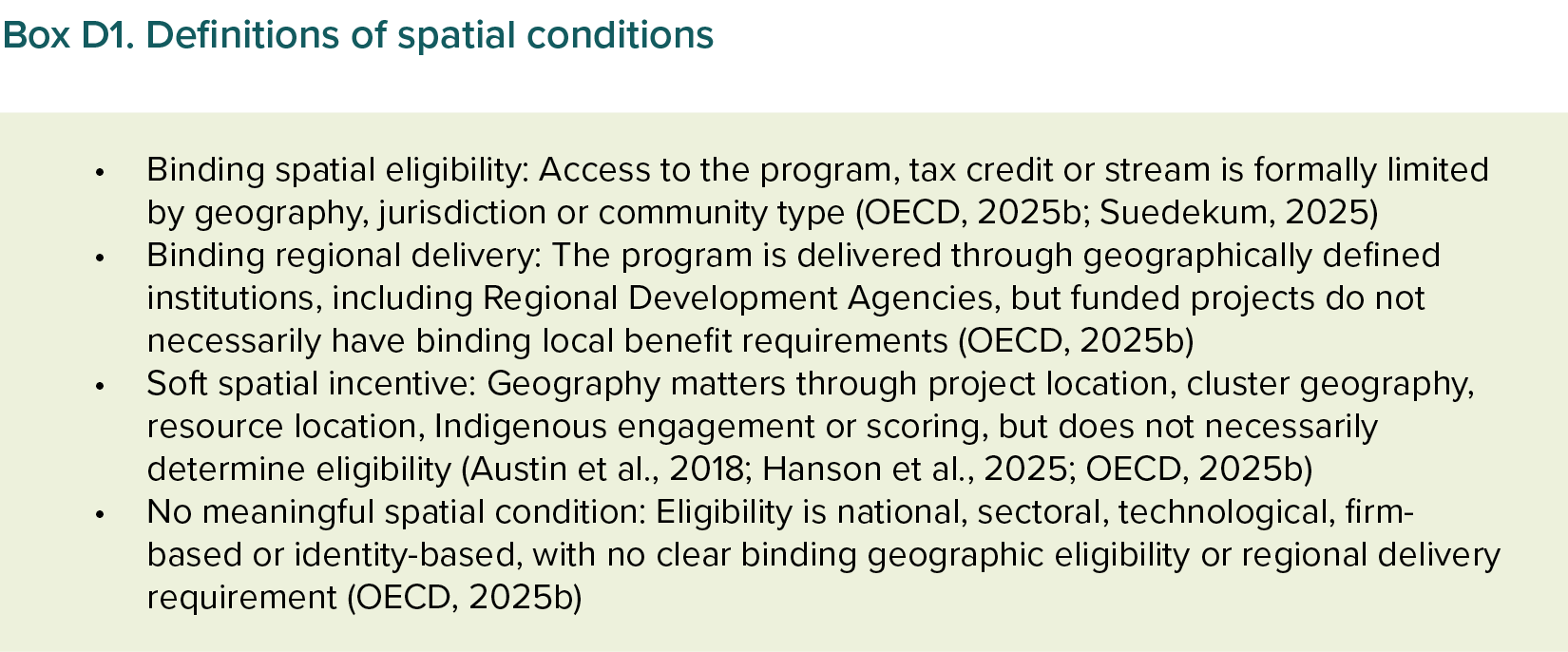

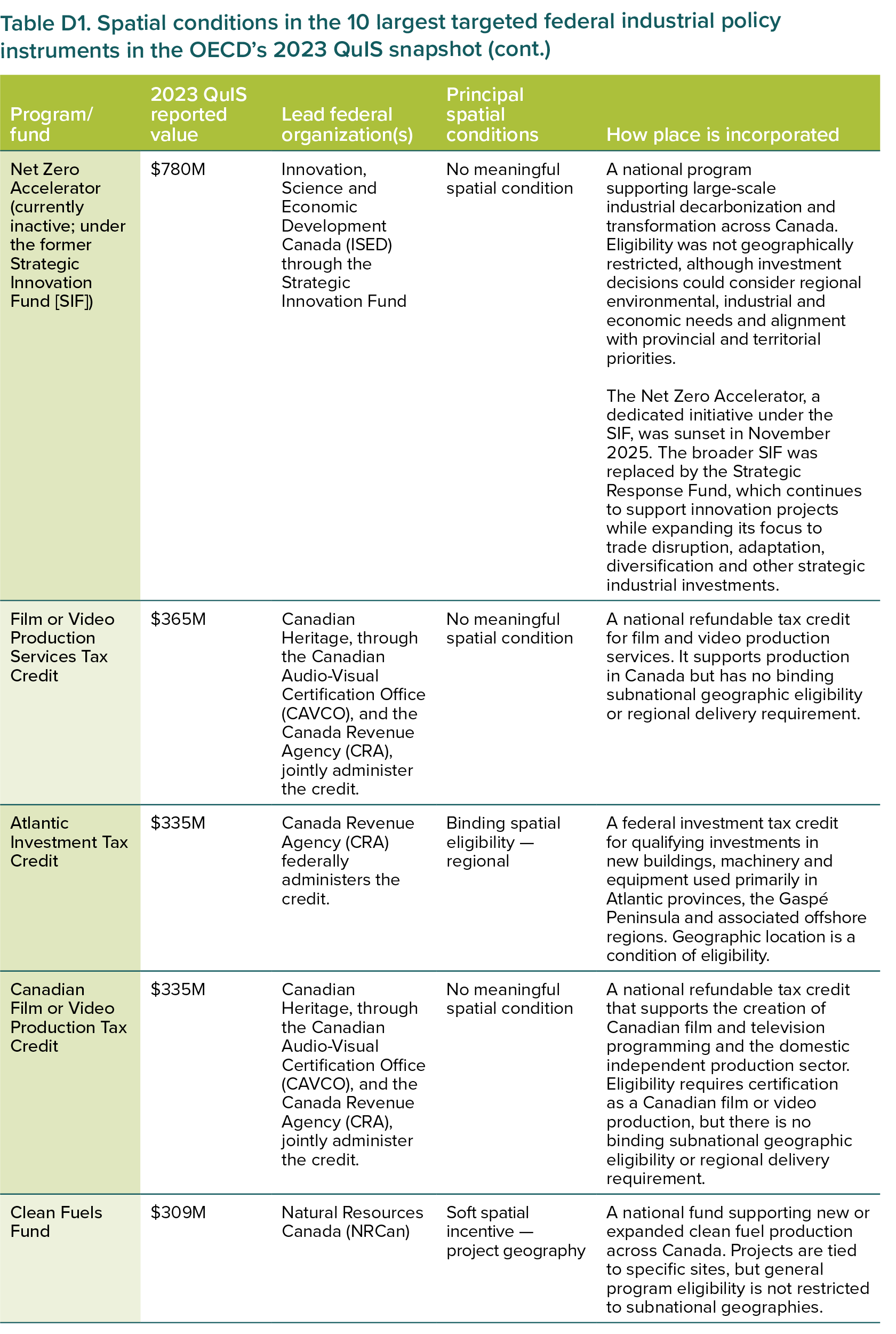




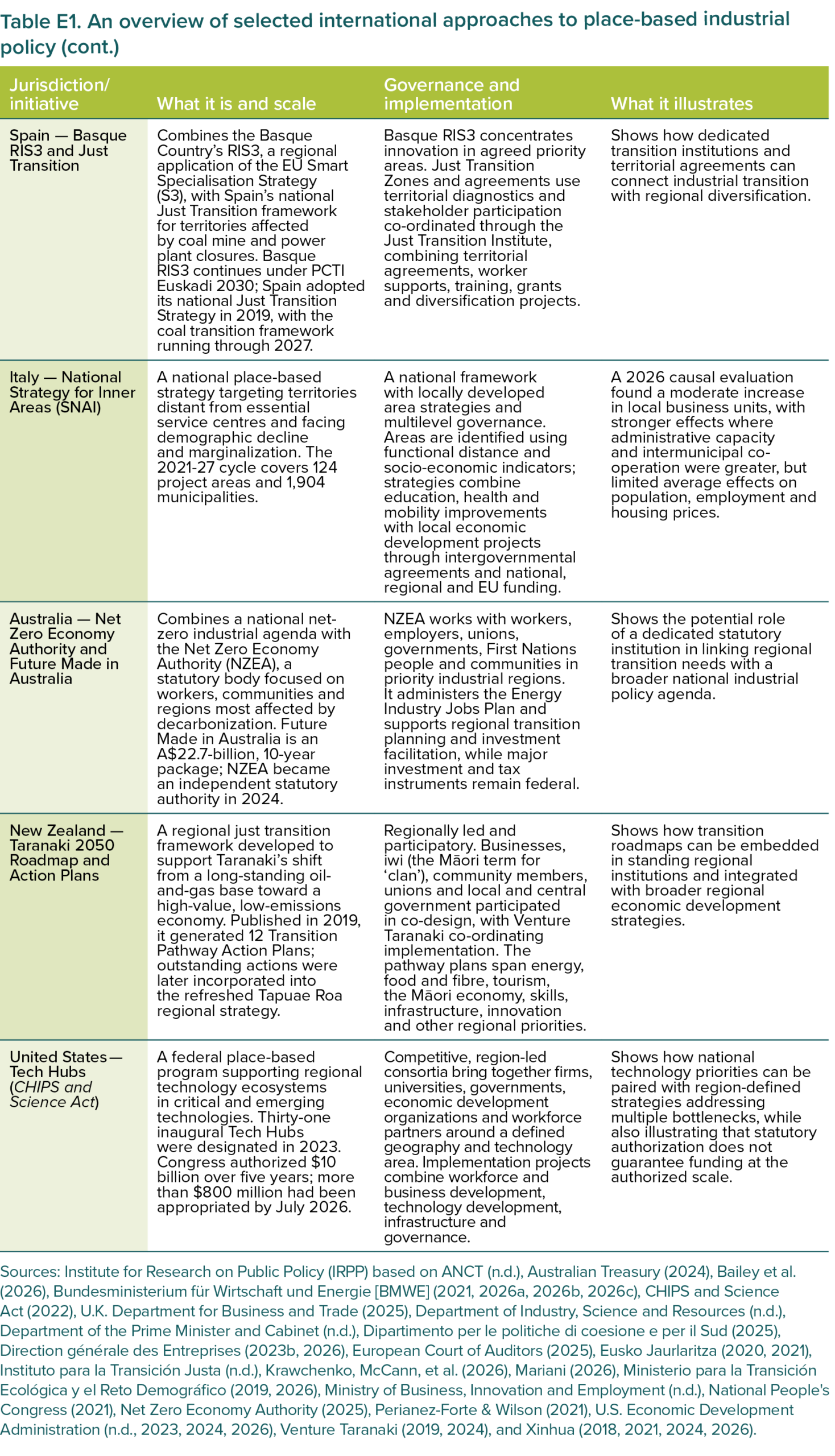
This Policy Brief was published as part of the IRPP’s Community Transformations Project. The manuscript was copy-edited by Prasanthi Vasanthakumar, proofreading was by Zofia Laubitz, French publication management was by Étienne Tremblay, production was by Chantal Létourneau and art direction was by Anne Tremblay.
Shaimaa Yassin is senior research director at the Institute for Research on Public Policy.
Rachel Samson is vice-president of research at the Institute for Research on Public Policy.
Dena Abtahi is a research associate at the Institute for Research on Public Policy.
Abigail Jackson is a former senior research associate at the Institute for Research on Public Policy.
The Community Transformations Project was funded in part by The McConnell Foundation and Vancity. Research independence is one of the IRPP’s core values, and the IRPP maintains editorial control over all publications.
To cite this document: Yassin, S., Samson, R., Abtahi, D., & Jackson, A. (2026). A place for place: The role of place-based industrial policy in a more ambitious Canada. Institute for Research on Public Policy. https://doi.org/10.26070/hkww-2231
The authors would like to thank the many experts who reviewed this Policy Brief for their valuable insights and feedback, particularly Tamara Krawchenko, David Wolfe and Bruno Arcand. The authors also thank Marilyn Crewe, Carla Arsenault, Rick Van Staveren, Nigel Wodrich and Gordon More for sharing their local knowledge and perspectives on the communities featured in this Policy Brief. The authors also thank IRPP research director Ricardo Chejfec for his insights and contributions to discussions that informed this Policy Brief.
AI coding assistance tools were used to support the development of scripts for the data analysis used in figures 2, 3 and A1 and to assist with the visual styling of figures in this Policy Brief. All generated code and outputs were verified and tested by the authors, who take full responsibility for the output.
This Policy Brief has undergone rigorous internal and external peer review for academic soundness and policy relevance. The opinions expressed in this Policy Brief are those of the authors and do not necessarily reflect the views of the individuals consulted or the IRPP Board of Directors.
If you have questions about our publications, please contact irpp@nullirpp.org. If you would like to subscribe to our newsletter, IRPP News, please go to our website at irpp.org.
Illustration: Auni Milne, Sumack Loft.