



Five Steps to Advance Robust Industrial Policy in Canada
Robust industrial policy can catalyze economic transformation that benefits communities and regions, but only if it is designed with local capacities and needs in mind.




Canada’s economy is evolving, which will bring both positive and negative change. But transitions — such as moving toward a low-carbon economy, shifting trade relationships or the rise of AI — can disrupt specific workers in specific places. In some instances, people in affected sectors will keep their jobs or move into new, often similar, roles. But for those who lose their jobs, the path forward is rarely obvious. Finding a new career is a complex decision, and Canada’s approach to workforce development has historically failed to adequately equip workers, businesses and communities to face these disruptions.
This study demonstrates what a place-based, skills-based approach to transition planning can look like in practice. Rather than starting from credentials or job titles, it asks two questions: What do workers actually do on a day-to-day basis? And where do the competencies they have overlap with other occupations?
Applying a data-driven methodology across seven Canadian communities susceptible to workforce disruption from the low-carbon transition, the study identifies potential career pathways for 15 occupations and the specific skill gaps workers would need to bridge to alternative occupations. In doing so, it also makes the case for greater investment in the data infrastructure that underpins this kind of place-based analysis.
In practice, this framework narrows hundreds of potential career pathways to a manageable number. The approach follows four steps:
Our study does not advocate for any single pathway, nor does it predict which opportunities will emerge in a given community. Because the analysis works with existing occupational data, it cannot capture emerging opportunities — such as new roles tied to nuclear, defence or major infrastructure investments, or shifts driven by changing trade relationships. It also relies on national-level competency profiles that may not fully reflect local labour market dynamics.
For example, a heavy equipment operator may have the skills to become an elevator constructor, but if multi-storey buildings are not planned for the community, it is not a realistic pathway. These limitations underscore a central argument of this study: that greater investment in timely, granular and accessible skills data and projections would make this kind of analysis significantly more powerful. And because career transitions are ultimately personal and shaped by community context, this framework is designed to be refined through local knowledge and engagement — providing an evidence-based foundation for decisions that workers, communities and policymakers reach together.
While the methodology focuses on disruption that could arise from the low-carbon transition, the same approach can be used to support workers facing disruption from trade policy, automation or other structural changes.
Based on our findings, we offer four recommendations for governments, employers and education providers to better support a skills-based approach to workforce development:
1. Federal, provincial and territorial governments should institutionalize a skills-based approach to workforce development.
2. Federal, provincial and territorial governments should invest in data infrastructure to make skills-based approaches effective.
3. Education and training institutions, working collaboratively with industry, should experiment with innovative approaches to delivering non-cognitive skills.
4. Communities facing foreseeable economic transitions should be equipped with actionable skills-based analyses and supported in building the local capacity to use them.
Canada’s economic prosperity and labour market are affected by broad drivers, including an aging population, climate change, geopolitical shifts, technological change and the rise of artificial intelligence. As the economic landscape rapidly evolves, these factors are driving changes in overall employment levels as well as the types of jobs and skills in demand. These shifts are occurring simultaneously and can be exacerbated by unpredictable shocks, such as the COVID-19 pandemic or, as witnessed in early 2025, a rapid change in trade policy that can negatively impact workers and communities. In some cases, these shifts entail job losses or necessitate job transitions to other sectors and occupations.
In light of these transformative drivers, successful workforce development policies and programs are central to supporting people, communities and businesses. However, Canada’s track record in this regard leaves much to be desired. Previous policies and programs to help unemployed workers return to work and underemployed workers change jobs or manage ongoing transformations within their current roles have had limited success.
In recent years, there has been a welcome acknowledgment of the role of skills as central to successful workforce development initiatives. However, progress is slow and not keeping pace with the dynamic changes and challenges unfolding in Canada’s labour market.
This study demonstrates a skills-based approach to identifying career transition pathways for workers and communities facing economic disruption, applied to Canada’s low-carbon transition.
Some global pathways to net zero could result in job losses in Canada, as businesses adopt new technologies and adapt to changing market conditions (Caranci & Fong, 2021). There can be significant impacts on workers who rely on the primary industries affected, as well as on other workers who are indirectly connected to these industries in their local economies, such as suppliers or the retail sector. Labour market adjustments of this nature are often unevenly distributed across sectors as well as types of workers and geographies.
At the same time, the global and domestic efforts to reduce greenhouse gas emissions bring the potential for new employment opportunities in activities and sectors that continue to expand. In some instances, growth sectors may have trouble finding workers. Critical mineral development and electricity production, for example, are expected to expand significantly (Merwat, 2026; Natural Resources Canada, 2022).
Exactly how employment and skills demand will evolve amid these transformations is unknown. However, there is increasing awareness that public policy efforts would greatly benefit from more effective career-planning information tools that use a skills-based approach (Oschinski & Nguyen, 2022). A skills-based approach refers to the determination of suitable job opportunities by “identifying overlaps in competencies, work activities and interests between a person’s current or more recent occupation and alternative options” (Oschinski & Nguyen, 2022, p. 5). It contrasts with a credentials-based perspective that focuses on a worker’s degrees, certificates or most recent job title.
With that context, this study builds on a 2022 IRPP publication that developed a framework for a new skills-based career guidance approach (Oschinski & Nguyen, 2022). The current research applies the skills-based approach to examine certain occupations that are susceptible to disruption from the low-carbon transformation across a range of communities in Canada. We assess the suitability and viability of alternative employment pathways for these workers using the prevailing skill requirements of various jobs, as well as quantitative and qualitative data on economic, labour market and community conditions. We look at major skill gaps between susceptible occupations and potential viable occupations to suggest where workers might require the most support in pursuing an alternative pathway.
Importantly, such a mixed-methods approach, built on publicly available skills-related insights and labour market information, can be applied to workforce transformations beyond the low-carbon transition — whether driven by shifting trade relationships, technological displacement, changing market demand that disrupts resource-dependent industries, or other structural changes.
Section 2 provides an overview of the methodology. Section 3 presents the background and context, including past labour market adjustment efforts, the net-zero transition and the advantages of a skills-based approach. Section 4 details each step of the analysis and its findings, including an illustrative case study. Section 5 concludes with key takeaways and policy lessons.
The objective of our study and approach is not to provide specific (in some cases, narrow) career options for workers and communities affected by disruption. Rather, the aim is to show how labour market information can guide the difficult and complex decisions that workers and communities face when confronted with workforce adjustment, including during the shift to a low-carbon economy.
No matter the source, disruption brings change that can be difficult for workers to navigate. Our study does not have all the answers, but it demonstrates a replicable framework — and the data infrastructure needed to support it — for translating skills-based analysis into practical guidance for workers, communities and policymakers.
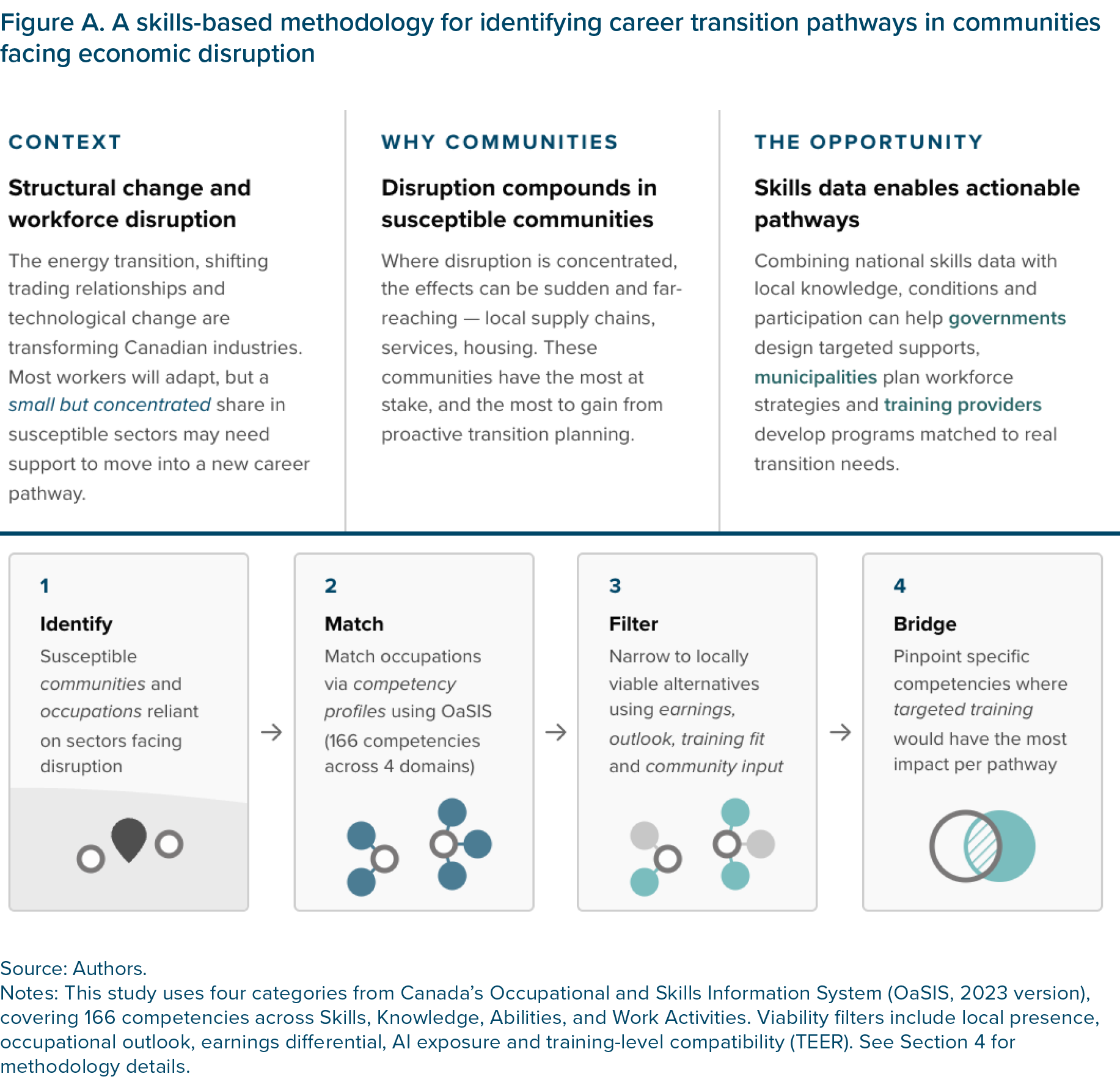
This study demonstrates how publicly available skills data and labour market information can be combined into a practical, skills-based approach to support workers and communities navigating economic disruption. The methodology follows four steps (figure 1).
The IRPP identified and shared with us susceptible occupations in communities that would be adversely affected by the low-carbon transformation based on its Community Transformations Project.
As part of this project, IRPP researchers developed a methodology for measuring community susceptibility to workforce disruption from decarbonization efforts (box 1). They chose susceptible communities from those that scored the highest, with the intention of highlighting a diverse set of regions and economic profiles. Together, we chose susceptible occupations from jobs with the most employees in sectors driving these communities’ high susceptibility scores.
We developed an algorithm to determine the jobs most similar (“most suitable”) in characteristics, such as skills and abilities, to those likely to be adversely affected by the low-carbon transformation (i.e., susceptible occupations).
Figure 1. A four-step methodology, starting with identifying susceptible communities and occupations and ending with the specific skill gaps workers would need to bridge
Source: Authors.
Notes: This study uses four categories from Canada’s Occupational and Skills Information System (OaSIS, 2023 version), covering 166 competencies across Skills, Knowledge, Abilities, and Work Activities. Viability filters include local presence, occupational outlook, earnings differential, AI exposure and training-level compatibility (TEER). See Section 4 for methodology details.
We performed a quantitative and qualitative assessment of the potential suitable occupations to determine which held the greatest prospect for workers in these communities. The result was a list of potential “viable occupations.”
We used a second algorithm to identify the most pressing gaps between the susceptible occupations and the associated potential viable occupations. Our analysis highlights where workers pursuing these career paths may require the most upskilling support to transition to the new alternative job.
Additional details on the methodology used in each step are included in Section 4.

A major global energy transition is underway. A shift that was originally driven by climate policy has now developed its own market momentum, with electrification and renewable energy supplanting traditional choices based on performance and cost alone (International Energy Agency, 2026). These efforts are driving widespread changes in technology, energy systems and markets, which are expected to reshape industries and communities across the country. Canada has also committed to reach net-zero emissions and double electricity capacity by 2050 (Environment and Climate Change Canada, 2022; Prime Minister of Canada, 2026a).
The resulting economic transformation is likely to have wide-ranging economic impacts in Canada, creating challenges and opportunities for the labour market. There are implications for both employment levels and the composition of jobs.
First, increased investment in electrification and renewable energy could reduce demand for fossil fuels, which could in turn directly and negatively impact workers in sectors such as oil, gas and coal production. The trend toward electrification is also disrupting industries like auto manufacturing, given the gradual shift toward electric vehicles, and steel production, which has historically relied on a carbon-intensive production process. These disruptions may extend to adjacent sectors, such as auto parts suppliers, that are directly tied to the operations and maintenance of carbon-intensive sectors or part of the broader, related supply chains.
Second, in communities with high concentrations of employment in affected sectors, local businesses — including retail stores, service providers and suppliers — that rely on the spending and economic activity generated by businesses and workers in these industries are also likely to experience considerable disruption. This can lead to further job losses and economic decline. This ripple effect can create a challenging cycle of economic contraction, making it difficult for smaller communities to recover or attract new investment.
The transformation toward net zero will also create new opportunities. Over the next decade and beyond, employment in Canada’s electricity sector is expected to grow, with long-term projections suggesting roughly 130,000 job openings between 2028 and 2050 — about 60,000 of them from expansion (Natural Resources Canada, 2026a). The skills composition of these (and other) jobs is evolving rapidly. Many of the planned investments in these projects could go unrealized if they are unable to attract enough workers with the right skill sets (Augustine et al., 2023). The U.K.-based Institute for Public Policy Research found that workers in carbon-intensive occupations can retrain with the goal of entering green (low-carbon) and blue (climate-compatible) occupations (Emden et al., 2024). However, in some cases, these green and blue occupations might require workers to relocate, which could still harm communities.
Significant adjustments across and within sectors will create uncertainty and potential inequities for certain regions and occupations, and in turn, individuals. We must better understand how these changes will affect communities and individuals and what supports they need through the low-carbon transformation.
Canada’s employment insurance (EI) system, the primary means to support unemployed workers, faces significant hurdles in assisting workforce transitions.
First, certain vulnerable workers lack coverage (e.g., self-employed persons). Significant gaps in coverage persist due to restrictive eligibility rules, insufficient benefit levels and an outdated structure that fails to reflect the dynamism of today’s labour market (Tamburri & Chejfec, 2025).
Second, employment benefits and support measures — the EI-funded programs that help unemployed individuals access retraining and maintain workforce attachment — remain underutilized and poorly targeted. Participation rates are low, and the programs often prioritize rapid re-employment over skills development, limiting their effectiveness for workers facing structural transitions (Canada Employment Insurance Commission, 2025; IRPP, 2022, 2025b).
Finally, EI-funded programs do not adequately target those most vulnerable to job loss, with skills acquisition often considered of secondary importance (Tamburri & Chejfec, 2023). For instance, under EI rules, recipients may be forced to abandon a skills-training program should an appropriate job offer materialize.
Other, more ad hoc initiatives introduced to support workers and communities facing structural adjustment have often fallen short in terms of re-employment outcomes. For instance, the Program for Older Worker Adjustment, which ran from 1987 to 1996, provided income support targeted at pre-retirement workers, aged 55 to 64, who had lost their employment as a result of a mass layoff (Human Resources Development Canada [HRDC], 1996). Although participants valued the financial support, this passive income disincentivized labour market participation. Re-employment prospects for older workers were poor among both program participants and those in a control group, with only a minority finding work again after being laid off (HRDC, 1996).
The Targeted Initiative for Older Workers (TIOW) program (2007-17) provided support to unemployed older workers in small communities, with a population of 250,000 or less, experiencing high levels of unemployment (Employment and Social Development Canada [ESDC], 2017). TIOW combined essential employment assistance activities, including employment counselling, job search strategies and interview preparation, with a minimum of two employability enhancement activities, such as peer mentoring, skills training and wage subsidies. An evaluation of the program suggested that participants were more likely than non-program participants to find new employment. However, it is challenging to determine the program’s success in this regard due to a high degree of non-response to employment outcome questions (ESDC, 2017).
The Canada Coal Transition Initiative (2019-25) directed $185 million toward economic diversification and skills development in coal-reliant communities. However, a 2022 audit by the Commissioner of the Environment and Sustainable Development found that the federal government lacked a comprehensive implementation plan, and that displaced workers were often redirected into generic employment programs poorly aligned with their skills and local labour market conditions (Commissioner of the Environment and Sustainable Development, 2022).
More recently, workforce development has gained new prominence in federal policy, tied both to transition planning and to Canada’s major-projects agenda. The 2026-30 Sustainable Jobs Action Plan, tabled in February 2026 under the Canadian Sustainable Jobs Act, consolidates a range of federal commitments. These include sectoral workforce alliances that bring together employers, unions and training institutions to address workforce needs in six priority areas, among them energy and electricity, mining and minerals, and advanced manufacturing (ESDC, n.d.-a; Natural Resources Canada, 2026b). Team Canada Strong, launched in April 2026 with a commitment of $6 billion over five years, aims to recruit, train and certify 80,000 to 100,000 new Red Seal skilled trades workers by 2030-31, and in July 2026 received an additional $2 billion for bilateral agreements with provinces and territories to expand training capacity (ESDC, 2026; Prime Minister of Canada, 2026b).
These efforts are recent, and it is too early to assess them. Ultimately, however, their success will depend on having workers with the right skills, in the right places, at the right time. That, in turn, requires doing a far better job of helping workers identify and take up new opportunities. Achieving this means strengthening and institutionalizing a skills-based approach to workforce development, ideally as a core element of a broader national workforce strategy — one that can address Canada’s pressing workforce challenges and make the most of these ambitious and timely initiatives.
Looking ahead, workforce development policies must shift away from an income-replacement model that focuses on education. To be effective, these policies must move toward a model that targets skill gaps to help workers affected by layoffs or closures to transition toward new and emerging opportunities (Braham & Tobin, 2020). Rather than relying on an individual’s degrees, a skills-based approach can help highlight how a person’s current work activities and competencies can be best leveraged for a new job opportunity (Oschinski & Nguyen, 2022).
The closeness of skills requirements between pre- and post-displacement jobs also affects workers’ wages. Displaced workers who end up in alternative jobs with very different skills portfolios are more likely to experience greater wage losses than those moving into roles that require similar skills (Poletaev & Robinson, 2008). This wage penalty also increases with the distance between the skills requirements of the old and new occupations (Gendron, 2011; Organisation for Economic Co-operation and Development [OECD], 2013). Consequently, a skills-based approach can be crucial for supporting transitions for workers affected by displacement. This approach broadens the range of employment pathways individuals could consider and may result in improved employment and social outcomes for them. It may also create economic and societal benefits from reduced labour and skills mismatches (Conference Board of Canada, 2023).
An improved understanding of workers’ skills in susceptible sectors could also inform economic development efforts. This would help ensure that workers can remain in their communities and economic development is, at least in part, driven by the ability of communities to leverage local talent. For example, if governments (regional, provincial or federal) know that oil and gas well drilling workers could become chemical plant machine operators, they could bolster efforts to attract new chemical or hydrogen investments.
Through a skills-based approach, governments can empower workers to seize new employment opportunities and better navigate career adjustments. They can help workers bridge skill gaps by providing targeted training programs, reskilling initiatives and upskilling opportunities. A skills-based approach to career planning would also enable providers to design more targeted retraining efforts. By understanding the skill gap between occupations (combined with efforts to assess the individual’s skills), training initiatives can focus on the skills needed to transition to new employment opportunities.
However, the design of future training initiatives would benefit from greater conceptual clarity and a deeper understanding of the importance of non-cognitive or “higher-order” skills, such as problem-solving and conscientiousness. While the mechanisms for fostering foundational skills, such as literacy and numeracy, are well understood, this is not the case for non-cognitive skills. These higher-order skills are increasingly valued and sought after — but how they are defined, cultivated and measured remains unclear (Deming, 2022; Deming & Silliman, 2024). As the use of artificial intelligence becomes more widespread, questions around the importance of traditional cognitive skills versus non-cognitive skills, and their prominence within education and training programs, are likely to persist.
Ultimately, a holistic approach that addresses both educational attainment and the acquisition of various types of skills is essential for fostering a workforce that remains competitive and resilient in the face of changing economic realities.
Every community has distinct cultural, economic and industrial characteristics that influence its vulnerability to change. In the transformation to net zero, some sectors could face significant downside risks. Communities face amplified risk when their dominant sectors experience disruption, often exacerbated by factors such as recent changing trade policies.1
In the first phase of work for the IRPP’s Community Transformations Project, community and workforce susceptibility to the low-carbon transformation was assessed using an original methodology that drew on 2021 Census data as well as other publicly available datasets. The IRPP’s analysis led to a list of 68 susceptible communities. From that list, we selected seven Canadian communities as the focus for this study (figure 2). Economic transitions may have particularly pronounced effects in these regions, potentially affecting both direct employment and broader community resilience.
Figure 2. Seven communities across Canada were selected to illustrate how the approach works across different economic profiles
Source: Authors, based on IRPP Community Transformations Project susceptibility methodology (Chejfec et al., 2025).
Notes: Community susceptibility was assessed using 2021 Census data across three metrics: facility emissions, employment in emissions-intensive sectors, and labour force in globally traded sectors. Susceptible occupations were selected based on each community’s dominant industrial structure. The Northwest Territories is assessed as a whole territory rather than a single census division, due to occupation data availability constraints at the sub-territorial level. See box 1 for methodology details.
Based on each community’s sectoral and employment composition, we put together a list of susceptible occupations based on the likelihood (and magnitude) of jobs impacted by emissions reduction costs and/or changes in domestic and global markets. The distribution of these susceptible occupations reflects each community’s dominant industrial structure.
For instance, in census divisions No. 1 of Saskatchewan (Estevan) and No. 16 of Alberta (Wood Buffalo), susceptible occupations are concentrated in mining, quarrying, and oil and gas extraction — with coal mining in the former and oilsands production in the latter. In Oxford, Ontario, the susceptible occupations cluster is in automotive manufacturing, while Division No. 3, Newfoundland and Labrador (Channel-Port aux Basques), shows susceptibility in fishing and marine transportation occupations. Some occupations are susceptible across multiple locations, with transport truck drivers, material handlers and heavy equipment operators particularly exposed to economic and technological disruptions despite their critical role in Canada’s industrial landscape.
An overview of the industries that anchor the economic fabric of the seven communities is presented below.
Situated at Newfoundland’s southwestern tip, Division No. 3 relies heavily on maritime transport, with 14 per cent of its workforce in transportation and warehousing. The headquarters of Marine Atlantic, the ferry that travels between Nova Scotia and Newfoundland, is in Port aux Basques. Other top industries are health care and social assistance, and agriculture, forestry, fishing and hunting. Water transport deck and engine crew positions account for nearly three per cent of local employment, highlighting the community’s exposure to maritime sector transitions.
The ferry is not at risk of closure, as the service is constitutionally protected under legislation enacted when Newfoundland and Labrador joined the federation in 1949. It is also considered part of the Trans-Canada Highway. However, workers could experience disruption as Marine Atlantic fulfils its commitment to achieve net-zero emissions by 2050 (IRPP, 2025a).
Algoma county, situated along the Canada-U.S. border in northern Ontario, exemplifies a community built around a single dominant industry. The steel mill has historically anchored the local economy, with the manufacturing sector employing nine per cent of the workforce. The mill’s economic impact extends well beyond direct manufacturing employment, creating significant spillover effects across multiple sectors and reinforcing the community’s dependence on steel production. Algoma Steel’s workforce is facing significant disruption as the company shifts to a lower-emission technology and to products aimed at the Canadian market to avoid U.S. tariffs (IRPP, 2026a). Other top industries are health care and social assistance and retail trade.
Oxford, located in southwestern Ontario, has a high concentration of manufacturing due to its General Motors CAMI automotive assembly plant. In 2021, manufacturing employed approximately 20 per cent of the local workforce, with motor vehicle assemblers, inspectors and testers representing a substantial portion of these jobs.
The community’s deep integration with the automotive sector makes it particularly sensitive to disruption. The General Motors CAMI assembly plant, which transitioned from making SUVs to electric vans in 2022, ceased production in 2025 (IRPP, 2025b). In its announcement about the closure, General Motors cited low demand for the electric vans and said it would contemplate an alternative model (Dolynny, 2025). Other top industries are agriculture, health care and social assistance and retail trade.
Division No. 15 in southwestern Manitoba has both manufacturing and agriculture, forestry, hunting and fishing sectors, each employing approximately 15 per cent of the workforce. Agricultural managers comprise nine per cent of local employment, while industrial butchers and meat cutters account for seven per cent, reflecting the community’s significant role in food production and processing. Neepawa anchors the census division’s food-processing sector, home to a HyLife pork processing plant that employs roughly 1,700 people (IRPP, 2026b).
Division No. 1 in southeastern Saskatchewan near the Canada-U.S. border represents another example of dual-sector economic dependence. Agricultural managers constitute nearly 10 per cent of the local workforce, underscoring the region’s strong farming base. This agricultural foundation is complemented by significant energy production (coal power plants) and resource extraction (oil and gas production, coal mining) activities, creating an economic structure that bridges both traditional farming and energy sectors.
Linked to the industrial base, transport truck drivers are a top occupation. Discussions of closing the coal power plants and coal mine to adhere to federal emission regulations created significant concern in the community. However, in 2025, the provincial government announced it planned to extend the life of its coal plants and keep them open until 2050 while developing nuclear power in the province (Government of Saskatchewan, 2025). The shift from coal to nuclear power production could create risks and opportunities for workers (IRPP, 2025c).
Division No. 16 in northeastern Alberta demonstrates the highest level of industrial concentration among the seven focus communities, with mining, quarrying, and oil and gas extraction (oilsands production) employing nearly 30 per cent of the local workforce. Heavy equipment operators represent the largest occupational group at seven per cent of total employment. Transport truck drivers are another top occupation.
This pronounced dependence on oil production makes the community especially vulnerable to both global commodity market fluctuations and reductions in demand driven in part by the shift toward electric vehicles. Workers, such as haul truck drivers, are also susceptible to automation (IRPP, 2026c).
Unlike the other communities, the Northwest Territories is assessed as a whole territory rather than a single census division, due to data availability constraints at the sub-territorial level.2 The resources of the Northwest Territories include substantial diamond and critical mineral deposits. While mining continues to drive economic development through resource extraction activities, the region’s employment structure reflects a more complex reality. Public services play an equally vital role in sustaining local communities and are a major source of employment, creating a unique hybrid economy that distinguishes the territory from other resource-dependent regions.
With the territory’s diamond mines closing and critical mineral mines slow to develop, the region could face disruption to workers as well as suppliers, contractors and businesses that support the mining sector (IRPP, 2025d).
Taking the susceptible occupations as the starting point, the second step of the analysis identified potential “suitable occupations” using a skills-based approach. Skills, knowledge and abilities are commonly viewed as competencies applied in the performance or completion of a task (Labour Market Information Council [LMIC], 2019). Research suggests that alignment between an individual’s competencies and those required by their job has a high influence on job satisfaction and performance (Bayona et al., 2020). As such, identifying potential suitable occupations based on skills can help uncover alternative jobs in which a displaced worker could potentially thrive, including occupations in different industries.
To compare occupations, we used a “proximity algorithm” to assess job requirements across Canada’s recently developed Occupational and Skills Information System (OaSIS) domains (see Appendix C). This approach builds on earlier work using the U.S. Occupational Information Network (O*NET), a detailed inventory of occupations developed by the U.S. Department of Labor (Oschinski & Nguyen, 2022).
OaSIS offers a comprehensive framework for understanding the competencies of over 900 different Canadian occupations, as defined per the National Occupation Classification (NOC) system.3 Our research leverages this rich and underutilized resource.4
The over 200 competencies in OaSIS (2023 version) are organized into seven categories similar to those in O*NET. Each category encompasses several competencies organized according to ESDC’s Skills and Competencies Taxonomy. For instance, the Skills category has 33 competencies, including numeracy and instructing. The Abilities category has 49 competencies, including body flexibility and hearing sensitivity.
We used four categories for this project: Skills, Knowledge, Abilities and Work Activities (table 1).
Within the Skills, Knowledge, Abilities and Work Activities categories, OaSIS assesses the applicability of each competency for every occupation using a binary yes/no scale. Applicable competencies are then rated on a scale of 1 to 5 — for proficiency in the case of Skills and Abilities and for complexity in the case of Work Activities. For Knowledge, the scale is 1 to 3.
For example, for the occupation of mining engineers (NOC 21330), applicable skills include critical thinking and communicating with co-workers. Critical thinking is required at the highest proficiency level (5), while communicating with co-workers is required at a slightly lower level (4). Analyzing data or information is a work activity required at the highest complexity level (5), while controlling machines and processes is also applicable but at moderate complexity (3).
To identify potential suitable alternative occupations for each of the susceptible occupations identified in Phase 1, we used a proximity algorithm.
This algorithm calculates similarity scores between occupations based on their values across OaSIS domains (ESDC, n.d.-b). It compares the degree to which two occupations share similar competency requirements across the four OaSIS domains of Skills, Knowledge, Abilities and Work Activities. All 166 OaSIS competencies entered the calculation with equal weight; no domain-level reweighting was applied. Proximity between occupations was calculated as the cosine similarity between two occupations’ vectors of ratings across all 166 competencies, with sub-occupation profiles averaged to the 5-digit NOC level.
Table 1. The study uses four OaSIS categories covering 166 competencies
Source: Employment and Social Development Canada (ESDC), Occupational and Skills Information System (OaSIS), 2023 version.
Notes: OaSIS covers seven categories in total; this study uses the four shown here. A rating of 0 is equivalent to not applicable.
Our resulting similarity scores range from 0 to 1, with higher scores indicating a greater overlap in occupational requirements. The most similar alternative occupations were identified for each susceptible occupation. For example, the susceptible occupation of heavy equipment operator had its highest level of similarity with the occupation of crane operator, with an overall skills proximity score of 0.97.
Figure 3 illustrates the resulting similarity landscape across all susceptible occupations and their top alternatives. Appendix A presents the top potential suitable occupations for each susceptible occupation, based on this concept of skills proximity.
Figure 3. Nearly all of the 15 susceptible occupations have skill-similar alternatives spread across three or more occupation families, suggesting broad potential before local conditions are considered
Number of individual occupations from each National Occupation Classification (NOC) 2-digit group appearing in the top 10 most skill-similar alternatives
Source: Authors’ calculations using Occupational and Skills Information System (OaSIS), 2023 version.
Notes: For each susceptible occupation (rows), the similarity algorithm identifies the 10 most skill-similar alternatives from across the Canadian labour market. These candidates are grouped by their NOC 2-digit occupation family (columns). Cell values show how many individual occupations from that family appear in the top 10. The numbers in brackets correspond to the occupation’s NOC code. Only columns where more than one row has values are shown. These suitable candidates represent the starting pool before community-specific viability filters are applied.
Economic and regional factors can affect the viability of alternative occupations that are otherwise potentially suitable from a purely skills-based perspective. Consequently, we used a systematic filtering process to integrate other factors and narrow the list of potential suitable occupations to those that show the most promise for the workers and communities in focus.
We applied quantitative criteria and qualitative insights to transform the list of potential suitable occupations strictly based on skills into a list of potential “viable” occupations that considers other labour market and contextual factors (figure 4).
Figure 4. Starting from a ranked list of suitable occupations, successive filters narrow the pool to a focused set of locally viable alternatives
Illustrated for material handlers (training, education, experience and responsibilities [TEER] level 5) in Oxford, Ont.
Source: Authors’ calculations using Occupational and Skills Information System (OaSIS), 2023 version, Census (2021), Labour Force Survey (2023), Canadian Occupational Projection System (COPS) projections, and Community Transformations Project profiles.
Notes: Each dot represents a candidate occupation; the centre ring is the susceptible occupation. Proximity to the centre indicates higher competency similarity. Faded dots have been filtered out at that stage.
As a precondition, suitable occupations that are themselves susceptible to disruption were excluded. Recommending a transition to another at-risk occupation would be counterproductive; this step ensures that the filtering process begins with a set of candidates that are not facing the same structural pressures as the source occupation.
A suitable occupation with limited opportunities in the province or territory (i.e., employment below a minimum threshold at the provincial level) was not deemed viable. This ensures that identified career transition pathways reflect actual local labour market opportunities.
For example, metal caster was a potentially suitable occupation for heavy equipment operators from a skills proximity perspective. However, according to the 2021 Census and 2023 Labour Force Survey, no metal casters were employed in Saskatchewan. Consequently, metal caster was removed as a potentially viable occupation for heavy equipment operators in Estevan.
Beyond provincial availability, we also checked whether an occupation had any local employment in the community itself. Occupations with no local presence were flagged as unlikely local pathways, though this screen could be overridden at the community-review stage where local knowledge could indicate genuine prospects.
This criterion implicitly recognizes it is preferable, maybe even ideal, that individuals can remain in their community, but that moving to another part of the province or territory may be an inevitable part of labour market adjustment (albeit less desirable from a community perspective).5
A limitation of this approach is that census employment counts workers where they reside, not where they work. In communities with substantial fly-in/fly-out or rotational workforces — notably the Northwest Territories and Wood Buffalo — some workers employed locally are counted at home addresses elsewhere, so provincial and territorial presence figures can understate the true local workforce.
We also considered the future sustainability of suitable occupations, using federal (COPS) and, where available, provincial projections to assess whether an occupation faces workforce shortages or surpluses.6 Occupations projected to face a strong risk of labour surplus were excluded, as weak demand makes them poor transition targets.
Outlook data are available at the national and provincial levels but not at the community level. A province-wide shortage in a given occupation may not hold locally. Community conditions can diverge significantly, particularly when a major employer closes or new investments arrive. This limitation underscores the importance of complementing quantitative screening with community-level insights.
We assessed the earnings differential between potential suitable occupations and the susceptible occupation. Potential suitable occupations without a median income of at least 65 per cent of the original susceptible occupation were excluded. This recognizes that workers may not view a potential new occupation to be viable if it involves a substantial cut in earnings. This threshold helps maintain workers’ economic stability during and after their career transitions.
We screened potential suitable occupations for their exposure to AI, drawing on Li and Dobbs (2025), who measure the degree to which AI can perform the tasks that make up an occupation. Occupations classified as medium- or high-exposure were excluded. This criterion played a limited role: the large majority of suitable alternatives fell into the low-exposure category, so relatively few occupational pathway candidates were removed on this basis.
We considered the degree of alignment between the training and education levels of the susceptible and potential suitable occupations. To do so, we used Canada’s TEER system, which groups occupations by the level of training, education, experience and responsibilities (TEER) required. Most susceptible occupations had TEER levels of 3 (post-secondary or apprenticeship training of less than 2 years), 4 (completion of secondary school or several weeks of on-the-job training with some secondary school education) or 5 (short work demonstration and no formal educational requirements).
Two different scenarios were considered to identify subsets of potential viable occupations:
In the second scenario, apart from the need to close major skill gaps, greater qualifications may be required depending on the occupations and individuals in question. Even for two occupations within the same TEER category, beyond closing skill gaps, additional occupation-specific certifications may be required (e.g., a particular type of driver’s licence).
Occupations requiring substantially more training than the susceptible occupation — those more than two TEER levels above — were excluded as unrealistic transitions.
To ensure the final list of potentially viable occupations reflected the specific needs and contexts of each community, we undertook a qualitative review in collaboration with the IRPP. This stage recognized that different communities have divergent economic conditions and growth strategies.
Drawing on IRPP community profiles and local data, we simulated the kind of review a community itself would conduct: excluding occupations tied to the same declining sector or with no realistic local employer and adding occupations of strategic local importance even where they fell outside the top matches. The result is a curated selection of pathways for each community. These pathways are illustrative; in practice, the selection should be shaped by local knowledge and community input.
The list of potential viable occupations resulting from this multi-dimensional screening process is presented in Table 2. This is a more focused set of employment alternatives than the occupations identified as suitable based on skills proximity alone. By considering not only workers’ existing skills but also regional, economic, technological and educational factors, these viable occupations represent more sustainable career pathways.
For each susceptible occupation, the filtering process typically yields multiple viable alternatives. Table 2 presents this curated selection for Estevan. The middle column summarizes the top viable occupations that passed screening; the final column presents the curated pathways a community might act on after applying local knowledge.
This exercise is not intended to be predictive or prescriptive but rather to support forward-looking planning. We illustrate potential pathways for workers with the understanding that career transitions are individual and complex decisions. Our goal is to demonstrate how governments can adopt a data-informed approach to identify vulnerable segments of the workforce and consult with communities to find the best potential careers moving forward. These insights can then guide the design of targeted skills development, training and employment support strategies, in line with the principles of a just transition and other emerging opportunities.
Table 2. For each susceptible occupation in Division No. 1, Sask., viable alternatives are identified at comparable and higher training levels
Source: Authors’ calculations using Occupational and Skills Information System (OaSIS), 2023 version, Census (2021), Labour Force Survey (2023), Canadian Occupational Projection System (COPS) projections and IRPP community consultations.
Notes: For each susceptible occupation, the middle column shows the top viable occupations that passed screening, grouped by occupation family (2-digit National Occupation Classification [NOC]). The final column presents the curated pathways selected through a simulated community review, shown at comparable and more extensive training levels.
Our approach highlights how data and qualitative insights can also better inform the choices of individuals and communities. Skills proximity is only a starting point. Every effort should be made not only to make such data more widely available but also to update them regularly to reflect, as best they can, current and anticipated realities.
At the same time, it is important to note that economic and labour market conditions can change rapidly, such as with the recent trade volatility or investments in major projects. Therefore, any prognosis on the outlook of an occupation or sector comes with some uncertainty.
Nonetheless, economic opportunities are emerging across the country. In fact, geopolitical turmoil has led to a dramatic re-prioritization of bilateral trade and investment opportunities as well as increased emphasis on reducing barriers to internal trade and domestic demand. The federal government’s Budget 2025 (Department of Finance Canada, 2025) shows that several economic sectors in Canada have significant growth potential and opportunities for new investments, such as infrastructure and transportation, including high-speed rail and trade diversification corridors. More recent announcements about a defence industrial policy, electricity strategy, nuclear strategy and major projects also point to areas where employment opportunities are likely to grow (Prime Minister of Canada, 2026a, 2026c). As economic and structural conditions shift, the need for systematic, data-informed approaches to workforce transition planning only grows.
In the study’s fourth and final step, we sought to uncover where major skill gaps may exist for workers transitioning from a susceptible to a viable occupation.8 To do so, the skills of each type were compared using a skill-gap algorithm based on revealed comparative advantage (RCA) — a concept commonly used in international economics to assess a country’s export potential.9
By adapting this concept to occupations and skills, the RCA can indicate how much a skill is relied upon in a particular occupation relative to all occupations. An occupation uses a specific skill with relatively high intensity — a revealed comparative advantage, so to speak — when the ratio of the occupation’s requirement for that skill to the total skills requirement exceeds the same ratio for total occupations. For example, the occupation of heavy equipment operator (NOC 73400) has a score of 2.19 for the skill “repairing,” which indicates this skill is used more intensely by this occupation compared to all occupations.
A “skill gap” was considered to exist where a potential viable occupation had a score of greater than 1 for a competency requirement (as per OaSIS) while the associated susceptible occupation had a score of less than 1 for that same competency. This gap can indicate where workers might require additional support to successfully transition along a specific career pathway (e.g., heavy equipment operator to crane operator).
Figure 5 shows the results for two career transition pathways for a potential viable occupation — one with a comparable TEER level and one requiring a more extensive TEER level.10
The first example shows that material handlers would likely need to augment their skills in quality control testing and management of material resources, in particular, to transition to the potential viable occupation of construction trades helpers and labourers. Material handlers already require a certain amount of these skills as illustrated by the grey portion of the bars. However, construction trades helpers and labourers rely on these two skills more intensely. In this example, the susceptible occupation (material handlers) and the potential viable occupation (construction trades helpers and labourers) have a TEER level of 5, indicating that they both have a similar level of education and training requirements.
Figure 5. A revealed comparative advantage (RCA) approach pinpoints where each transition pathway requires the most upskilling
Two examples of how the RCA approach identifies where workers would need to build skills
Source: Authors, using Occupational and Skills Information System (OaSIS), 2023 version.
Notes: Each bar shows the RCA for a competency. Values above 1.0 (dashed line) indicate that the occupation relies on that competency more intensely than the average across all occupations. Where the viable occupation (teal, narrow) extends beyond the susceptible occupation (grey, wide), a training gap exists. Left panel: same training, education, experience and responsibilities (TEER) level (5). Right panel: TEER upgrade required (3 → 2).
The second example shows the susceptible occupation of transport truck driver typically requires less training and education (TEER 3) than the potential viable occupation of crane operator (TEER 2). Our analysis highlights that a transition from transport truck driver to crane operator would not only necessitate an upgrade in TEER, but would also require more intensive expertise in digital literacy and management of personnel resources.
In both examples, the analysis points to areas where workers looking to transition from one occupation to another may need to augment their skills. Importantly, other job-specific requirements beyond TEER and occupation-specific skills should also be considered. For example, even if skill gaps are addressed, additional licences and certifications may be required. No matter how much digital literacy a truck driver acquires, they still need a crane operator certification to do that job.
Looking beyond individual pathways, certain skill gaps recur across communities (figure 6). In five of the seven communities, product design — a skill related to designing or adapting equipment and technology — appears as a top training gap across several transitions. This finding suggests that investments in targeted training areas could serve workers across multiple transition pathways.
Figure 6. Common skill gaps across communities can inform regional training investments
Most common skill gaps for each community, across highlighted susceptible-to-viable transition pairs
Source: Authors, using Occupational and Skills Information System (OaSIS), 2023 version, and RCA methodology.
Notes: For each community, the table shows the competencies that most frequently appear as a top skill gap across all curated transition pairs. Gaps are identified using a revealed comparative advantage (RCA) approach: a competency is a gap when the viable occupation’s RCA exceeds 1 and the susceptible occupation’s RCA is below 1. The denominator is the total number of curated transition pairs per community.
This section brings together the four steps of the analysis to highlight an example — potential career pathways for material handlers in Oxford, Ont. (figure 7).
Identify susceptible communities: Using the IRPP’s the methodology, Oxford was identified as a community at risk of disruption. The community’s economy was historically deeply integrated with automotive manufacturing through the General Motors CAMI assembly plant, which transitioned from producing SUVs to electric vans in 2022 and ceased production in 2025 (Dolynny, 2025; IRPP, 2025b).
Select susceptible occupations: Based on Oxford’s economic and sectoral structure — anchored by automotive assembly and related manufacturing — material handlers were identified as particularly susceptible to disruption, given their concentration in the sector.
Based on the skill and job characteristics of material handlers, the occupations with the closest competency overlap included chain saw and skidder operators, logging labourers, longshore workers, other labourers in manufacturing and construction trades helpers, among others (see Appendix A). At this stage, the list reflects skills proximity alone, before any local or economic considerations are applied.
We then applied the viability filters described in Section 4 to the suitable occupations for material handlers, screening for earnings, regional presence, occupational outlook and AI exposure. Regional presence is assessed at the provincial level: an occupation is retained if it exists in the province (a minimum number of workers reported being employed in this occupation in 2021), as recent commuting-zone-level employment data are not consistently available.
Some of the remaining occupations are present in Oxford directly. Labourers in metal fabrication and labourers in rubber and plastic products manufacturing, for example, met all quantitative criteria and are employed locally, consistent with a regional manufacturing base that extends beyond vehicle assembly into parts and materials production.
The qualitative review is where this gap between provincial and local data is addressed through judgment. For this study, we approximated the community-review step using each community’s IRPP profile together with news and labour market data from the surrounding area. Examining the results for material handlers in this light identifies pathways that pass the provincial filter but have little local presence, and that a community might still choose to pursue.
Railway and motor transport labourers and foundry workers are two such occupations. Both are among the closest skills matches to material handlers and both are employed elsewhere in Ontario, but neither has an established presence in Oxford. Whether to treat that absence as disqualifying is a matter of local strategy. Goods movement and rail are consistent with Oxford’s position on the Highway 401 corridor, and metals and casting work is associated with the electric vehicle and battery supply chain expanding elsewhere in southern Ontario. Read this way, the analysis can inform — and in turn be shaped by — a community’s own economic development priorities, rather than only describing current employment.
Foundry worker also illustrates the training-level dimension of the filtering. It is classified one TEER level above material handlers (TEER 4 rather than 5), so a transition could involve additional training and, in some cases, occupation-specific certification beyond closing the relevant skill gaps.
A further consideration concerns the occupations excluded by default. As a precondition, the filtering removes alternatives that are themselves susceptible to disruption, as a transition into another at-risk occupation would offer limited protection. Susceptibility, however, is not fixed: an industry’s outlook can shift as markets and policies change. Oxford offers a current example. After the CAMI plant ended electric van production, its future use has been the subject of active discussion, including the possibility of converting it to military vehicle production (Lupton, 2026).
Were such a use to materialize, some automotive assembly and related manufacturing occupations might no longer warrant exclusion, and could re-enter the set of viable pathways. At the same time, the sector continues to face considerable uncertainty from shifting trade and tariff conditions, which could just as readily reinforce its susceptibility. More broadly, this illustrates that the same analysis can support transition planning across very different drivers — here, a potential shift from commercial vehicle to defence or to renewed automotive production. Investments in high-speed rail or nuclear energy could also create supply chain opportunities.
For each pathway carried forward, a skill-gap analysis identifies the specific competencies material handlers would most need to develop. Figure 7 illustrates this for one pathway — the transition to foundry worker — which shares seven competencies with material handlers but shows three training gaps. The largest are quality control testing, product design and management of material resources: competencies that foundry work relies on more intensely than material handling does.
This is a starting point for assessing skill gaps at the individual level, not a prescription. It offers strategic guidance on where early investments in skills development are likely to be needed, while leaving room for the occupation-specific certifications and local conditions that any real transition involves.
Figure 7. Sample career transition pathways for material handlers in Oxford, Ont.
An illustrative walkthrough from susceptible occupation to viable alternatives, including skill gap identification
Source: Authors, using Occupational and Skills Information System (OaSIS), 2023 version, 2021 Census, Canadian Occupational Projection System (COPS) projections, and IRPP community profiles.
Notes: Left panel shows the top skill-similar occupations ranked by cosine similarity across 166 OaSIS competencies. Centre panel screens candidates for presence in the province or territory (POOL), educational and training requirements (TEER), earnings (≥65% of source median), occupational outlook (COPS), AI exposure, and the simulated community review (QUAL). Right panel previews training gaps for a selected viable occupation using the RCA approach. Qualitative assessment notes reflect community-level context from IRPP research and extrapolations from the data.
Understanding the major skill gaps between occupations can help governments, workers, communities and local colleges make more informed decisions on education and training investments and priorities. Our approach adds value by more precisely pinpointing the various skill requirements by occupation and key gaps between occupations.
Governments can use our analysis to develop targeted training programs and align workforce development strategies with local economic development to ensure synergies between community assets and evolving labour market needs. This type of analysis, while occupation-specific, can also provide preliminary insights into reskilling efforts to support workers moving between declining and emerging jobs. Local colleges and training providers can tailor programs to close the most pressing gaps, ensuring that curricula stay relevant and responsive to regional economic priorities. In this way, together, employers, workers and communities can identify more realistic and contextualized pathways to better jobs.
However, translating these insights into actionable training initiatives will require more thoughtful consideration. This is because skills frameworks like OaSIS encompass both foundational skills and higher-order skills such as critical thinking and social perceptiveness (as highlighted by the potential career pathway examples above).
The emergence of these higher-order (or “non-cognitive”) skills is not a new phenomenon, but is more significant due to anticipated skill changes in the face of AI. However, higher-order skills remain difficult to define, measure and assess. And while these skills are often deemed transferable, they are also highly context-dependent, as their application, intensity and complexity vary across tasks, occupations and sectors. Therefore, these skills may be difficult to isolate and train as stand-alone competencies for any given job in a community.
The discourse on how and in what manner to deliver non-cognitive skills training to the workforce is at best nascent. Given the importance of higher-order skills in workforce development today, the education and training system must respond to these challenges.
Changing trade relations with the United States have created anxiety and, to some extent, exposed Canada’s workforce vulnerability. Regardless of the outcome of any impending negotiations, structural factors, notably the importance of moving toward a low-carbon economy, will inevitably necessitate community and workforce adjustments. However, Canada’s current workforce development policies fall short, and considerable effort is needed to support workers, businesses and communities through these upheavals.
Years ago, an RBC (2018) report highlighted how Canada must place greater emphasis on skills to navigate the unprecedented challenges confronting the world of work. Since then, some progress has been made, including the development of OaSIS, the Canadian framework that articulates and enumerates the skills, abilities, personal attributes, knowledge and interests usually required to work in over 900 different occupations across the country. But progress has been slow in integrating a skills-based approach to workforce development in a systemic manner.
Finding a new job and considering new career pathways is a difficult and complex decision, with many factors at play. As communities and individuals grapple with business closures and job loss, our study demonstrates how a skills-based approach can identify potential pathways and training priorities for workers in occupations susceptible to disruption. This study focuses on disruption from the low-carbon transition, but the approach can be applied to other disruptors like changes in trade policy.
While skills are at the core of this data-oriented approach, other considerations — such as wages, job prospects and education — should be part of the broader strategy. Indeed, most of these data considerations should form the foundations of a robust and publicly accessible labour market information infrastructure. At the same time, these elements cannot be examined in isolation.
A comprehensive approach to community transformation must also consider strategic opportunities for the region. That means attracting investment in sectors that closely match the skills of the local population, or helping major projects succeed by identifying how local workers and their skills can be deployed to meet their needs. Moreover, a data-driven assessment that narrows hundreds of potential pathways to a manageable number needs to be contextualized to the community in question. This is why it is imperative that communities be at the table — qualitative insights about the opportunities, projects and aspirations of each community are invaluable to the process.
As job disruption intensifies — driven by the transition to net zero, changing trade patterns and AI — an approach that centres on what workers can actually do, rather than the credentials they hold, will be essential to helping individuals, employers and communities navigate new opportunities.
Canada has made some progress in this regard. OaSIS data are now integrated into the occupational profiles in the federal government’s Job Bank. Its Skills Match tool allows users to discover occupations with similar competency requirements (Government of Canada, n.d.). However, this integration remains primarily informational — OaSIS serves as a reference for individuals and career counsellors, but is not embedded into the design and delivery logic of Canada’s core employment and training programs.
Canada’s landscape of skills-based initiatives also remains highly fragmented. Programs like the Prior Learning Assessment and Recognition (PLAR) used by the Nova Scotia Community College and the University of Winnipeg operate in isolation from one another and without a clear link to a national framework. Similarly, promising skills-based initiatives — such as the University of Victoria’s Essential Soft Skills Training program or New Brunswick’s Skills in Action — are not yet co-ordinated in a common direction.
Countries like Singapore show what a more mature system can look like. SkillsFuture Singapore (SSG), established in 2016 as a statutory board under the Ministry of Education, plays a co-ordinating role across government. It works with external partners to systematically analyze online job postings and capture real-time changes in skill demands. This intelligence informs skills planning, training provision and career guidance (SSG, n.d.). This example illustrates what becomes possible when a skills-based approach is institutionalized and embedded across government rather than piloted in fragments.
The federal government is well positioned to connect skills-based programs across the country, such as PLAR, in shared language that links training, employment services and credential recognition across jurisdictions.
It should also lead by moving OaSIS from a reference tool to a structural component of its employment programs, including employment insurance and the Labour Market Development Agreements (LMDAs) that fund provincial and territorial training. This means that when a displaced worker accesses employment services, the assessment and matching process should systematically draw on skills profiles — not just credentials or job titles — to identify transition options and training needs.
Provincial and territorial governments, many of which already maintain sophisticated labour market information and projection systems of their own, should integrate skills-based thinking into their existing programs, career guidance, prior learning assessment and credential recognition. And they should work with the federal government toward a shared framework.
A skills-based approach to workforce development is only as useful as the data that underpin it. OaSIS represents an important foundation, but it remains an early-stage system whose profiles and descriptors are still relatively general. As with any emerging framework, its specificity and usefulness will grow through continued investment and, critically, through real-life application — the kind of applied, place-based analysis demonstrated in this study.
Beyond OaSIS, significant investments are needed in the broader landscape of labour market data and skills insights — particularly at the sub-regional level. Outside of census years, Canada lacks reliable employment counts at the census division or municipality level. However, this study’s approach depends on understanding local conditions: whether viable occupations actually exist in a given community, what they pay, and whether demand is growing or shrinking. Similarly, real-time insights on skills remain hard to come by: much of the relevant data — online job postings, for instance — sit with private providers, are costly or difficult to access, and are rarely integrated into public efforts to anticipate emerging skills needs.
COPS produces 10-year projections at the national level, but these are not designed for community-level granularity (ESDC, n.d.-c). Several provinces — including Alberta, British Columbia, Quebec and Saskatchewan — maintain their own projection systems with varying degrees of regional detail. There is a significant opportunity to better co-ordinate across these federal and provincial systems, extend their reach to the sub-regional level, and incorporate skills-related dimensions that would make them far more useful for the place-based transition planning this study shows.
Federal, provincial and territorial governments, in partnership with Statistics Canada, should make concerted investments in three areas. They should:
Critically, these investments must come with a commitment to place skills-related data and tools in the hands of those who need them most, such as career development professionals, employment counsellors and community planners — not just institutional users like academics, government ministries and think tanks that have traditionally had access (Tobin, 2025). Together, these investments would move Canada’s labour market intelligence from a patchwork of static, siloed resources toward the integrated, responsive system that a skills-based approach requires.
Understanding what skills a worker needs to transition is an important step, but the harder challenge lies in knowing how to deliver them — particularly non-cognitive skills, such as empathy, perseverance, adaptability and collaboration. These competencies are increasingly central to the occupations identified as viable transitions in this study, yet knowledge gaps persist in how to teach them effectively. Moreover, while non-cognitive skills are often described as “transferable,” their acquisition and application tend to be context-specific: collaboration in a manufacturing environment differs meaningfully from collaboration in health care or community services. Training that treats these skills as generic risks producing credentials without capability.
Education and training institutions — including colleges, polytechnics and community-based providers — should take the lead in experimenting with delivery models that are occupation-aware, practical and grounded in local labour market realities. They could:
The skill gap analysis demonstrated in this study offers a starting point: by identifying the non-cognitive competencies that represent the largest gaps for specific transition pathways, training providers can focus their efforts where they are most needed.
Federal and provincial governments have a role in supporting and incentivizing this experimentation — through LMDAs, targeted training funds such as the Skills for Success program, and procurement and program design that favours skills-based approaches over credential-based ones. The goal should be to create the conditions for informed experimentation — and to build the evidence base for what works.
Our study’s approach was designed with a specific type of disruption in mind: economic transitions that are foreseeable and geographically delimited, such as a plant closure in a resource-dependent community or a sector-wide contraction driven by decarbonization or trade realignment. In these settings, the most important question is not whether or when disruption will come but how communities can prepare for any eventuality. A skills-based analysis that identifies viable transition pathways, quantifies skill gaps and contextualizes findings against local labour market conditions can provide a critical head start — but only if it reaches the people and institutions positioned to act on it.
This is where the ability to act as a bridge becomes essential. The study’s data-driven approach is most effective not as a stand-alone tool but as a bridge between analysis and the qualitative knowledge that communities hold: their economic development plans, employer intentions, workforce aspirations and practical realities that no dataset fully captures (FSC, 2025).
Smaller and more rural communities often have limited resources and small economic development teams. For these communities, the immediate priority is to deliver actionable, ready-to-use analyses, such as transition pathway reports, skill gap profiles and occupation comparisons. These resources can inform career guidance, training design and community planning without requiring significant in-house analytical capacity.
Federal, provincial and territorial governments should work together to ensure that this type of analysis is available and actionable for communities facing transition. Whether through commissioned studies, co-ordinated data-sharing or direct support for career service providers, the system should aim to make skills-based labour market intelligence a standing, accessible resource — one that economic developers, career counsellors, training providers and community organizations can draw on as part of their daily work, not only in moments of crisis. The objective is not to prescribe transition pathways from a distance, but to equip communities and their workers with the means to chart their own.
Ultimately, a skills-based approach is one part of a more comprehensive strategy to support individuals and communities. For individuals, the next career move is a complex decision shaped by factors that extend well beyond skills proximity: wages, location, family circumstances and personal aspirations. For communities, their unique characteristics and needs, coupled with their workforce’s talent and skills, will shape the career pathways they focus on.
Our study’s approach aims to empower individuals, and those supporting them, with better information to make the right decisions for themselves. The approach demonstrated here — from identifying susceptible occupations to mapping viable transitions and pinpointing skill gaps — is designed to be replicated, adapted and improved as Canada’s skills data infrastructure evolves to match new labour market realities. That will require sustained investment and a commitment to developing and embedding skills-based approaches within workforce programs. As Canada embarks on an ambitious agenda of major projects and workforce commitments, the ability to connect workers to new opportunities has never been more critical.
1 For example, IRPP’s interactive dashboards highlight how certain communities are more reliant on exporting goods to the United States.
2 While employment data are assessed for the territory as a whole, the accompanying community profile and map
focus on Yellowknife and Region 6, where the project’s qualitative research was concentrated (IRPP, 2025d).
3 Skills taxonomies of this nature, be it O*NET or OaSIS, are not without their drawbacks. For instance, they are typically based on a small set of skills and cannot capture emerging skills (LMIC, 2019).
4 In addition to skills taxonomies, real-time labour market data, such as those gathered by scraping online vacancies, can provide invaluable insight into the skill requirements of jobs. There are questions regarding their representativeness and ability to assess the relative importance of any skill, but they should be viewed as a critical source of input into any workforce development ecosystem focusing on skills (International Labour Organization [ILO], 2020). However, such real-time labour market information is not widely publicly available in Canada.
5 The ultimate decision to take up another job, including in another community or province, is a complex individual (or household) decision that considers a wide range of criteria — including personal preferences, family considerations, community ties and housing affordability. Given data and measurement restrictions, the analysis presented here focuses on defining viability via the occupation and community lens, rather than building an individual optimization function.
6 See Appendix B for details on the occupational outlooks for viable occupations.
7 In the TEER categorization scheme, a lower numeric TEER category label entails relatively higher levels of training, education, experience and responsibilities. The TEER categories range from “0 – Management responsibilities” to “5 – Short work demonstration and no formal educational requirements.”
8 Similar analysis and future research could also seek to understand the gaps in other domains of OaSIS, such as Knowledge.
9 In the context of international trade, RCA is measured as the share of a product in a country’s total exports in relation to that product’s share of world trade. RCA can take values between 0 and infinity. A value of 1 for a specific commodity indicates that the country has no advantage or disadvantage producing and exporting that commodity compared to the world. An RCA value above 1 indicates a country has a comparative advantage in exporting that commodity. A value of less than 1 suggests the country has a comparative disadvantage in producing and exporting that commodity.
10 Appendix D contains the pronounced skill gaps for each of the susceptible-to-potential viable occupation pathways.
Augustine, T., Kendrick, M., Khan A., McNally, J., Newcombe, G., Okeke, C., & Renzetti, N. (2023). Ready for green jobs: How ready are Canadian regions to attract and support the skilled workforce needed to reach climate targets and drive clean growth? The PLACE Centre. Smart Prosperity Institute.
Bayona, J. A., Caballer, A., & Peiró, J. M. (2020). The relationship between knowledge characteristics’ fit and job satisfaction and job performance: The mediating role of work engagement. Sustainability, 12(6), Article 2336. https://doi.org/10.3390/su12062336
Braham, E., & Tobin, S. (2020). Solving the skills puzzle: The missing piece is good information. Public Policy Forum. https://ppforum.ca/publications/solving-the-skills-puzzle/
Canada Employment Insurance Commission (2025). Employment Insurance monitoring and assessment report, 2024-25. Government of Canada. https://www.canada.ca/content/dam/esdc-edsc/images/programs/ei/ei-list/reports/monitoring2025/2024-2025_EI_MAR-EN-20260420.pdf
Caranci, B., & Fong, F. (2021). Don’t let history repeat: Canada’s energy sector transition and the potential impact on workers. TD Economics. https://economics.td.com/esg-energy-sector
Chejfec, R., Samson, R., & Jackson, A. (2025). The Community Transformations Project: Supporting workers and communities on the road to net zero. A methodology for measuring community susceptibility. Institute for Research on Public Policy. https://irpp.org/wp-content/uploads/2025/01/Supporting-Workers-and-Communities-on-the-Road-to-Net-Zero.pdf
Commissioner of the Environment and Sustainable Development. (2022). Report 1 — Just transition to a low-carbon economy. Office of the Auditor General of Canada. https://www.canada.ca/en/auditor-general/our-work/audit-reports/parl-cesd-202204-01-e.html
Conference Board of Canada. (2022). Beyond blue and white collar: A skills-based approach to Canadian job groupings. https://fsc-ccf.ca/wp-content/uploads/2022/08/FSC_beyond-the-blue-and-white.pdf
Deming, D. J. (2022). Four facts about human capital. Journal of Economic Perspectives, 36(3), 75-102. https://doi.org/10.3386/w30149
Deming, D. J., & Silliman, M. (2024). Skills and human capital in the labor market (NBER Working Paper No. 32908). National of Bureau of Economic Research. https://doi.org/10.3386/w32908
Department of Finance Canada. (2025). Budget 2025. Government of Canada. https://budget.canada.ca/2025/report-rapport/intro-en.html
Dolynny, T. (2025, October 21). GM to end electric van production at CAMI plant in Ingersoll, Ont. CBC News. https://www.cbc.ca/news/canada/london/gm-to-end-electric-van-production-at-cami-plant-in-ingersoll-ont-9.6946611
Emden, J., Sudmant, A., & Farinha, T. (2024). Skills matter: Shaping a just transition for workers in the energy sector. Institute for Public Policy Research. https://www.ippr.org/articles/skills-matter
Employment and Social Development Canada (ESDC). (n.d.-a). Workforce alliances. Government of Canada. https://www.canada.ca/en/employment-social-development/programs/workforce-alliances.html
Employment and Social Development Canada (ESDC). (n.d.-b). Welcome to the Occupational and Skills Information System (OaSIS 2025 Version 1.0). Government of Canada. https://noc.esdc.gc.ca/Oasis/OasisWelcome
Employment and Social Development Canada (ESDC). (n.d.-c). Canadian Occupational Projection System (COPS). Government of Canada. https://occupations.esdc.gc.ca/sppc-cops/
Employment and Social Development Canada (ESDC). (2017). 2016 evaluation of the Targeted Initiative for Older Workers. Government of Canada. https://www.canada.ca/en/employment-social-development/corporate/reports/evaluations/2016-targeted-initiative-older-workers.html
Employment and Social Development Canada (ESDC). (2026, July 16). Government of Canada announces new $2-billion funding for provinces and territories under Team Canada Strong [News release]. Government of Canada. https://www.canada.ca/en/employment-social-development/news/2026/07/government-of-canada-announces-new-2-billion-funding-for-provinces-and-territories-under-team-canada-strong0.html
Environment and Climate Change Canada. (2022). 2030 emissions reduction plan: Canada’s next steps for clean air and a strong economy. Government of Canada. https://www.canada.ca/en/environment-climate-change/news/2022/03/2030-emissions-reduction-plan–canadas-next-steps-for-clean-air-and-a-strong-economy.html
Future Skills Centre (FSC). (2025). Combining data-driven pathways with in-person guidance.
Gendron, M. (2011). The consequences of occupational mobility in Canada: How does a change of skills required by an occupation affect wages? [Information note]. Human Resources and Skills Development Canada, Labour Market Policy Directorate.
Government of Canada. (n.d.). Job Bank. https://www.jobbank.gc.ca
Government of Saskatchewan. (2025, October 20). Government releases the Saskatchewan First Energy Security Strategy and Supply Plan [News release]. https://www.saskatchewan.ca/government/news-and-media/2025/october/20/government-releases-the-saskatchewan-first-energy-security-strategy-supply-plan
Human Resources Development Canada (HRDC). (1996). Program for Older Worker Adjustment: Evaluation report. Government of Canada. https://publications.gc.ca/collections/collection_2013/rhdcc-hrsdc/RH64-74-1996-eng.pdf
Institute for Research on Public Policy. (2022). How to modernize employment insurance: Toward a simpler, more generous and responsive program. IRPP Working Group Report. https://irpp.org/wp-content/uploads/2022/05/EI-Report-FINAL.pdf
Institute for Research on Public Policy (IRPP). (2025a). Channel-Port aux Basques: Looking toward a post-Fiona future. https://irpp.org/research-studies/channel-port-aux-basques-post-fiona-future/
Institute for Research on Public Policy (IRPP). (2025b). Ingersoll: Ontario auto town grapples with the EV transition. https://irpp.org/research-studies/ontario-auto-town-grapples-with-ev-transition/
Institute for Research on Public Policy (IRPP). (2025c). Estevan: Saskatchewan’s energy city seeks to chart its own course. https://irpp.org/research-studies/saskatchewan-energy-city-chart-own-course/
Institute for Research on Public Policy (IRPP). (2025d). Yellowknife: Riding the resource waves. https://irpp.org/research-studies/yellowknife-riding-the-resource-waves/
Institute for Research on Public Policy (IRPP). (2026a). Sault Ste. Marie: Ontario steel city looks to forge new path. https://irpp.org/research-studies/sault-ste-marie/
Institute for Research on Public Policy (IRPP). (2026b). Neepawa: Manitoba’s fast growing “land of plenty.” https://irpp.org/research-studies/neepawa/
Institute for Research on Public Policy (IRPP). (2026c). Fort McMurray: The heart of the Alberta oil sands finds its strength in a world of change. https://irpp.org/research-studies/fort-mcmurray/
International Energy Agency. (2026). Electricity 2026. https://www.iea.org/reports/electricity-2026/executive-summary
International Labour Organization (ILO). (2020). The feasibility of using big data in anticipating and matching skills needs. https://www.ilo.org/publications/feasibility-using-big-data-anticipating-and-matching-skills-needs
Labour Market Information Council (LMIC). (2019). Bridging the gap between skills and occupations: A concept note to identify the skills associated with NOC (LMI Insights No. 16). https://lmic-cimt.ca/wp-content/uploads/2020/01/LMI-Insights-No-16.pdf
Li, V., & Dobbs, G. (2025). Right brain, left brain, AI brain: AI’s impact on jobs and skill demand in Canada’s workforce. The Dais. Toronto Metropolitan University. https://dais.ca/reports/right-brain-left-brain-ai-brain/
Lupton, A. (2026, January 7). CAMI plant’s future in Ingersoll, Ont., could include military vehicles, union head says. CBC News. https://www.cbc.ca/news/canada/london/military-cami-ingersoll-9.7036513
Merwat, S. (2026). Mine & refine: Bridging Canada’s critical minerals capital gap. RBC Climate Action Institute. https://www.rbc.com/en/thought-leadership/climate-action-institute/energy-reports/mine-refine-bridging-canadas-critical-minerals-capital-gap-2/
Natural Resources Canada. (2022). The Canadian Critical Minerals Strategy. Government of Canada. https://www.canada.ca/en/campaign/critical-minerals-in-canada/canadian-critical-minerals-strategy.html
Natural Resources Canada. (2026a). Industry profile: Electricity and renewable energy. Government of Canada. https://natural-resources.canada.ca/sustainable-jobs/industry-profile-electricity-renewable-energy
Natural Resources Canada. (2026b). Building a prosperous future for workers and communities: Canada’s 2026–2030 Sustainable Jobs Action Plan. Government of Canada. https://natural-resources.canada.ca/sustainable-jobs/action-plans
Organisation for Economic Co-operation and Development (OECD). (2013). OECD employment outlook 2013. OECD Publishing. http://dx.doi.org/10.1787/empl_outlook-2013-8-en
Oschinski, M., & Nguyen, T. (2022). Finding the right job: A skills-based approach to career planning (IRPP Study 86). Institute for Research on Public Policy. https://irpp.org/research-studies/finding-the-right-job-a-skills-based-approach-to-career-planning/
Poletaev, M., & Robinson, C. (2008). Human capital specificity: Evidence from the Dictionary of Occupational Titles and Displaced Worker Surveys, 1984-2000. Journal of Labor Economics, 26(3), 387-420. https://doi.org/10.1086/588180
Prime Minister of Canada. (2026a, May 14). Prime Minister Carney announces forthcoming national electricity strategy [News release]. Government of Canada. https://www.pm.gc.ca/en/news/news-releases/2026/05/14/prime-minister-carney-announces-forthcoming-national-electricity
Prime Minister of Canada. (2026b, April 29). Prime Minister Carney announces Team Canada Strong — a nationwide plan to recruit up to 100,000 skilled trades workers [News release]. Government of Canada. https://www.pm.gc.ca/en/news/news-releases/2026/04/29/prime-minister-carney-announces-team-canada-strong-nationwide-plan
Prime Minister of Canada. (2026c, February 17). Prime Minister Carney launches Canada’s first Defence Industrial Strategy to strengthen security, create prosperity, and reinforce strategic autonomy [News release]. Government of Canada. https://www.pm.gc.ca/en/news/news-releases/2026/02/17/prime-minister-carney-launches-canadas-first-defence-industrial
RBC. (2018). Humans wanted: How Canadian youth can thrive in the age of disruption.
https://www.rbc.com/en/future-launch/resource-type/research-insights/humans-wanted-how-canadian-youth-can-thrive-in-the-age-of-disruption/
SkillsFuture Singapore (SSG). (n.d.). Our SkillsFuture story: Empowering every Singaporean to build future-ready skills for fulfilling careers. Ministry of Education. Government of Singapore. https://www.skillsfuture.gov.sg
Tamburri, R., & Chejfec, R. (2023, April 28). High-quality training programs needed to weather labour market disruptions. Policy Options. Institute for Research on Public Policy. https://policyoptions.irpp.org/2023/04/quality-training-programs-labour-market-disruptions/
Tamburri, R., & Chejfec, R. (2025, March 21). It’s time to put Canada’s employment insurance program on solid footing. Policy Options. Institute for Research on Public Policy. https://policyoptions.irpp.org/2025/03/employment-insurance-reform/
Tobin, S. (2025). Working collaboratively to close skills-related LMI gaps. Future Skills Centre.
https://doi.org/10.58068/J1NV-1H02
For each susceptible occupation, the table below lists the 10 most similar occupations based on OaSIS competency profiles across four domains: Skills, Knowledge, Abilities and Work Activities. Similarity is measured using cosine similarity (see Appendix C) and is identical for a given susceptible occupation regardless of community. The table is organized into blocks, one per susceptible occupation, ordered by NOC code. Each block opens with the occupation name and is followed by a sub-header listing the census divisions where it is present. Not all curated viable pathways discussed in the study (Appendix B) appear in the top 10; some were selected for community-specific reasons beyond competency similarity.


Viable occupations are those that passed a multi-dimensional screening based on competency similarity, training requirements, earnings, local workforce presence, occupational outlook and AI exposure (see Appendix C for the methodology).
From the set of viable occupations, a subset was curated to reflect the choices a community might make when vetting transition pathways against local conditions — such as excluding occupations tied to the same declining sector, or prioritizing transitions supported by the local industrial base. This simulated selection draws on IRPP community profiles and local data to approximate the qualitative judgments that community stakeholders would apply, narrowing the viable set to the pathways most likely to represent actionable career transitions. The table below shows these curated pathways, alongside the labour market indicators a community would weigh when prioritizing retraining investments. In practice each community would exercise its own judgment, and some of the selections presented here may not align with local priorities or conditions not captured in the data available to the study.
The table is organized by community, then by susceptible occupation. For each curated pathway, it shows the TEER level of the viable occupation with a training-jump indicator, the median income of the viable occupation as a percentage of the susceptible occupation, employment counts at the census division and provincial levels, and the Canadian Occupational Projection System (COPS) outlook. While the screening framework also assessed AI exposure, the column is omitted here as all viable occupations have low exposure by construction.
Notes

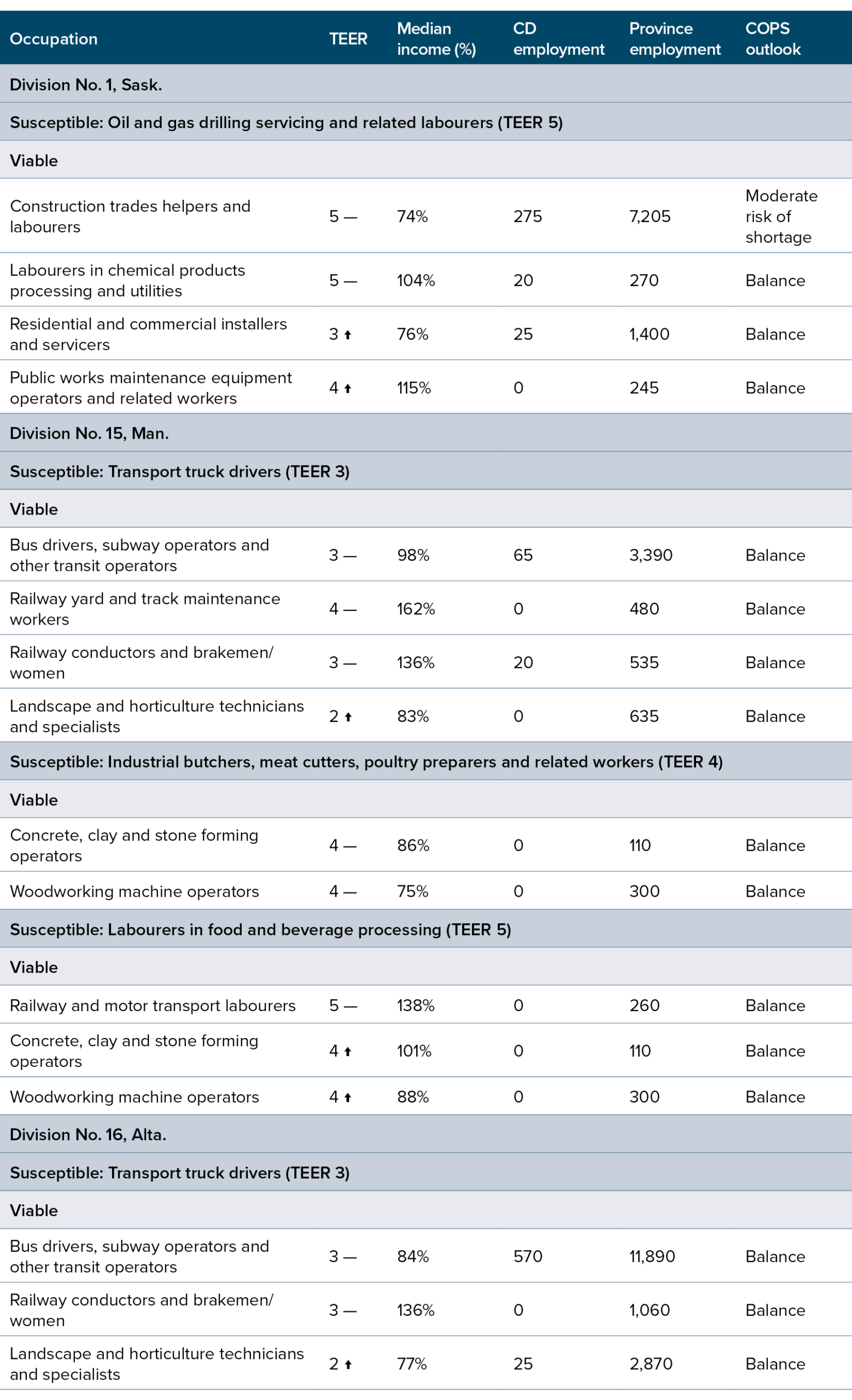


The first step identifies potential suitable occupations for each susceptible occupation — that is, jobs with similar competency profiles.
Each occupation’s competency profile comes from Employment and Social Development Canada’s Occupational and Skills Information System (OaSIS), which rates the applicability and required level of competencies across multiple domains. This study draws on 166 competencies across four domains: Skills (33 competencies, 0–5 scale), Knowledge (44 competencies, 0–3 scale), Abilities (49 competencies, 0–5 scale), and Work Activities (40 competencies, 0–5 scale). OaSIS defines its own sub-occupations, which are finer than the five-digit National Occupational Classification (NOC). Sub-occupation ratings are averaged to the NOC level before computing similarity.
Similarity between occupations is measured using cosine similarity. This method identifies pairs of occupations where the same competencies are comparably important to their respective profiles. For each competency, the ratings of two occupations are multiplied together — so a high score only results when a competency matters to both roles. That overlap is then adjusted for each occupation’s overall rating level, so that two occupations with the same pattern of competencies score highly even if one rates everything slightly higher than the other.

where Ro,s and Rd,s are the OaSIS ratings for competency s in occupations o and d, and the sums run over all 166 competencies across the four domains. The result ranges from 0 to 1, where 1 indicates identical profiles. Within and across domains, all competencies receive equal weight.
The most similar occupations are then assessed for local viability through a series of labour market screens described in the main text.
The skill gap analysis focuses on the Skills domain (33 competencies). For every occupation o and skill s, the raw OaSIS score (Ro,s ) is transformed into a location quotient (LQ) that measures how intensively that skill is used relative to the average across all occupations:

where the sums run over all 33 skills and all occupations. The LQ is computed within the Skills domain only, so the different rating scales of the other domains do not affect the measure.
Where:
Ro,s = rating of skill s in occupation o;
∑s Ro,s = sum of all skill ratings in occupation o within the domain;
∑o Ro,s = sum of that skill’s ratings across all occupations;
∑o ∑s Ro,s = grand total across all skills and occupations in the domain.
The numerator shows how important a given skill is within the occupation’s own profile. The denominator shows how common that same skill is across the labour market as a whole. If the ratio exceeds 1 (LQo,s > 1), the occupation uses that skill more intensively than the average job (a relative strength). If it is below 1 (LQo,s < 1), the skill is less emphasized (a relative weakness).
For a pair of occupations — a susceptible origin (o) and a viable destination (d) — a skill gap exists whenever
LQo,s < 1 nd LQd,s > 1.
This threshold-crossing rule captures skills that shift from below-average to above-average importance between the two occupations. Even small changes crossing 1.0 (e.g., 0.9 → 1.1) are treated as meaningful, as they mark a transition from supporting to core skills.
The magnitude of each gap, which helps rank training priorities, can be expressed as:
ΔLQs = LQd,s – LQo,s
Example transition: Material handler (NOC 75101, TEER 5) → Construction trades helper (NOC 75110, TEER 5), Skills domain.

These values correspond to Figure 5 and Appendix D. The grey baseline in Figure 5 marks LQ = 1.0, dividing below- and above-average intensity. For more information on this approach and how it was applied in the U.S. context, see Oschinski and Nguyen (2022).
This appendix identifies instances of pronounced skill gaps within the curated career pathways presented in this study. A pronounced skill gap is considered to exist where a skill is not used intensely in a susceptible occupation (a location quotient less than 1.0) but is used intensely (a location quotient greater than 1.0) in the associated viable occupation (see Appendix C for the methodology).
The gap magnitude, shown in the final column, represents the difference in skill intensity between the viable and susceptible occupations (LQviable – LQsusceptible ). Larger values indicate skills that require the most development in the transition.
Some career pathways have no pronounced skill gap. This does not mean that other training and reskilling is not required to make the occupational transition — but rather that among the 33 skills rated in OaSIS, none cross the threshold from below-average to above-average intensity between the susceptible and viable occupations. Differences may remain in other OaSIS domains or in credentials and experience requirements not captured by the competency taxonomy.


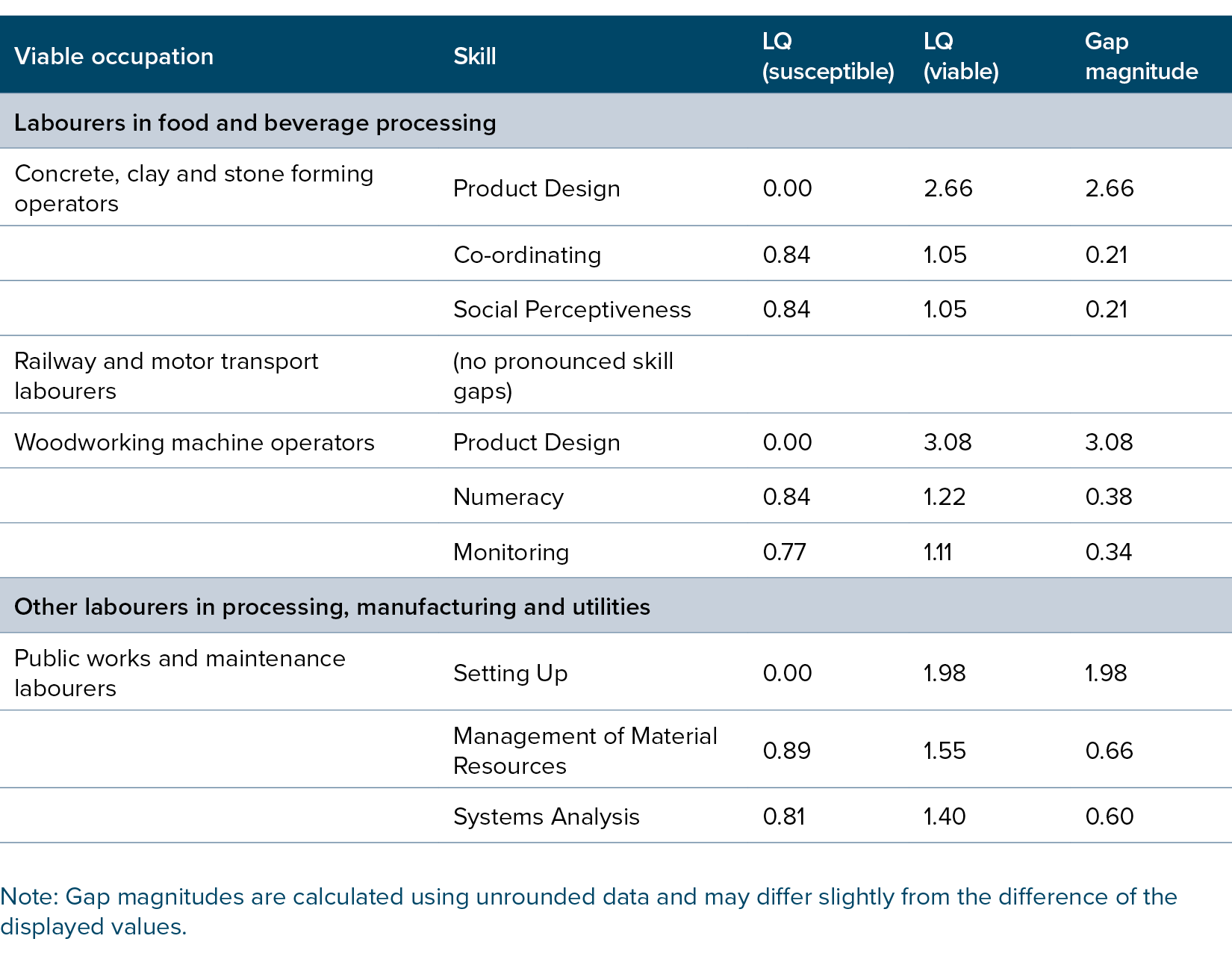
This study was commissioned by the IRPP, with financial support from the Max Bell Foundation, as part of the IRPP’s Community Transformations Project. The project explores potential sources of economic disruption that could affect workers and communities in Canada. The study was developed under the direction of research director Ricardo Chejfec. The manuscript was copy-edited by Prasanthi Vasanthakumar, proofreading was by Zofia Laubitz, editorial co-ordination was by Étienne Tremblay, production was by Chantal Létourneau and art direction was by Anne Tremblay.
Matthias Oschinski is a Senior Fellow at Georgetown University’s Center for Security and Emerging Technology (CSET) and the founder of Belongnomics. At CSET, he leads the institute’s workforce line of research. His research primarily focuses on the impact of emerging technologies on labour and skills, as well as inclusive innovation.
Steven Tobin is a leading labour market expert with more than two decades of international experience spanning the ILO, the OECD and senior roles in the Canadian government. He currently leads a private consulting firm helping global clients navigate complex labour market challenges, and previously led the startup and growth of a national not-for-profit institute in Canada focused on workforce development. His work spans employment and skills policy, the future of work, and the labour market implications of technological, demographic and green transitions.
The authors would like to thank Gabrielle Dark and Emily McGirr for their contributions to early drafts, and Ricardo Chejfec for his analytical support, including detailed analysis and data visualizations. The authors would also like to thank several anonymous reviewers whose feedback and comments greatly strengthened the paper.
The authors report no use of artificial intelligence in the research or drafting of this manuscript. For publication, the IRPP utilized AI coding assistants exclusively for the technical replication of data analysis and the development of the accompanying visualizations.
To cite this document:
Oschinski, M., & Tobin, S. (2026). A skills-based approach to career transitions: Identifying pathways for workers and communities facing economic disruption. IRPP Study No. 98. https://doi.org/10.26070/xd5t-h478
The opinions expressed in this study are those of the author and do not necessarily reflect the views of the IRPP or its Board of Directors.
IRPP Study is a refereed monographic series that is published irregularly throughout the year. Each study is subject to rigorous internal and external peer review for academic soundness and policy relevance.
If you have questions about our publications, please contact irpp@nullirpp.org. If you would like to subscribe to our newsletter, IRPP News, please go to our website, at irpp.org.
Photo: Ricardo Chejfec and Elyssa Khoury ISSN 1920-9436 (Online)