
Supporting Workers and Communities on the Road to Net Zero
Canada’s communities are facing major challenges, and opportunities, in the coming decades as the global economy and trade relationships transform.
Efforts to reduce greenhouse-gas emissions are driving changes in technology, markets and trade that are expected to affect workers and communities across the country. A changing trade relationship with the U.S. could also have significant local implications.
By identifying the communities that are susceptible to workforce disruption, governments can collaborate with people who live and work in the communities to provide targeted support that builds resilience and optimism in the face of uncertainty.
This multi-year project includes an interactive map, a methodology paper, community profiles, policy briefs and expert-led studies. Publications will continue to be added to the site as they are ready.
For more information check out the video of our related webinar, which took place on January 21, 2025 — or feel free to contact the team at communitytransformations@nullirpp.org.
![]()
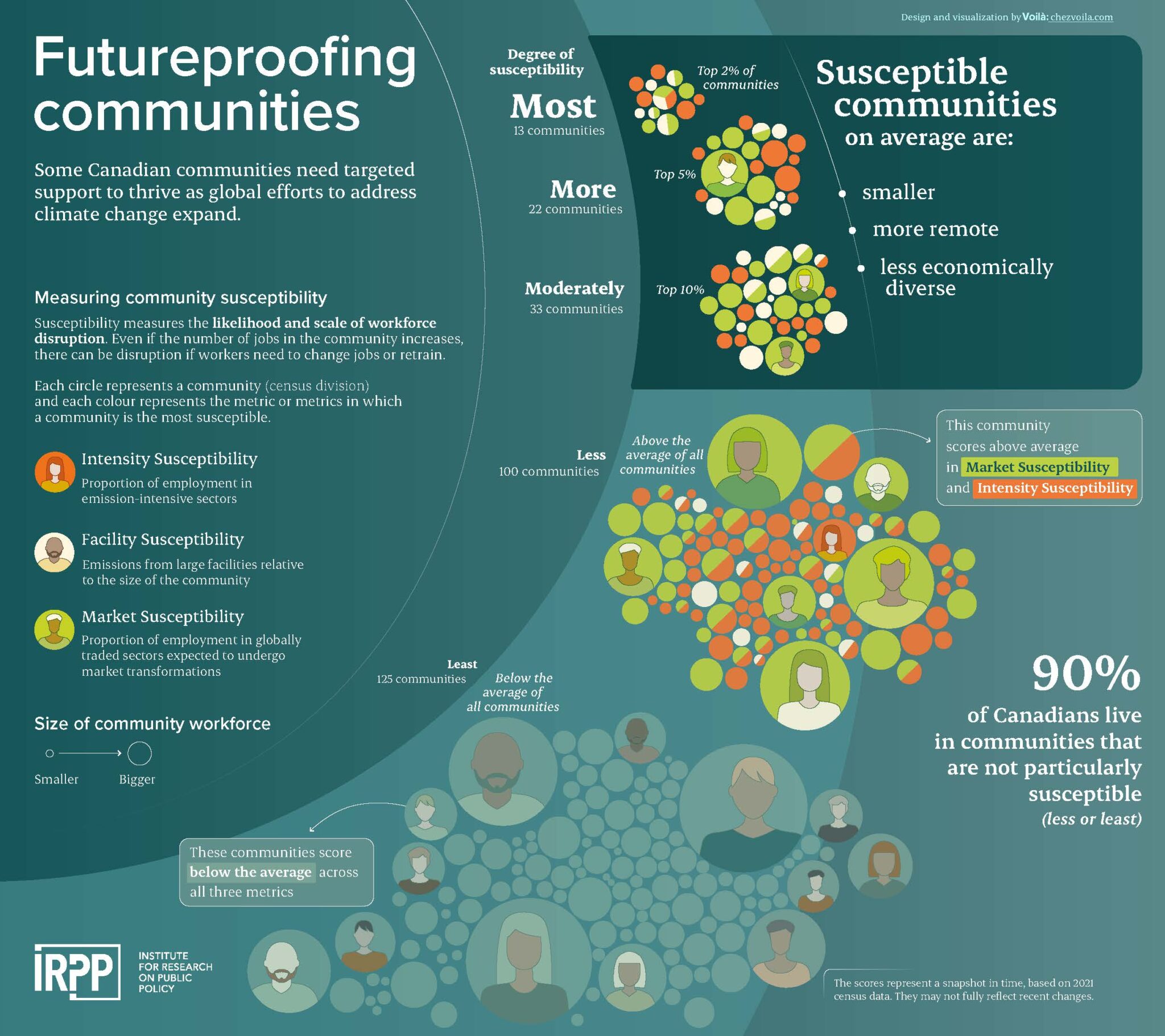
Measuring Community Susceptibility
For a snapshot of what the Community Transformations Project is all about, check out our infographic! It describes how we measure community susceptibility, plus some ideas on how we can best support workers and communities on the road to net zero.

Stay tuned for more Policy Briefs

Stay tuned for more Profiles
This joint IRPP–Future Skills Centre research project looks outward to international experiences with net-zero transitions that could be applicable to Canada.
Partner

Oil pipelines are once again a hot topic of discussion everywhere, from political panels to kitchen tables. As Canada navigates a fraught relationship with its largest trading partner, and the economic uncertainty that brings, many see oil pipelines as a panacea. Indeed, memories of the oil booms of past decades — and the economic largesse they brought — are fresh for workers and businesses, as well as for the communities that benefited. With Canadians now fearful of the consequences of trade tensions, it is no surprise that there is substantial interest in tried-and-true economic solutions.

by Rachel Samson - January 26, 2026

Abigail Jackson, Rachel Samson, Ricardo Chejfec - July 16, 2025

by Ricardo Chejfec, Abigail Jackson, Rachel Samson, Rosanna Tamburri - January 16, 2025

Webinar
November 26, 2025

Webinar
January 21, 2025

Vice-President, Research

Research Associate

Research Director

Senior Research Associate

Senior Research Director

CEO and Founder, LabourX

Senior Fellow, Center for Security and Emerging Technology (CSET)

Doctoral Candidate in Economics, Oxford University

Visiting Scholar; Associate professor of political management, Carleton University

Founder, Energy Mix Productions

Program Lead, Community Data Program

Senior Analyst, Community Data Program

Visiting Scholar; Associate professor of political management, Carleton University

Associate Professor, Public Administration, University of Victoria
The Institute for Research on Public Policy is leading the Community Transformations Project, an initiative that seeks to identify the communities that are most likely to be susceptible to the changes in policy, technology and markets that will occur as Canada and the world reduce greenhouse-gas emissions.
Through research, data analysis and interviews with people who work and live in the communities that are likely to be affected, we will gather information, insight and advice that can support government decision-making and empower workers and communities concerned about their future.
Given the breadth and depth of this multi-year project, the IRPP has partnered with the Canadian Community Economic Development Network’s Community Data Program and The Energy Mix. External experts will also provide advice and guidance, as well as authoring complementary studies.
This project was made possible in part thanks to support from the Max Bell Foundation, the McConnell Foundation, and Vancity. Research independence is one of the IRPP’s core values, and the IRPP maintains editorial control over all publications.

Vice-President, Research
Rachel Samson is a policy research executive with 25 years of experience providing evidence-based policy advice. As vice-president of research at the IRPP, Rachel has directed policy research and analysis relating to Employment Insurance, long-term care, child care, digital-technology adoption and industrial policy. She also led the IRPP’s role as the research and knowledge mobilization partner of the Affordability Action Council.
Prior to joining the IRPP in 2022, Rachel was research director for clean growth at the Canadian Climate Institute, where she led multiple in-depth research reports, including Sink or Swim: Transforming Canada’s Economy for a Global Low-Carbon Future. Before that, Rachel worked as a consultant, undertaking policy research and writing for the Organization for Economic Co-operation and Development (OECD), Canada’s Ecofiscal Commission and the Smart Prosperity Institute. Rachel also spent 15 years as an economist and executive with the federal government, with roles at Environment Canada, Finance Canada, Natural Resources Canada, the Privy Council Office, the Treasury Board Secretariat and the Canadian Environmental Assessment Agency. Rachel holds a master’s degree in economics from Queen’s University.
Recent Policy Options articles by Rachel:

Research Associate
Dena Abtahi is a policy researcher with a Master of Public Policy from the University of Toronto, specializing in public health and energy transitions. At the IRPP, she supports the Community Transformations project, with a focus on rural post-secondary access, workforce resilience and regional fairness. Her previous work includes research on youth justice, Indigenous engagement and health equity. She has also published on long-term care, opioid policy and cystic fibrosis care models.

Research Director
Ricardo Chejfec is a research director at the IRPP, leading the Empowering Canada’s Workforce program. He also helps lead the Community Transformations Project, aimed at supporting workers and communities through the low-carbon workforce transformation, is involved in research examining the role of industrial policy in Canada’s next economic transformation, and is part of the secretariat of the Affordability Action Council.
As the former Lead Data Analyst, Ricardo spearheaded research and analysis for IRPP-authored publications, including Building a Package of Compromise Solutions for EI Reform and others in a series on Employment Insurance, as well as several policy briefs related to housing, transportation and food as part of the work of the Affordability Action Council. He also advises the research team on artificial intelligence, technology adoption, data analysis and visualization. He previously worked as a research associate and business analyst and holds a Bachelor of Arts and Science in cognitive science and a Master of Public Policy from McGill University.
Recent publications by Ricardo:

Senior Research Associate
Abigail Jackson has worked on a number of IRPP initiatives, including the Toward a More Equitable Canada research program and the Supporting Workers and Communities through Low-Carbon Transformation project. Abigail served on the secretariat of the Affordability Action Council and contributed to the research and writing of five policy briefs related to housing, transportation and food in the context of climate and affordability challenges. In 2023, she received the Jack Layton Prize for a Better Canada. Previously, Abigail worked at Habitat for Humanity, administering programs related to energy efficiency, affordable housing and community development. She holds a Bachelor of Arts in business and international political economy from the University of Puget Sound and a Master of Public Policy from McGill University.

Senior Research Director
Shaimaa Yassin is a senior research director at the Institute for Research on Public Policy. She leads the Toward a More Equitable Canada research program, which has published studies on affordability, including housing and other basic needs that intersect with climate and energy policy, food insecurity and income supports for lower income Canadians, and proposed dental care and pharmacare programs. She leads the IRPP’s role as a research and knowledge mobilization partner of the Affordability Action Council and also serves as a member. She manages the IRPP’s postdoctoral fellowship program in support of Indigenous, Black and other racialized scholars.
She is a policy-oriented economist with over 15 years of experience in translating challenging academic research into strategic advice for a broad audience. A labour economist by training, her work focuses on identifying ways that governments can help lower costs of living, improve access to basic needs, enhance economic participation, increase income, and address barriers people face in capturing opportunities—particularly where labour market dynamics and skills intersect with issues of equity.
Previously, Shaimaa served as senior director at the Community Economic Development and Employability Corporation (CEDEC) in Montreal. Shaimaa has consulted for several governments and organizations such as the World Bank, Chaire “Sécurisation des Parcours Professionnels” in France, and the Economic Research Forum in Egypt. She was a research fellow in the economics department of several academic institutions, namely McGill University (Swiss National Science Foundation Fellow), the University of Lausanne and the University of Neuchâtel. She has an extensive record of publications, including peer-reviewed journal articles, the Les Accidents de Carrière book (Presses de Sciences Po, 2017) and chapters in edited volumes on labour markets in the Middle East and North Africa (Oxford University Press, 2014 and 2015). Shaimaa holds a PhD in economics from the University of Paris 1 Panthéon-Sorbonne and a MSc in empirical and theoretical economics from the Paris School of Economics.
Recent Policy Options articles by Shaimaa:

CEO and Founder, LabourX
For more than two decades, Steven’s career has been dedicated to providing data, research and policy insights on a range of cross-disciplinary subject matters in countries across the globe. He is currently leading a small a private consulting firm dedicated to helping global clients navigate complex labour market issues. In addition, Steven is also a C.D. Howe Research Fellow and Special Advisor to the Future Skills Centre. Recently, he was responsible for the start-up and growth of a national not-for-profit institute in Canada dedicated to providing data in innovative ways to facilitate and support career, education and workplace choices. Prior to that, he spent nearly a decade at the International Labour Organization (a United Nation’s agency) where he was responsible for coordinating their flagship research report and kickstarting a multi-year research project evaluating labour market policies. In addition, Steven worked as an Economist at the OECD for a number of years and has also held senior positions in Canada with the federal and provincial governments.

Senior Fellow, Center for Security and Emerging Technology (CSET)
Matthias is a Senior Fellow at Georgetown University’s Center for Security and Emerging Technology (CSET) and the founder of Belongnomics. At CSET he leads the institute’s workforce line of research. His research primarily focuses on the impact of emerging technologies on labor and skills, as well as inclusive innovation.

Doctoral Candidate in Economics, Oxford University
Jacob Greenspon is the Research Coordinator at the Harvard Kennedy School Reimagining the Economy Project and a Doctoral Candidate in Economics at the University of Oxford. He has previously served as a consultant on energy transition research at Resources for the Future and the World Bank and worked as an economist at several think tanks and government organizations in Canada and the US. He holds a Master in Public Policy from the Harvard Kennedy School of Government, a MA in Economics from Queen’s University, and a BA in Economics and Political Science from McGill University

Visiting Scholar; Associate professor of political management, Carleton University
Jennifer Robson is an associate professor of political management at Carleton University, where she teaches courses on public policy and research methods. She holds a PhD in public policy and degrees in political science and psychology. Her research addresses social and tax policy, poverty in Canada and public administration. Prior to joining Carleton, she held several policy and research roles in the nonprofit and public sectors. She was director of policy for the nonprofit SEDI (now Prosper Canada) and worked in the federal public service. Jennifer has also served as a member of the Advisory Panel on Tax Expenditures to the Minister of Finance and was a member of the National Research Committee on Financial Literacy for the Financial Consumer Agency of Canada.

Founder, Energy Mix Productions
Mitchell Beer is founder of Energy Mix Productions and publisher of The Energy Mix, a non-profit community news site and e-digest series on climate change, energy, and the shift off carbon. He traces his background in renewable energy and energy efficiency to 1977, in climate change to 1997. He delivered a TEDx Ottawa talk in October, 2019 on how to build wider, more constructive conversations on climate change and the energy transition, and received the Canada’s Clean50 Lifetime Achievement Award in 2022.

Program Lead, Community Data Program
Michel holds a Master of Urban Planning (1993) from McGill University and is a full member of the Canadian Institute of Planners, Ontario Professional Planners Institute and the Project Management Institute. Michel has served as program lead for the Canadian CED Network’s Community Data Program since 2005. He also served as primary consultant for the Federation of Canadian Municipalities’ Quality of Life Reporting System (2002-2015) and contributed to the Community Foundations of Canada’s Vital Signs Reports (2006-2010). Michel has practiced in Canada and across the Caribbean managing or participating in numerous projects in the areas of urban planning, community data, and community resilience. Michel’s role typically includes any combination of strategy & plan preparation, the design and implementation of training & capacity building programs, stakeholder engagement strategies, and monitoring & evaluation systems.

Senior Analyst, Community Data Program
Michael has worked as Program Coordinator and Senior Analyst for the Community Data Program for the past 8 years. Over the last 20 years, he has worked on various knowledge-sharing and monitoring initiatives that focus on the creation and dissemination of indicators to track local trends and inform policy, with a pause taken to return to school for a Masters degree in Applied Science at École Polytechnique de Montréal.

Associate Professor, Public Administration, University of Victoria
Dr. Tamara Krawchenko, Associate Professor in Public Administration at the University of Victoria, is an internationally recognized scholar whose work spans the fields of comparative public policy, regional development and sustainability transitions. She serves as the Research Area Lead for Policy and Planning with the Accelerating Community Energy Transformation (ACET), an initiative supported by the Canada First Research Excellence Fund (CFREF). She also serves as Chair of the Local Governance Hub and as a core team member of the Coastal Climate Solutions Leaders program. Over 2025-2026, she joins the Institute for Research on Public Policy as a Visiting Scholar, contributing to its work on regional development and community transformations.