

A Skills-Based Approach to Career Transitions: Identifying Pathways for Workers and Communities Facing Economic Disruption
Matthias Oschinski and Steven Tobin





Like many advanced economies, Canadian governments are increasingly turning to industrial strategies to try to strengthen their economic sovereignty — defined here as the capacity to protect and shape key domestic economic capabilities — and to support economic growth aligned with the global energy transition and net-zero emissions goals. This represents a shift from previous decades when governments in Canada generally favoured market-led approaches and limited direct intervention.
Industrial policy refers to government actions that deliberately seek to shape the structure of economic activity, which could include what is produced, where production takes place, or which firms, sectors or regions and places are supported in pursuit of a public goal. It’s not new. Government efforts to promote economic development in particular sectors have a long history. Consider Alberta’s oil sands industry or Ontario’s automotive industry. What sets the current period apart is the scale and scope of industrial policy. Government intervention in the economy is now much more extensive, ambitious and better-funded.
Three pressures are driving this new generation of industrial policy: weak productivity growth and persistent regional divides that market-based policies have not fully addressed; climate and digital transformations that require co-ordinated long-term investment at a scale and pace markets are unlikely to provide without public direction or support; and geoeconomic rivalry as countries increasingly use trade, investment and industrial capacity as strategic tools to advance economic and geopolitical interests.
In this context, industrial capacity is increasingly seen not only as an economic policy but also as a requirement to achieve strategic autonomy — the capacity to act independently or with a significant degree of independence from other powers.
While industrial policies could help address these issues, they also pose a hard test of state capacity to steer economic change. More specifically, this refers to whether governments can achieve the following: set clear and focused objectives; design instruments that fit those objectives; co-ordinate across institutions and levels of government; deliver policies effectively, including arm’s length bodies where useful; and evaluate results.
A key challenge facing policymakers is to ensure they have the institutional capacity to guide economic transformations. Our research suggests that the design and governance arrangements underpinning industrial policies largely influence whether state interventions will catalyze and support economic transformation or merely subsidize the status quo.
How are recent industrial policy measures in Canada designed and implemented? How do they compare with those in other advanced democracies?
In a recently published report, we explored this question by assessing and comparing the governance of industrial policy in Canada and the United Kingdom. The U.K. offers a useful benchmark. Like Canada, it has historically relied on market‑oriented approaches to economic development and has been cautious about more direct government intervention. Yet, it has still managed to advance an industrial policy agenda despite the disruptive effects of Brexit and frequent changes in political leadership. As both nations have recently moved toward explicit industrial strategy and deliberate government intervention, they provide a useful setting for understanding how states with similar institutional structures navigate this policy field.
Our analysis does not seek to evaluate whether recent industrial policies have achieved their intended results. Instead, we draw on a comparative analysis to provide a set of evidence-grounded principles against which strategy design and governance arrangements can be evaluated.
We identify five key elements:
(See figure 1 for an overview of means across all areas for Canada and the U.K.)
Figure 1. Comparing Canada and the U.K. on industrial policy elements
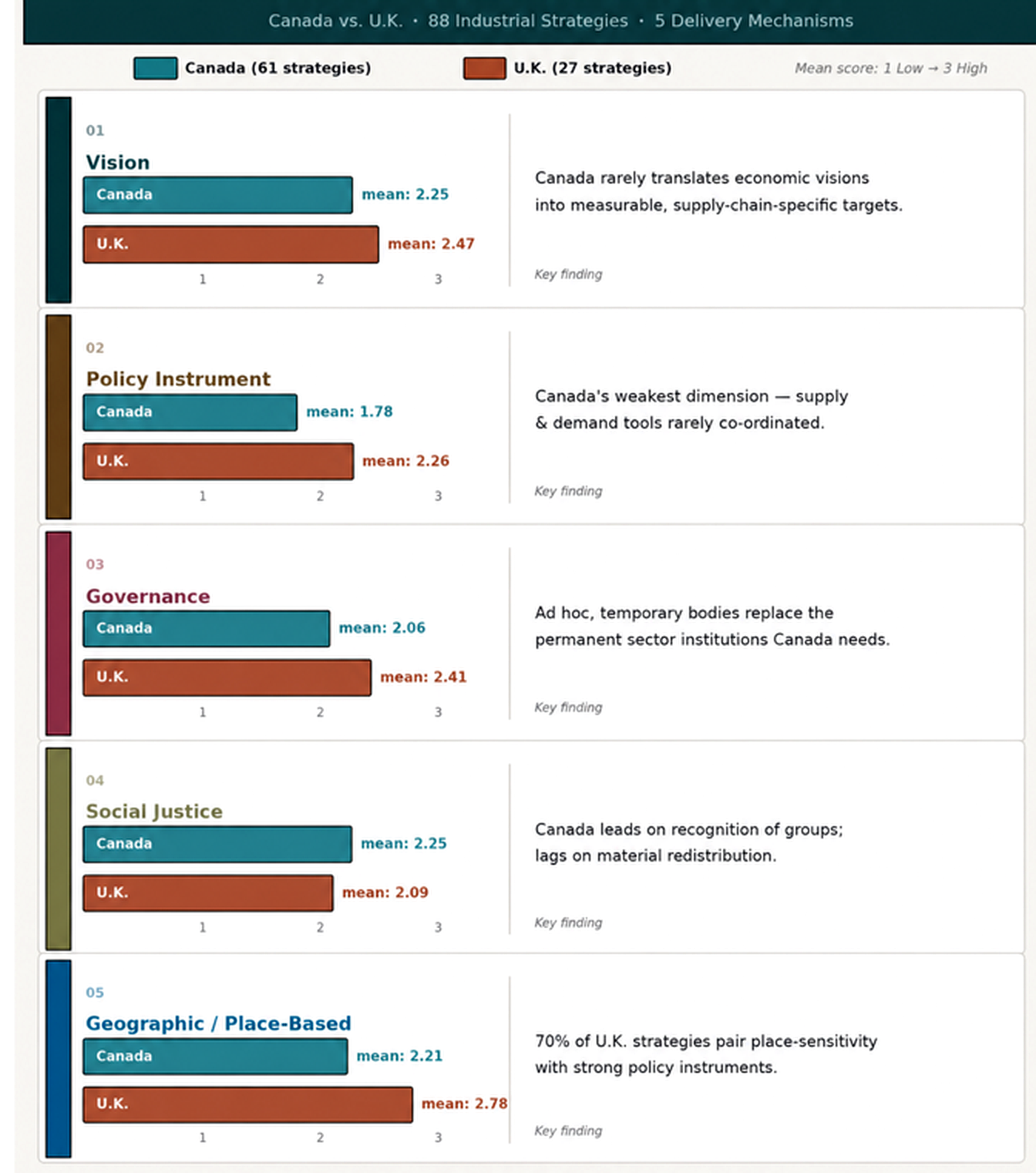
Source: Authors’ analysis based on: Krawchenko, T., McCann, P., Arcand, B., & Hsu, M.-W. (2026). The governance of new industrial strategy: An inclusive and green agenda for economic transformation. 10.18357/1828/23746
A key idea from our report is that these five mechanisms reinforce one another. Strategies that acknowledge spatial complexity — the differences across places, regions and local economies — tend to reach for more binding requirements or incentives with clear conditions. This is because place-specific challenges require targeted responses. Conversely, strategies that lack place-based grounding tend toward generic, weak instruments. Strategies without governance accountability tend to have gaps between the stated goals and the tools used to achieve them.
While such relationships do not imply causality, they align with the literature on industrial policy, which underscores the importance of these dimensions in state-led economic transformations. In this way, these mechanisms provide a framework for assessing the capacity of states to govern industrial transformation.
In what follows, we explore each element and reflect on how they can help improve industrial policymaking in Canada.
Research on industrial policy has long warned against the pitfalls of overpromising its benefits. For policymakers, a key way to minimize this risk is to first articulate a vision of where the economy should go and why. Then, translate this vision into measurable, time-bound economic targets that reflect competitive goals in specific value chains, i.e., from input to production, processing and end use. While ambition is important, it must be paired with a deep understanding of what is actually achievable. Policymakers need high-quality information in specific sectors to devise such targets.
Our analysis shows a number of industrial strategies in Canada fall short in this regard. Many policy documents lack any measurable objectives, making it almost impossible to track progress. In addition, many outlined objectives are too broad to help focus investments. For example, many strategies set employment and export targets within broad economic areas such as clean energies, natural resources and digital technologies. While each area on its own may be promising, their broad formulation makes it difficult to map the precise part of the supply chain that governments aim to build or grow. Without such details, policy targets cannot be used to co-ordinate investments or monitor whether government support translates into productive capacity.
Canada’s strategy on critical minerals is a partial step forward on this front by explicitly prioritizing six sectors: lithium, graphite, nickel, cobalt, copper and rare earth elements. But it falls short of turning these priorities into actionable economic targets that reflect the role Canada could play in this global value chain. While recent international commitments — such as the G7 pledge to reduce reliance on single suppliers for rare earths and permanent magnets to under 60 per cent by 2030, with an ambition to reach 50 per cent “as soon as possible” — begin to articulate dependency‑reduction goals, they do not yet translate into clear, Canada‑specific production, investment or capability targets along the value chain.
The U.K. critical mineral strategy offers a better approach. It sets the objective of meeting at least 10 per cent of that country’s critical mineral demand through domestic production by 2035. This economic goal is then translated into production targets for specific critical minerals, such as at least 50,000 tonnes of lithium carbonate equivalent by 2035. In addition, the report estimates the quantity of each prioritized critical mineral across a range of end-user sectors, such as electric vehicles and life sciences, thus helping to anticipate the scale of the opportunity and boost investment across entire supply chains.
The U.K.’s critical minerals strategy is not an isolated case. Our analysis shows it has set production or deployment targets for several economic priorities, including low-carbon hydrogen, carbon capture, utilization and storage, and offshore wind. This approach aligns with existing literature, which emphasizes the importance of turning economic visions into measurable competitive objectives.
In public debates, industrial policy is often associated with government subsidies to preferred firms. Under this approach, the key task facing policymakers is to correctly identify the most promising companies, then design policies that ensure cost-effective results, such as adequate profits to sustain the firm.
But to really understand industrial policy, we need to start from the observation that the structure of an economy, or what is being produced, matters for public goals. A key task for policymakers is to ensure the economy is on a trajectory aligned with societal ambitions. This entails not only assessing current performance but also anticipating future transformations that reshape global value chains. So, a core function of industrial policy is deliberately aligning structural change with public goals to achieve outcomes that markets may not deliver at the necessary scale or pace.
Achieving this objective requires more than simply subsidizing firms. It requires a diverse and co-ordinated mix of policy instruments, including funding, financial incentives or procurement policies that shape production and demand in strategically important areas. These areas can include digital and clean technology products and services that matter for climate, security, or productivity and prosperity goals.
In other words, industrial policy is not about picking corporate winners but about deliberately co-ordinating investments to catalyze and support the development of economically promising value chains in areas that advance economic, social, environmental and national security objectives, including sovereignty and economic resilience.
Our report shows that co-ordination across supply-side and demand-side policy instruments is less developed in Canada than in the U.K. Supply-side instruments strengthen the capacity to produce or provide targeted goods, services or technologies, while demand-side instruments create or stabilize the markets for those goods, services or technologies.
The U.K.’s industrial strategy for offshore wind is a concrete example. Guided by a clear target of 50 gigawatts of power by 2030, it combines targeted support for domestic manufacturers with incentives, such as contracts for difference, with a set price for output and a government guarantee it will pay the difference if market prices are lower. This strategy aims to encourage electricity generation from renewable sources, including wind.
The strategy also sets a target of achieving 60 per cent local content in the offshore wind supply chain by 2030, thereby helping to align investment in domestic wind turbine manufacturing with electricity generation. With the U.K. accounting for more than 40 per cent of Europe’s total installed offshore wind capacity, it is a good example of how industrial policy can support decarbonization goals.
Canada is moving more slowly in deploying a comprehensive policy mix in industrial policy. Consider the electric vehicle (EV) industry. In recent years, Canadian governments have introduced ambitious policy measures to support both the production and consumption of EVs. But mechanisms that deliberately link domestic production to consumer demand, such as local content targets or requirements, remain largely absent. Failure to close this gap risks hindering Canada’s ability to achieve both its climate and economic goals in transportation.
While recent federal initiatives such as the Defence Industrial Strategy and the forthcoming Nuclear Energy Strategy show a shift toward more integrated, value chain‑oriented approaches in other sectors, a comparable level of co-ordination has yet to emerge around EVs.
All of this suggests that the question is less about how much governments should spend on specific firms than about whether policy instruments — tax incentives, regulations, R&D funding, consumer subsidies, etc. — work together to accelerate investment and build or grow production capacity across strategic value chains.
The governance dimension of industrial strategy — the institutions and processes used to co-ordinate, monitor and adjust strategy — is an important predictor of whether strategic ambitions translate into actual changes in investments, production and sectors.
In general, the literature points to four key dimensions of robust governance arrangements in industrial policy: industrial strategy is embedded at the heart of government; sector-specific co-ordination bodies are used to drive structural change; dedicated public-private forums co-create roadmaps and strategies; and departments take a whole-of-government approach to the policy mix using sustained, multi-year horizons.
Advanced democracies have long been portrayed as institutionally ill-equipped to govern state-led economic transformations. While there is still room for improvement in the U.K., the British government has made important progress in recent years in this area.
In the climate sphere, research published in Nature Climate Change has broadly described the country as exhibiting “high levels of state capacity and research body autonomy, as well as substantial policymaking authority afforded to climate-motivated bureaucrats.” Progress has also been made in industrial policy. A report by the International Institute for Strategic Studies noted that, following recent institutional reforms, “new ministries are [now] better aligned with the challenges of the energy transition and the digital transition, and imply greater focus in the UK government on strategic industries.”
Our findings broadly align with these observations, showing that the U.K. overall embeds collaborative delivery mechanisms across many of the studied strategies. Across the policy documents studied, we also found a relatively strong integration of climate and industrial objectives, which helps overcome departmental silos. This is not to say that the governance of industrial and climate policy in the U.K. is without weaknesses. These observations should instead be read as evidence that state capacity-building is possible and is happening here.
Like other studies, our report found that in Canada, the federal government is falling behind its trading partners in modernizing its governance arrangements for industrial policy. We found that the federal government often relies on ad hoc, temporary bodies to inform and govern industrial strategies. Without permanent co-ordination bodies specialized in specific sectors, Canadian industrial policy currently lacks the institutional foundation to learn and correct course based on independent expertise.
At a moment of rapid geoeconomic change, the ability to adapt strategy in response to new information is a condition for relevance. Addressing this gap is a critical step to move Canada’s industrial policy toward a better place.
One striking finding from our comparative analysis is that place-based thinking often goes hand in hand with stronger policy instruments. This type of thinking seriously considers how economic conditions, including assets, opportunities and challenges, differ across places and regions. Strategies that explicitly acknowledge spatial diversity by naming regions, targeting clusters or recognizing that different parts of the country face different opportunities and risks tend to use more robust policy tools than strategies that treat the national economy as if all places are essentially the same.
Nearly 70 per cent of U.K. strategies combine high place-sensitivity with strong instruments while 41 per cent of Canadian strategies combine low place-sensitivity with weak instruments. One reason is that place-based industrial strategy requires governments to develop detailed, contextual knowledge of specific industrial ecosystems, which are also conducive to more robust policy targeting and co-ordination with subnational governments.
In addition, the effects of deindustrialization, such as the loss of industrial jobs, firms or production capacity, are often highly uneven across regions and sectors. As such, place-sensitive industrial strategies are critical to avoid deepened spatial inequality.
The tendency of the federal government to prioritize spatially undifferentiated instrument design — sector-neutral tax credits, broad innovation programs, horizontally applied competitiveness measures — appears insufficient to rise to this challenge. There is also a tendency to put place-based policies into regional development agencies instead of integrating place-based approaches into national policies.
Our findings provide quantitative evidence that strategies investing in understanding clusters, local production systems and regional ecosystems are often the ones that advance more sophisticated policy instruments.
Quebec’s aluminum strategy is a good example. It prioritizes the local transformation of resources in specific regions and uses intermediary organizations to help inject local knowledge into policymaking and to connect innovation infrastructures to the specific needs of industries. This illustrates how place-sensitive thinking can be harnessed to improve the design and governance of industrial policy.
At its core, governing economic change is a distributive question, which inescapably creates winners and losers. For industrial policy, this means how gains from economic transformation are shared across firms, regions, communities and social groups must be an integral design criterion.
In the Canadian context, this takes concrete form in what has been called “inclusive industrial policy” or a framework in which economic growth, innovation and firm success are pursued alongside economic and social inclusion, community wealth and environmental sustainability. Core instruments include using public procurement to create local jobs and opportunities, broadening who can access and shape investment capital, and embedding inclusion metrics such as building equity goals and measures into program design and evaluation metrics.
Our comparative data found both Canada’s strength and its characteristic gap in this dimension: Canadian strategies score significantly higher than U.K. strategies on recognition of specific groups, reflecting the stronger integration of Indigenous rights frameworks and equity-oriented participation requirements. But this recognition advantage is often not matched by distributional instruments, such as community benefit agreements, equity stakes and mandatory revenue sharing. A good example of how to do this correctly is Indigenous Business Australia, a government enterprise that promotes the equity participation of Indigenous communities in industrial projects to foster their economic independence and the nation’s prosperity.
The U.K. strategy for carbon capture, utilization and storage offers another mechanism for making industrial policy work to reduce regional inequality between London and the country’s industrial regions. By making firms’ access to government funding for such projects conditional on locating in government-designated industrial regions, this mechanism helps promote green sources of economic development in economically struggling geographic areas.
It is worth noting that the prioritization of regions was not based solely on political considerations. The U.K.’s industrial regions were independently mapped using transparent criteria to identify those with the greatest economic potential for these projects. This approach to spatial prioritization helps align social and environmental goals with the pursuit of credible business opportunities.
All of this points to the need for industrial policy not only to improve its awareness of marginal communities but also to share appropriate returns with them. Without such redistribution, recognition creates the appearance of inclusion without the substance of shared prosperity.
Many nations are now using ambitious, targeted industrial policies to build specific industries in the 21st-century economy. In this environment, Canada needs targeted, co-ordinated and place-based industrial policy to address its current challenges, such as weak productivity and social inequality, and to strengthen its position in global value chains.
At the same time, there is no question that industrial policy is difficult. Canada needs to have an open, transparent debate about how it is done to ensure that risks and rewards are appropriately distributed across society. But to be productive, this conversation should not centre on how much state intervention is needed to shape economic transformation. We argue that a more productive starting point is to ask whether states possess the capacity to advance industrial policy strategically, accountably and in ways that distribute the benefits of change broadly across society.
To recapitulate, the evidence points to five interlocking elements to move in this direction: an operationally grounded vision; a diverse, integrated instrument mix that includes demand-side tools; a governance architecture that embeds accountability and enables learning; place-based thinking that acknowledges and addresses spatial heterogeneity; and inclusion that delivers material redistribution, not merely procedural recognition.
Canada’s current issues — geopolitical and trade pressure, climate targets and renewed federal interest in industrial policy — create a clear opportunity to apply these good design and delivery practices in industrial policymaking. If we focus on getting these design fundamentals right, industrial strategy can substantially shape Canada’s economic and social future.