





Rocher-Percé: Historic Strength, New Muscle in Quebec’s Gaspé Region
Institute for Research on Public Policy







Canada’s economic landscape is profoundly changing. A shifting trade environment, global efforts to reduce emissions and other structural trends are reshaping industries and job requirements. With these shifts, opportunities arise, but so do uneven risks and impacts.
Certain communities are disproportionately susceptible to the workforce disruption these changes will bring. In this Policy Brief, we focus on mass layoffs and major closures large enough to substantially raise local unemployment. These events can result in community-wide shocks that extend beyond directly affected workers and employers. The impacts can be especially acute in smaller, more remote and less economically diverse places, where they can ripple through suppliers and local businesses, weaken municipal revenues, strain housing markets, and erode social cohesion and well-being.
Canada’s system of supports focuses primarily on individual job losses and directly affected employers. It delivers fragmented, ad hoc measures rather than co-ordinated, rapid-response, community-wide supports. Responses can come too late or may not fully meet community needs in scale or form after major closures and mass layoffs. This approach falls short, especially in times of economic volatility.
To respond quickly and effectively to the people and places facing mass layoffs and major closures, we need a co-ordinated and comprehensive approach. To build rapid-response capacity and help these communities financially stabilize and plan for the future, the Institute for Research on Public Policy recommends the following measures. Each measure is tied to clear triggers, so that responses match different levels of community need:
Canada’s economy is in uncharted waters. Changing trade policies are compelling Canada to diversify beyond its largest partner (Prime Minister of Canada, 2025a). Efforts to reduce emissions worldwide are transforming cornerstone industries, including energy and manufacturing (Chejfec et al., 2025). And other global trends, from population aging to automation and artificial intelligence (Oschinski & Walia, 2025), are reshaping jobs and the skills workers need to do them. At the same time, Canadians are feeling the pressure. The rising cost of living, housing that is increasingly unaffordable and hard to find, and job insecurity all contribute to a growing sense of economic precarity (Coletto & Sheppard, 2025).
These transformations bring different outcomes for different people and communities. The global energy transition and changes in trade policy raise the risk of major closures and mass layoffs in some communities, making them more susceptible to workforce disruption. While the energy transition will likely create more jobs in Canada than it eliminates, new employment opportunities may not necessarily be in the same places or for the same workers that lost jobs (Atiq et al., 2022; Augustine et al., 2023; Brown et al., 2024; Future Skills Centre, 2022; Organisation for Economic Co-operation and Development [OECD], 2024; RBC Capital Markets, 2022). Communities in southern Ontario will face different challenges than communities in northern Quebec or Alberta. In smaller, more remote and less economically diverse communities, where workforces tend to be older and have less formal education, adjusting to shocks can be harder (Jackson et al., 2025).
As part of our Community Transformations Project, this Policy Brief is the third in a series examining how to support “susceptible” communities through economic transformations. The first Policy Brief, Empowering Community-Led Transformation Strategies, focused on community-led economic development plans to build long-term resilience (Samson et al., 2025). The second Policy Brief, Resilient Workers, Resilient Communities, highlighted the need for place-based skills development to build workforce resilience (Jackson et al., 2025).
This Policy Brief zeroes in on the acute phase of disruption — the critical period during, and immediately after, a major employer closure or mass layoff. Even when announced in advance, layoffs and closures often leave communities little time to adjust. We examine the socio-economic challenges that communities face during these disruptions, and the rapid-response social supports they need to cope with the fallout of large-scale local job losses.
Mass layoffs or group terminations are defined differently across jurisdictions (see box 1). For our purpose, we refer to events large enough, relative to the size of the local labour force or population, to noticeably increase unemployment among directly and indirectly impacted workers.
The timing and the scope of disruptions are inherently uncertain (Chejfec et al., 2025). By identifying susceptible communities in advance, governments can better prepare to support them through the cascading impacts of shocks.

The IRPP developed a methodology to identify communities (census divisions) susceptible to potential workforce disruption from the global energy transition (Chejfec et al., 2025) and changes in U.S. trade policy (Chejfec, 2025a). The methodology is based on underlying conditions in the community, rather than expectations relating to specific government policies or tariffs.
Susceptibility to net zero is assessed using three metrics that identify communities with disproportionately high measured values of:
Susceptibility to changes in U.S. trade policy is assessed by identifying communities with disproportionately high local employment in export-dependent sectors that rely on trade with the United States. Out of the 293 Canadian communities we analyze in this study, 19 are among the most susceptible to both sources of disruption; we refer to them as dual-susceptible communities (see figure 1).
All susceptible communities merit attention. Our recommendations can apply broadly to communities facing major closures or layoffs. For this Policy Brief, we focus on communities where impacts are likely to be most severe. In our analysis, we aim to get a sense of the potential scale of disruption and a community’s ability to adjust. To do so, we use select socio-economic indicators (see table A.1) to identify some communities that already face substantial economic, social or demographic pressures and are susceptible to workforce disruptions. This comprises communities susceptible to net zero, including the smaller subset that is also susceptible to changes in U.S. trade policy. For these communities, mass layoffs could amplify existing challenges and put additional strain on the whole community.

Plant closures and mass layoffs can reshape a community’s socioeconomic landscape (Behrens et al., 2021; Niftiyev, 2024). Major shifts in local labour markets are often associated with broader changes in community conditions and well-being. Studies examining how mass layoffs affect employment and productivity show that larger layoff events tend to have bigger and longer-lasting regional impacts, with rural regions hit harder on average (Vermeulen & Braakmann, 2023).
When a dominant employer closes, it can create a ripple effect across the local economy and supply chains (OECD, 2025). Figure 2 shows how this impact can extend beyond directly affected workers and employers. In some cases, a facility shutdown creates indirect impacts such as job losses and broader declines in related supply chains and other sectors of the local economy. Layoffs also create induced impacts by reducing wages and household spending on food, services and housing, which lowers demand for goods and services across the community (Dallaire-Fortier, 2024).
These indirect and induced spillovers can be significant (Marchand, 2012), yet their full scale is often unpredictable. In the long term, closures may even weaken local business confidence, making it harder to attract new investment and entrepreneurs to the community (Sutton et al., 2022).

Major employer closures can erode local tax revenue, which constrains a community’s ability to fund public services and infrastructure. For example, the shutdown of fossil fuel power plants in Illinois, U.S., eliminated more than US$1 million in annual property taxes in several counties (Funderburg, 2024). Canadian municipalities rely heavily on property taxes, which account for around half of municipal revenues (Federation of Canadian Municipalities, 2024). When commercial or industrial property taxes decline, the burden can shift toward households via higher residential property tax bills (Johal et al., 2019). Out-migration of residents can further reduce local tax bases (Sutton et al., 2022).
In addition to tax revenue, large employers often contribute substantially to local economies through in-kind contributions and donations (Oncescu, 2016). These employers and their higher-paid workers tend to support local charitable organizations such as the United Way in Canada (Card et al., 2010; Sutton et al., 2022). Significant job losses reduce these contributions.
When a major closure forces local economies to restructure, it can strongly affect rural community organizations. These effects can include reduced recreation participation, shifting program priorities, and heavier workloads for recreation services and amenities (Oncescu, 2016). While charitable organizations and local services falter, large-scale job loss simultaneously increases demand for assistance (Russo & Linkon, n.d.).
Increases in local unemployment can be associated with declines in local house prices, which can further strain household balance sheets across the community (Nam, 2024).
Layoffs and income shocks make it harder for households to keep up with their debt payments, including mortgages. Bank of Canada (2025) projections show that many households would struggle to service their debts in the event of a sharp labour market shock from layoffs tied to trade disruptions, interest rate pressure and slowing economic growth. Economic uncertainty tied to rising unemployment and trade tensions is increasing household financial stress and mortgage delinquency risk (Canada Mortgage and Housing Corporation [CMHC], 2025; Office of the Superintendent of Financial Institutions, 2025).
Rising uncertainty and falling housing demand can depress real estate prices and reduce the value of property that households and firms can borrow against. Estimates using U.S. data suggest that a one percentage point increase in unemployment is associated with a 1.55 per cent decline in house prices, driven mainly by uncertainty rather than income losses (Nam, 2024). People facing employment and income insecurity tend to delay home purchases, further softening housing demand (Attanasio et al., 2012; Lersch & Dewilde, 2015). This uncertainty can also turn would-be buyers into renters, which may reduce rental vacancies and raise rents (CMHC, 2024a).
During the 2007-09 recession in the United States, many people lost their homes to foreclosures. First-time home buyers also delayed purchases, leading to more renters and competition for affordable units. With limited new supply, rental vacancy rates fell and rents rose in many markets (Joint Center for Housing Studies of Harvard University, 2011). In Fort McMurray, Alberta, there was a substantive drop in housing prices in 2015 due to lower oil prices and associated layoffs and wage rollbacks at oilsands facilities and their suppliers (Postmedia News, 2015). In the two years from January 2014 to January 2016, average home prices fell by 17 per cent (Gensey, 2016).
When housing prices drop, collateral loses value. Businesses with property assets have less to borrow against, which can restrict credit and contribute to job cuts, reinforcing local unemployment (Pinter, 2015). For households, lower prices shrink home equity — the difference between their home’s worth and what they owe on it. This makes it harder for families to refinance their mortgages or borrow against their home’s value to cover everyday expenses during periods of income loss (Bank of Canada, 2023). Some families may owe more on their mortgage than their home is worth, making it difficult for them to relocate (Dsouza, 2025). A glut of homes on the market could also leave families struggling to sell their main asset.
Job loss can undermine local social integration, prompting social withdrawal, reducing social support, and disrupting social and family ties (Brand, 2015). For instance, residents in small, rural or remote communities may have to travel further for new jobs or services, reducing time in their communities and with their families. This absence fractures community engagement and cohesion and residents’ sense of belonging. If left unaddressed, it can dismantle the social foundation of rural communities (Oncescu, 2015).
Unemployed workers can face immediate and long-term mental health challenges. For instance, after Mitsubishi automotive plants in Australia closed in 2004, displaced workers reported higher levels of mental health distress and changes to their social life (Beer et al., 2006). Disruptions to income, daily structure and psychological well-being can lead to depression, anxiety and lower life satisfaction among displaced workers (Brand, 2015). Children’s well-being is also affected during and after parental job loss (Newman & McDougall, 2009). In Estevan, Saskatchewan, concerns about the coal plants and mine closing were linked to rising rates of addiction in the small city (IRPP, 2025a). In Ingersoll, Ontario, layoffs raised demand for mental health services (IRPP, 2025b).
Mass layoffs can cause working-age residents to leave communities when comparable employment opportunities are not locally available (Foote et al., 2018; OECD, 2025; Oncescu, 2016; Sutton et al., 2022). Younger workers are especially sensitive to the availability of suitable local jobs (Behrens et al., 2021), and Canadian evidence shows they are more likely than older cohorts to relocate after job loss (Morissette & Qiu, 2021).
An exodus of working-age residents can further disrupt communities, resulting in shortages of labour, knowledge and expertise (Stalker & Phyne, 2014). It can reduce the local workforce, local tax revenues and the community’s ability to attract new economic opportunities, especially in smaller or remote places (Bruce et al., 2005).
As local workforces shrink while populations age, local services like health care face growing pressures (Labour Market Information Council, 2024). For example, in Cape Breton, Nova Scotia, out-migration has been a significant problem since the end of steel manufacturing, coal mines and cod fishing (IRPP, 2025c). Between 2001 and 2021, Cape Breton Island’s population declined by 13 per cent. About 30 per cent of its population is aged 65 and older, placing it among the oldest regions in Canada (Murray & Campbell, n.d.). With a smaller workforce and aging population, Cape Breton is struggling to meet the needs of its labour market because not enough young people are available to replace retiring workers (Murray & Campbell, n.d.).
At the same time, regional relocation rates after job loss are generally low, especially among older or longer-tenured workers and those with less education (Morissette & Qiu, 2021). Many people prefer to stay put for social and economic reasons. About two-thirds of unemployed individuals hesitate to move for new jobs elsewhere (Morissette, 2017). Some policy debates focus on relocation from hard-hit communities, but evidence on large-scale relocation is mixed. Moving can be costly and disruptive for families and communities (Morissette, 2017). For example, there was significant pushback in Quebec when Premier François Legault suggested in 2025 that people in forestry communities experiencing closures should move to find work in mining or at the provincial utility (Carabin, 2025; Van Praet & Jang, 2025). Place-based approaches (see box 2) focus on helping communities adapt and supporting workers where they live (OECD, 2025; Yassin & Jackson, 2025).
Recovery after a business closure or a mass layoff varies by place. Communities that are larger, more economically diverse and closer to urban areas tend to fare better when a primary industry is disrupted (O’Hagan & Cecil, 2007). Regional structural and policy differences, including the geographic concentration of particular industries or immigration policy, can also influence community resilience after an employment shock (Behrens et al., 2021).
Communities more susceptible to workforce disruption from net zero are, on average, smaller in population, more geographically remote and less economically diverse than others. They tend to have older workers, workers with less post-secondary education and, in some cases, higher shares of Indigenous workers (Jackson et al., 2025; Samson et al., 2025).
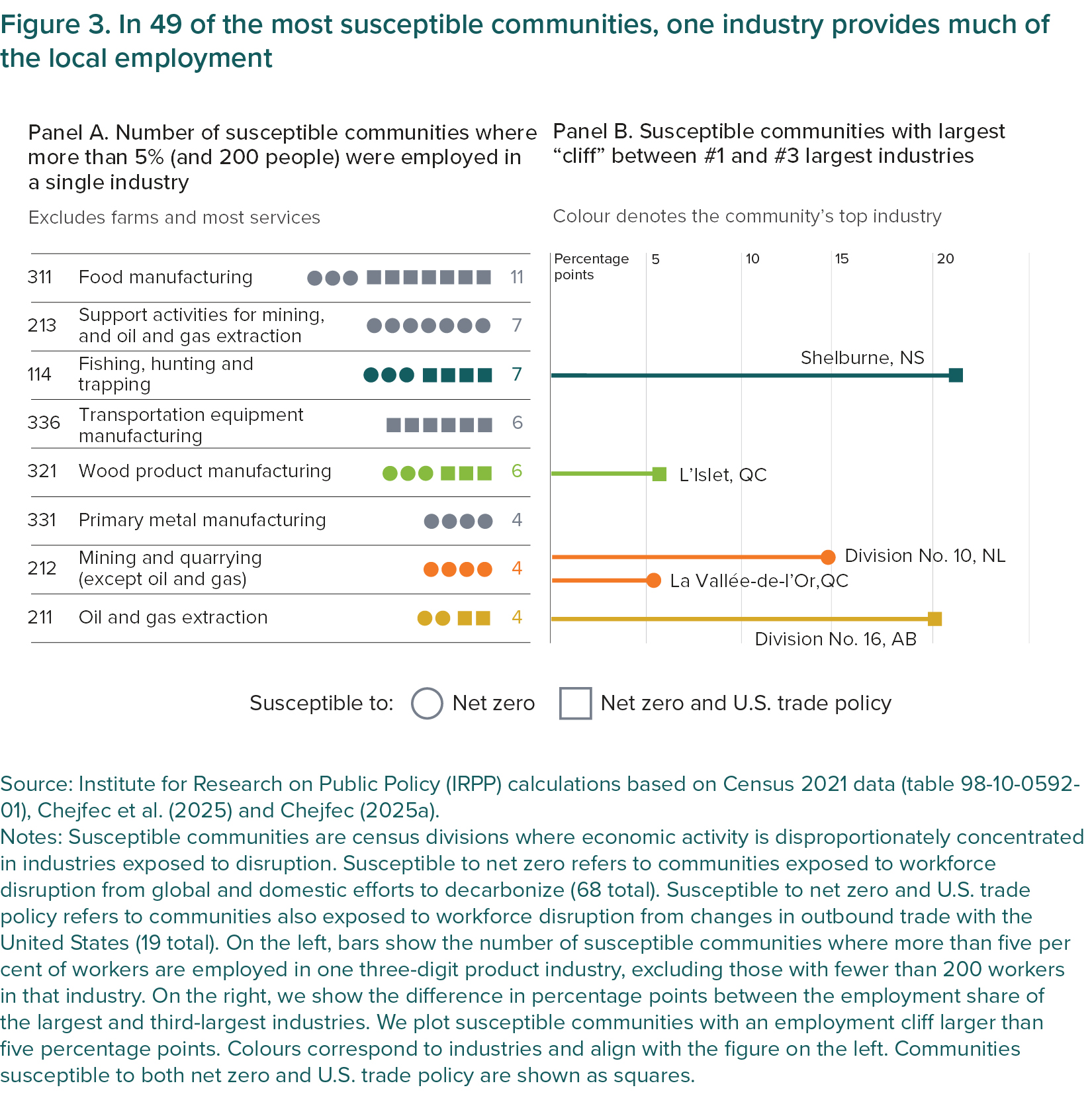
In smaller, remote communities in Canada that often rely on one sector or employer, a major closure or layoff could have more pronounced community-wide impacts (Bruce et al., 2005). Figure 3 shows how often this reliance occurs in communities susceptible to net zero, including those also exposed to changes in U.S. trade policy.
In Panel A, we count susceptible communities where more than five per cent of workers and at least 200 people are employed in one industry, excluding farms and most services such as education, health care and public administration. About three-quarters of the most susceptible communities in Canada have this concentration.
Panel B highlights communities with a gap of more than five percentage points between their largest and third-largest industries. The bigger the gap — the employment cliff — the more likely it is that the community disproportionately relies on its top industry for local employment.
Together, the two panels show that certain communities, such as Shelburne, Nova Scotia (fishing, hunting and trapping), Alberta’s Division No. 16 (oil and gas extraction) and Newfoundland and Labrador’s Division No. 10 (mining and quarrying), are very specialized and have considerable employment cliffs. These qualities increase the likelihood that these communities could face more severe impacts following major closures in their top industry. This exposure is substantial, as figure 3 captures only direct employment and not indirect or induced jobs. In many of these communities, numerous other local jobs also depend on the continued viability of these industries.
Pre-existing economic, social and demographic pressures can mean that, when major closures or mass layoffs occur, community-wide impacts are more severe (OECD, 2025; Vermeulen & Braakmann, 2023). For example, Alasia et al. (2008) predict greater risk of future employment decline in communities with higher vulnerability scores. These scores are estimated based on indicators, such as industrial mix and exposure to restructuring, unemployment and labour force participation rates, educational attainment (human capital), economic diversification and proximity to major centres.
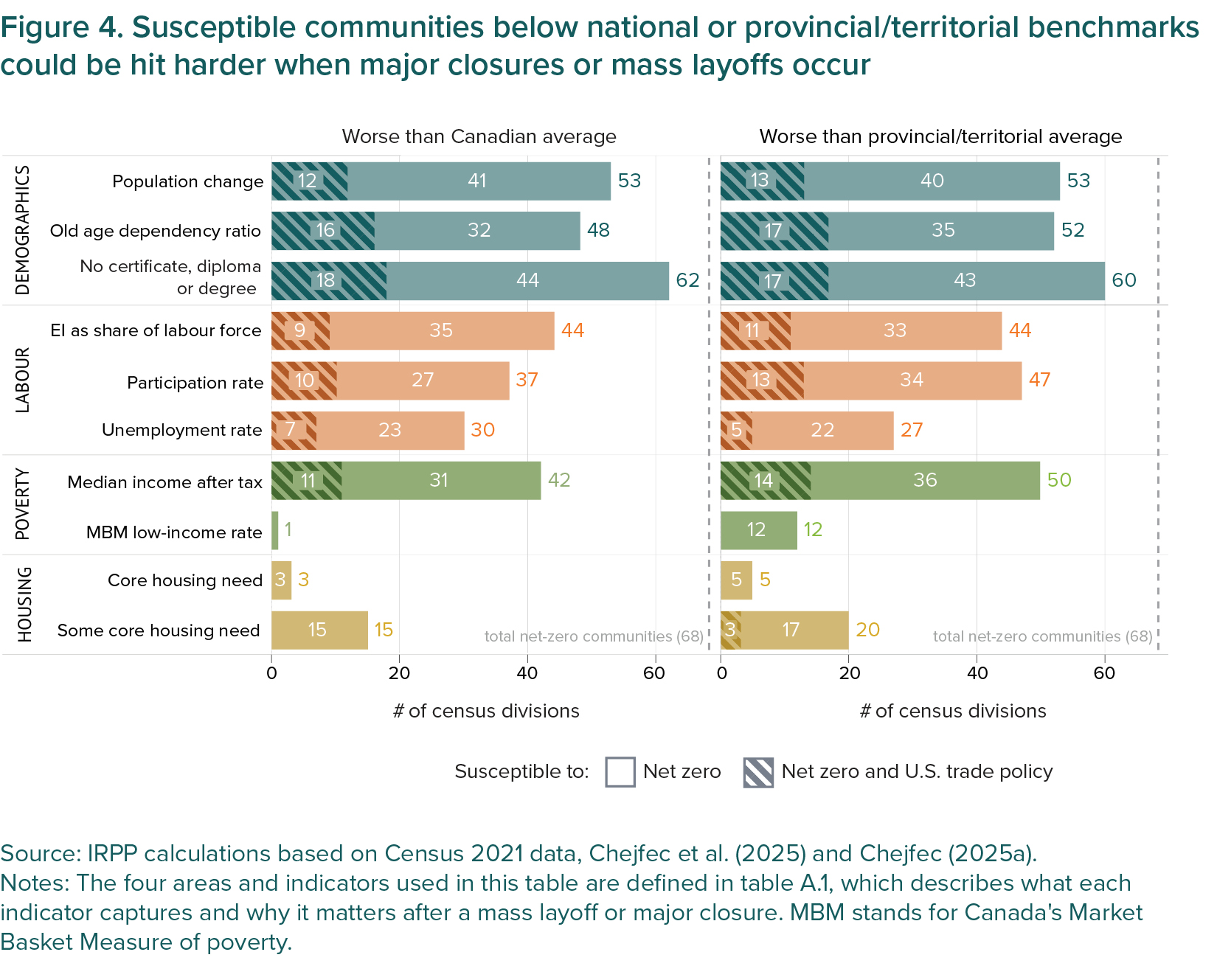
In our analysis, among communities susceptible to workforce disruption from net zero, we highlight those that perform worse than national and corresponding provincial and territorial averages across a range of socio-economic indicators. This performance suggests weaker conditions in those communities even before a shock (see figure 4).
To assess pre-existing conditions in susceptible communities, we apply our own framework across four areas — demographics, labour, poverty and housing.
The framework focuses on baseline conditions or indicators that could worsen the ripple effects of a closure across a community. As our analysis of susceptible communities is conducted at the census division level, we are limited by the indicators available at that geographic scale. Table A.1 summarizes the framework, outlining each indicator, what it captures and why it matters when mass layoffs occur. It is an example of how policy-makers may identify communities with weaker starting points and predict the likelihood of larger community impacts.
For each indicator, figure 4 shows how many susceptible communities perform worse than the Canadian average (left panel) and their provincial or territorial averages (right panel) — highlighting where socio-economic conditions may already be weak. These panels do not necessarily overlap; a community may lag its province or territory without being a national underperformer, and vice versa.
Comparing communities only to others in the same province or territory can minimize local problems if the whole region is struggling. Similarly, comparing communities only to a national average can mask local disadvantages and structural differences, including labour markets, industrial mixes and costs of living. Sixteen susceptible communities perform worse than either Canadian or provincial/territorial averages on at least one indicator in each of the four areas (demographics, labour, poverty and housing) (see table A.2).
Major closures or mass layoffs can hit rural, remote and Indigenous communities especially hard because unique pressures can worsen the impacts. Many of these communities also experience weaker socio-economic conditions.
Many rural, remote and Indigenous communities, including some of the susceptible communities our analysis identifies in figure 1, have service gaps. Limited safe, affordable and reliable transportation reduces access to jobs, education or training, and essential social services (Affordability Action Council, 2024). Inadequate transportation and limited access to local services can increase social isolation, especially among seniors (ESDC, n.d.). Access to education opportunities and online learning are also constrained by uneven broadband access (Jackson et al., 2025). As a result, many of these communities face a catch-22 — they can’t attract workers to grow businesses without better amenities, but they can’t finance amenities without scaling business opportunities (IRPP, 2025c, 2025d).
IRPP profiles of susceptible communities — which tend to be, on average, smaller, more remote and less economically diverse than non-susceptible communities — show how hard it can be to attract and retain skilled workers. These challenges are often driven by gaps in local infrastructure, amenities and services, including housing, health care, transportation, schools, child care, internet and cell service (IRPP, 2025a, 2025b, 2025c, 2025d, 2025e). Figure 5 presents vignettes of three census divisions that hold susceptible communities profiled by the IRPP. With weaker socio-economic conditions, these places are among the susceptible communities in figure 4.

In census divisions identified as susceptible to workforce disruption from net zero, there are 131 First Nations communities, seven Inuit communities and eight government-recognized Métis land settlements (Jackson et al., 2025). Some Indigenous communities rely on susceptible industries for employment, contract work and revenue generation (Statistics Canada, 2023b). Around 18 per cent of the national Indigenous labour force (151,000 Indigenous people) lives within census divisions that are most susceptible to net zero — nearly double that of the non-Indigenous labour force (Jackson et al., 2025). Major closures in susceptible communities could affect a substantial share of Indigenous workers. Pre-existing socio-economic disparities between Indigenous populations and non-Indigenous populations in Canada could make these shocks harder to weather and their impacts more severe.
Indigenous populations are younger and growing faster than the Canadian average, yielding a rapidly expanding Indigenous labour force. Yet educational attainment, labour force participation and employment outcomes continue to lag non-Indigenous averages (see table 1). In 2021, the labour force participation rate of First Nations on reserve was 45.6 per cent and 63.9 per cent for non-Indigenous populations — an especially pronounced and growing gap of 18.3 percentage points (up from 17.1 percentage points in 2016 and 14.9 percentage points in 2006). Employment rates are particularly low for Indigenous people of working age living in rural communities at 46.5 per cent compared to 57.4 per cent nationally in 2021 (National Indigenous Economic Development Board, 2024).
Higher poverty, elevated core housing need and varied access to services may intensify pressures when closures occur. Table 1 shows more severe, persistent socio-economic challenges for Indigenous populations.
There are also disparities across First Nations, Inuit and Métis communities, and between on-reserve and off-reserve contexts, including uneven access to basic needs such as housing (Abdi & Leedham, 2025; Indigenous Services Canada, 2023). Reasons for these disparities include colonialism, residential schools and a systematic underfunding of Indigenous education (Truth and Reconciliation Commission of Canada, 2015).

Our analysis in figure 4 helps identify communities that might already feel strained. However, as all indicators use 2021 census data due to available disaggregated data, they are backward-looking snapshots that may miss some communities under pressure today. Policy-makers that want to replicate the framework can identify more current conditions with timely, integrated local data and on-the-ground signals (IRPP, 2025f; Samson et al., 2025).
Take Ingersoll, Ontario, for example. The town is a susceptible community that does not show up consistently in figure 4 because it was doing relatively well in 2021. Recent on-the-ground perspectives paint a more comprehensive picture of where Ingersoll is today that is not yet visible in available official statistical data.
A community profile based on local interviews shows that a history of shutdowns at the town’s General Motors CAMI plant led to related supplier closures, the opening of a union-run food bank and rising demand for United Way supports. The profile highlights the effects of layoffs at the General Motors CAMI plant after 2021 (IRPP, 2025b).
While the CAMI plant secured government support to produce BrightDrop electric delivery vans in 2022, the community has grappled with unpredictable electric vehicle demand, trade uncertainty and workforce reductions. These challenges have also hurt supply chains and demand for local services. In May 2025, production was paused at the plant, and in October 2025, General Motors (2025) announced it was permanently ending BrightDrop production at the CAMI plant. Timely local data and on-the-ground signals can help flag that, today, Ingersoll faces disruption and is under strain.
Economic disruption can have community-wide impacts, but Canada’s social support system and response tools focus primarily on individual layoffs and firm adjustments. They deliver ad hoc measures, rather than co-ordinated, comprehensive and automatic community-level responses. This approach mismatches the timing, scale and nature of responses to major closures and mass layoffs in communities.
Existing programs span the spectrum from relatively integrated, community-facing models to fragmented, worker-only supports. For promising programs, consider B.C.’s Community Transition Services and Ontario’s Protect Ontario Workers Employment Response (POWER) Centres: these approaches illustrate elements of local partnership, rapid activation and a single point of service (Government of British Columbia, 2025; Ministry of Labour, Immigration, Training and Skills Development, 2025). However, many other programs across Canada remain siloed with eligibility and timing gaps, offer limited support for indirectly affected households, and have little capacity to stabilize local services.
Table A.3 summarizes relevant provincial programs focused on supporting displaced workers. The federal government has also announced a range of place- and sector-specific supports in recent years for industries facing disruption. Our review of these programs and initiatives reveals three gaps in the current system:
After mass layoffs, community demand rises for critical supports beyond employment services. Shocks like these can drive more people to seek housing supports such as prevention of rent and mortgage arrears, mental health and addiction services, family counselling, financial counselling and debt-servicing support. Municipal and not-for-profit organizations with revenue loss may also need temporary support (see “The Ripple Effects of Business Closures and Mass Layoffs” on page 8).
For instance, when a community’s major employer closes, the local tax base erodes and social service organizations face surging demand. However, most initiatives do not address municipal revenue gaps or social services capacity during this phase. Communities often require rapid help to scale food banks and counselling capacity, but there is no flexible government fund to meet those immediate needs (Charity Insights Canada Project, 2025; Nauta, 2022). Impacted communities need well-resourced, robust social services and holistic supports to improve local outcomes, but these are often overlooked in transition plans (ESDC, 2025b; OECD, 2025; Wells et al., 2020).
By mandate, employment insurance (EI) and many labour market programs, such as targeted wage subsidies and apprenticeship training, offer partial wage replacement and individual retraining for displaced workers. But community stabilization falls outside the scope of these programs (Canada Employment Insurance Commission, 2024, 2025).
Place- and sector-specific shock responses deliver helpful frontline supports, including training, job search assistance, EI Work-Sharing and targeted firm relief. However, they are limited, piecemeal and uneven across sectors and provinces. Moreover, they often target displaced workers and affected firms rather than the broader community (Commissioner of the Environment and Sustainable Development, 2022; Environment and Climate Change Canada, 2018). There are many examples of these specific responses:
While helpful, these measures are ad hoc and mostly limited to specific sectors and directly affected workers and businesses. They are not designed to address broader community needs when mass layoffs or business closures occur.
A patchwork of social supports makes it harder for impacted people and communities to get help. Existing programs and transition plans are triggered differently. In some cases, support is available when governments declare ad hoc initiatives for a specific affected sector or region. In others, programs activate through employer notifications, union involvement, or an opt-in or invitation process at the community level.
These programs and plans are also spread across silos and jurisdictions. For example: ESDC manages federal EI; LMDAs in each province and territory offer workforce and employment services; certain provinces provide economic transition services; Regional Development Agencies (RDAs) promote investments and programming that often span multiple provinces and territories; Innovation, Science and Economic Development Canada provides a range of sector-based supports; and municipalities and nonprofits offer local services. There is no clear and consistent single “front door” or on-the-spot navigator for affected communities.
The Canada Retraining and Opportunities Initiative is another part of the patchwork of federal programs intended to support community-level responses to mass layoffs. Delivered through the Community Workforce Development Program, it offers funding for community-driven projects where mass layoffs have occurred (ESDC, 2025c). Applicants must submit an expression of interest and wait for federal approval, and can only apply after a mass layoff has already occurred. With $50 million allocated over four years (2024-28), the program is time-limited and modest in scale, limiting its scope to provide ongoing support across the country (ESDC, 2025d).
A few provincial models get closer to a single “front door” approach. B.C.’s Community Transition Services and Ontario’s POWER Centres co-ordinate supports across agencies and offer event-specific, one-stop access for displaced workers. But these models are only available in their respective provinces and have limited resources to stabilize wider community services.
Activating existing rapid-response services at the provincial level often depends on union presence, employer co-operation or a community invitation. Support tends to be divided into streams — workers versus firms — with little for community services (Government of British Columbia, 2025; Ministry of Labour, Immigration, Training and Skills Development, 2025).
Some provincial models offer promising examples of co-ordinated supports. Other provinces provide a patchwork of transition services that vary by place and trigger. Together, they offer lessons in what could work and where there might be room for improvement.
Ontario’s POWER Centres, formerly known as Action Centres, are provincially funded, supported through LMDAs and operate via partnerships with local unions, community organizations and learning institutions. These union-led centres link workers to provincial supports including Employment Ontario, Better Jobs Ontario and the Skills Development Fund. They provide peer counselling, job search help, training referrals and some mental health resources for directly affected workers. Coverage varies by event and unionization (Ministry of Labour, Immigration, Training and Skills Development, 2025).
In its 2025 fall economic statement, the Government of Ontario noted that 10 centres had assisted nearly 15,000 people in the past year (Ministry of Finance, 2025). Going forward, with a renewed $20-million provincial investment and program expansion, POWER Centres will be able to proactively launch before layoffs occur and respond to support requests within 24 hours (Ministry of Finance, 2025).
B.C.’s Community Transition Services mobilize within 24 hours when invited by a community after a major shock and stay as long as needed. They form a local multi-partner team to conduct worker needs assessments, organize job and career fairs, deliver information sessions and connect workers with skills training (Government of British Columbia, 2025). These teams can shift into medium-term development roles if the community chooses. The effectiveness of these initiatives depends on local capacity and communities opting in and inviting support.
The B.C. model is particularly promising for adaptation elsewhere due to two features. First, its invitation-based, community-led approach relies on regional managers with trusted local relationships — something that is especially effective in rural and Indigenous contexts where trust can be fragile. Second, its process is structured in phases: it starts with the needs of workers, then focuses on contractors and the wider business ecosystem, and finally addresses the whole community. This triage approach ensures that cascading impacts are addressed systematically.
In 2020, the Nova Scotia government established a dedicated Forestry Sector Transition Team to advise on short- and long-term actions to support the forestry sector (Government of Nova Scotia, 2020a). This team provided input on initiatives totalling more than $75 million in investments, including a toll-free help line, retraining and employment services, emergency assistance and financing tools for businesses (Government of Nova Scotia, 2020b). These measures offered workers and businesses a co-ordinated menu of supports across government silos.
However, these services focused primarily on workers and businesses in the forestry sector. They did not include broader community-wide supports to stabilize municipal revenues or non-profit service capacity.
In 2015, the Government of Alberta committed to eliminating provincial emissions from coal-fired electricity and launched a package of sector-specific transition measures. It paired a $40-million dedicated fund for worker supports (e.g., relocation assistance, tuition vouchers, bridge-to-retirement grants and employment transition services) with a $5-million Coal Community Transition Fund for 12 municipal projects (Jobs, Economy, Trade and Immigration, n.d.-a).
Alberta’s coal phaseout plan also included workforce adjustment services, which continue to help businesses, labour unions and other community stakeholders develop a co-ordinated response to plan for and respond to workforce changes like layoffs, closures or downsizing (Jobs, Economy, Trade and Immigration, n.d.-b). Through these services, businesses and labour unions can form multi-stakeholder committees and hire facilitators to help affected workers.
In 2025, the Commission de la construction du Québec (CCQ) partnered with the Ministère de l’Emploi et de la Solidarité sociale (MESS) to respond to mass layoffs in the province. The initiative was launched in the context of increasing economic uncertainty from customs tariffs in Quebec and a need for more workers in the construction sector (Commission de la construction du Québec, 2025).
Businesses impacted by a mass layoff must notify the MESS, which then co-ordinates with redeployment assistance committees at the CCQ. When necessary, CCQ teams provide workers at the impacted company with information sessions and guidance to help them pursue careers in the construction sector (Commission de la construction du Québec, 2025).
Lessons from abroad
International examples show models that reduce fragmentation and ensure faster activation and easier navigation for communities. The following examples draw on IRPP case studies examining place-based community transformation supports, alongside broader international evidence.
In the United States, the Department of Labor’s Rapid Response teams deploy quickly after businesses notify them of a layoff, which is usually required at least 60 days in advance (Employment and Training Administration, n.d.). The teams provide on-site services for workers and companies, including unemployment insurance information, health insurance options, and access to skills and training resources. The team offers referrals to other programs and services, such as American Job Centers, through a single channel (Employment and Training Administration, n.d.).
The Latrobe Valley Authority was formed in 2016 as a dedicated authority to streamline community supports following the closure of a major coal power station (Regional Development Victoria, n.d.). The authority established career, training, and health and well-being supports for workers. It also put in place investment projects and programs for local businesses, including one-stop concierge services to improve access to supports, networks and grant funding for community organizations, and infrastructure (Regional Development Victoria, n.d.).
Spain’s Just Transition Strategy pairs worker supports with regional Just Transition Agreements that fund local projects and services, explicitly addressing community needs alongside individual measures. An autonomous Just Transition Institute oversees the strategy. It draws on European and national Just Transition Funds to provide a legislated, co-governed framework that helps diversify coal-dependent regions and stabilize rural populations (Yassin et al., 2025).
Scotland’s Partnership Action for Continuing Employment (PACE) operates as a national partnership of organizations, led through Skills Development Scotland. It includes 22 local PACE teams across the country that offer a single point of contact for businesses and workers facing redundancy. This single point integrates information on career, skills and income supports across government, non-profit, union and employer partners (Skills Development Scotland, n.d.).
Canada’s income support system cannot, on its own, meet the basic needs that arise when an entire community is impacted by a major closure or mass layoffs.
EI is the largest and most critical first layer of support. As households in the community lose income, whether directly or indirectly, after a major closure or mass layoff, EI is designed to provide an income backstop for eligible workers. In theory, EI should be an automatic stabilizer. It replaces a portion of lost income to support individual households, which helps soften the overall shock to the region. This is why EI uses regional triggers. When unemployment rises, benefits become more generous and easier to access. This approach acknowledges that workers may need more time to find suitable employment in distressed labour markets.
However, in practice, long-standing issues around complexity, eligibility and generosity undermine EI’s baseline effectiveness. EI is not designed to provide community-wide supports.
Complex EI rules and interactions, including eligibility requirements and benefit calculations, can slow access during a shock. Processing times take up to four weeks under normal circumstances. Program rules require claimants to skip the first week of benefits as a sort of deductible and also subtract separation payments from the first paycheque (IRPP Working Group, 2022a, 2022b). These rules can create a gap when incomes fall but support has not yet arrived. In some cases, they can leave less income replaced in the first weeks after a shock, limiting EI’s ability to cushion the income loss.
Furthermore, the program’s reach is limited. Only a portion of unemployed workers access benefits — roughly 35 per cent at the national level during the summer of 2025. While some individuals are never eligible (e.g., self-employed workers) and others exhaust their benefits, a significant portion fail to meet the requirement of working 420 to 700 insurable hours before being laid off. Research shows that labour market entrants and workers with intermittent or part-time hours frequently miss this threshold (Chejfec, 2025b; IRPP Working Group, 2022a).
Even for those eligible, supports may not always be sufficient. EI replaces roughly 55 per cent of earnings up to a maximum amount, which was $695 per week in 2025 and $729 per week as of January 2026 (Government of Canada, n.d.-a). For a low-income family in an urban centre, a remote community with high costs of living, or a household where more than one earner is affected, this amount may be insufficient to cover basic needs. While a Family Supplement top-up exists for low-income households, the eligibility threshold and resulting benefits are low: combined family income must fall below $25,921 per year, and the added benefit can range from only a few cents to roughly $90 per week depending on income and the number of children (Employment Insurance Regulations, SOR/2010-10).
The program’s design also creates gaps for non-traditional employees. Self-employed workers, including contractors, incorporated business owners and gig workers, are not eligible for EI jobless benefits. Additionally, because these benefits kick in only after a layoff, indirectly affected workers facing reduced hours or supplier slowdowns often lack clear pathways to support.
EI’s Work-Sharing program is a proactive solution designed to address this issue. It helps impacted firms avoid layoffs by subsidizing a portion of workers’ income during a slowdown. However, program uptake remains low, largely due to poor awareness among affected businesses (ESDC, 2024).
It can also be harder to access EI in rural and Indigenous communities, where limited services and poor connectivity make claims and follow-up challenging. A 2019 Service Canada evaluation found that Indigenous people, immigrants, people in rural and remote areas, and those with lower official language literacy, incomes and education have more difficulty accessing services and information. These difficulties stem from digital barriers, such as limited internet access and low computer literacy, and non-digital obstacles like physical and cognitive limitations and negative historical and cultural experiences (ESDC, 2019).
In response to U.S. tariffs imposed in 2025, the government introduced a suite of temporary measures: waived the one-week waiting period, suspended the allocation of severance, lowered the hours required to qualify for benefits, extended Work-Sharing agreements and granted additional benefit weeks to some long-tenured workers (Government of Canada, n.d.-b). While their actual impact on the economy is hard to discern, these ad hoc changes have eased short-term pressure for eligible workers (Chejfec, 2025b).
Yet, like responses to the pandemic and previous shocks, they are inherently reactive. Communities cannot rely on timely government interventions for every shock; they need standing mechanisms that can provide community-wide support when major closures or mass layoffs occur.
A healthy, modernized EI program remains a critical foundation for income support. But with its current design, it can’t reach everyone who needs support or stabilize whole communities on its own.
Beyond EI, provincial social assistance provides a minimal backstop. Benefit levels often fall below poverty thresholds (Laidley & Oliveira, 2025; Petit, 2024). By design, means-tested social assistance supports working-age adults with persistently low income and long-term financial need (Forget & Frankel, 2024). After major closures and mass layoffs, asset and income thresholds could delay eligibility until savings are depleted (Laidley & Oliveira, 2025). By the time support arrives, people may already be late on payments and face other household problems. Cross-country reviews find that social assistance is often an underdeveloped element of just transition policy packages, despite its importance in cushioning households through major economic transformations (Krawchenko & Gordon, 2021).
Other federal cash transfers delivered through the tax system, including the GST/HST credit, the Canada Child Benefit and the Canada Workers Benefit, provide important ongoing support to low- and modest-income households. However, they either provide modest amounts or are targeted to specific groups, are paid on set schedules and are generally based on prior-year income (Petit, 2024). As a result, they have a limited ability to provide support quickly or at scale when major closures or mass layoffs occur.
Canada’s tools for responding to mass layoffs and closures are fragmented, reactive and focused on directly affected workers and employers. A more proactive and comprehensive approach can offer immediate support and longer-term financial sustainability for communities facing major economic shocks.
The following recommendations offer a co-ordinated approach:
Together, these recommendations form a three-tiered framework of social supports. Community Transformation Agreements would provide a longer-term foundation to susceptible communities, rapid-response community support hubs would deliver immediate, on-the-ground support to those that experience a major closure or mass layoff, and targeted financial relief would be activated in cases of deep financial distress across a community. Specific triggers activate each measure, so responses match different levels of community need (see figure 6).
Aligning action across different levels of government can be challenging. Setting clear roles in advance, with pre-agreed protocols and triggers can reduce delays and ensure comprehensive supports are in place when shocks occur. Federal, provincial and territorial governments should also develop cost-sharing agreements and frameworks in advance to clarify roles and funding for readiness and maintaining capacity. These agreements should, for example, set out how costs will be shared when supports are activated. Similar approaches exist in the Early Learning and Child Care agreements, the Disaster Financial Assistance Arrangements and the Investing in Canada Infrastructure Program (Government of Canada, 2025; Housing, Infrastructure and Communities Canada, 2025; Public Safety Canada, 2025). This approach can provide more predictable funding and reduce ad hoc negotiations after a shock.

Community Transformation Agreements can co-ordinate supports and investments across all levels of government. Created in partnership with each community, these long-term, place-based agreements address the challenges facing communities undergoing economic transformation (see box 2). They set out clear roles, responsibilities and timelines, making sure support goes beyond workers and businesses to help the whole community and build long-term resilience. Spain’s Just Transition Agreements provide an international example of how opt-in, place-based agreements can work (Yassin et al., 2025).
The Athabasca Chipewyan First Nation gives us an example closer to home. In 2023, the First Nation recommended “net-zero planning agreements” to create more sustainable jobs in the shift to net zero through a nation-to-nation and government-to-government relationship. These partnerships are modelled on the conservation agreements used under the Species at Risk Act, where communities work with governments toward shared goals (Fung, 2023).

Governments should work with highly susceptible communities well before a shock hits. To pinpoint these communities, governments can use tools like the IRPP’s methodology to identify, for example, the top two per cent of communities most susceptible to workforce disruptions from the energy transition (Chejfec et al., 2025). If a community experiences a major closure or a mass layoff without a pre-existing agreement, it should still be able to opt in to initiate one.
Agreements are co-designed and co-governed by Indigenous governments and communities, provincial and territorial governments, municipal leaders, federal departments, industry partners, labour representatives and community organizations. Federal, provincial and territorial governments would support agreements through funding and align their relevant departments, ministries and programs within their mandates. Provinces and territories could steward agreements.
Local and Indigenous partners, with dedicated resources and capacity support, would co-develop priorities and implementation. Community Futures Organizations (CFOs), with an expanded mandate and the necessary resources, could convene partners and co-ordinate the process (Jackson et al., 2025). Regional Development Agencies can work with provincial, territorial and federal departments to align commitments across employment and social supports, as well as investment and economic development. A standard template for agreements could speed setup and help align partners across different levels of government, while allowing supports to be tailored to local needs.
Each agreement is tailored to the community and guided by local assets, needs and opportunities while drawing from common supports. Typical elements include:
Agreements should establish the roles and responsibilities of each level of government and local players. It should also include the implementation timeline, measurable outcomes, and a schedule for regular reviews and updates.
International practices and comparative analyses show that locally co-led, place-based partnerships are critical. For example, Spain’s Just Transition Agreements demonstrate how opt-in, place-based, co-governed agreements secure stable resources, co-ordinate governance and ensure worker supports, while keeping the design in community hands (Yassin et al., 2025).
With clear governance, sustained funding, and aligned workforce, social and economic planning, these partnerships are essential to successful and equitable transitions (Yassin & Jackson, 2025).
Rapid-response community support hubs serve as a “one-stop shop” for community-wide supports during and immediately after events like a major closure or mass layoff. These hubs can help break down the silos of our current social supports, making it easier for workers and communities to get help. Where a Community Transformation Agreement is already in place, hubs would be the operational arm that activates and delivers early-response elements after a major closure or mass layoff. Where no agreement exists, hubs provide immediate support and can help initiate longer-term planning.
Hubs would be funded by a Community Transformation Fund — a fund established by the federal government in partnership with the provinces and territories. This fund could be used to establish local hubs in provinces and territories where none exist. It can also expand the scope, capacity and resources of provinces like B.C. and Ontario that already run comparable services.
Rapid-response community support hubs should be included in future iterations of Canada’s Sustainable Jobs Action Plan, which is updated every five years, as a core mechanism to link prompt community supports with local and regional initiatives. These hubs also ensure that immediate assistance complements long-term workforce transformation strategies (IRPP, 2025f).
Provinces and territories, working with municipalities, Indigenous governments and local community partners — including federally funded Community Futures Organizations (CFOs) — would draw on the Community Transformation Fund to activate rapid-response hubs. Governments would align funding to co-deliver the supports communities choose based on their local needs and priorities.
To maintain capacity and deliver prompt action, governments should use the fund to set up the essentials for speed and consistency. These include framework agreements and protocols, a ready-to-deploy supports and services menu, and surge staffing rosters. The menu is a pre-defined set of supports and relief options that hubs, when activated, can draw on and tailor to the needs arising from a specific closure or mass layoff affecting the community. The rosters would include pre-identified staff and service providers who can be mobilized quickly when a hub is activated. Governments would also put in place temporary benefit-clawback exemptions to ensure rapid-response community supports do not reduce or prevent access to other benefits or social assistance for which individuals or households may otherwise be eligible. With these essentials in place, hubs can mobilize within days and plug into existing federal, provincial, territorial and community services.
Provinces and territories could anchor hub services within their systems, enabling direct integration with existing systems for skills training, economic development and social services. They could appoint a co-ordinating unit to align efforts with federal, municipal, Indigenous and other local partners as in B.C.’s Community Transition Services approach (Government of British Columbia, 2025). CFOs, municipalities, Indigenous governments, educational institutions, unions and other local partners could co-lead on the ground by convening actors and aligning supports with community economic development plans in susceptible communities. The IRPP previously recommended expanding the mandate of CFOs and increasing their financial resources. With this expansion, they can better support strategic planning and align local economic and skills development in susceptible communities (Jackson et al., 2025; Samson et al., 2025).
Where a major closure or mass layoff occurs, provinces or territories would proactively reach out to affected communities to offer rapid-response community hub support, following an approach similar to B.C.’s Community Transition Services model (Government of British Columbia, 2025). Local leaders could then assess community needs and invite support if they choose. Provinces and territories, as well as Regional Development Agencies, would monitor and confirm triggering events, supported by shared data infrastructure. The hubs should then automatically activate once transparent and objective criteria are met, avoiding slow, retroactive models. This should trigger funding and staffing supports to stand up services quickly, under pre-agreed protocols. Where criteria are not met exactly or data are uncertain, communities can request activation through a streamlined process.
A trigger could be a scheduled or announced closure of a major facility that will affect a significant share (e.g., five per cent) of the community’s workforce within a short period. This activation threshold should include directly and indirectly affected workers and businesses.
Governments at all levels should collaborate to establish clear thresholds that reflect local labour market structures, population size and data availability. This approach could be best supported by timely, granular local data with standardized definitions in a central location, such as the proposed Canadian Centre for Community Transformation (Samson et al., 2025). This type of repository streamlines access and reporting.
Our proposed rapid-response community support hubs prioritize support for displaced workers and employers. They also extend assistance to households, local businesses and community institutions indirectly affected by a major closure or mass layoff through the ripple effects on suppliers, services, municipal revenues and housing. Drawing on B.C.’s Community Transitions Services model, a triaged approach could start with the needs of workers, then turn to contractors and the business ecosystem, and finally focus on community services. These phases ensure cascading impacts are addressed systematically and the whole community is stabilized (Government of British Columbia, 2025).
Hubs provide a support package grounded in a menu of services adapted to the needs of each event and co-ordinated across federal, provincial, territorial, Indigenous and municipal partners. Services could include early information sessions, individual and personalized needs assessments, and wellness fairs to identify mental health, addictions, financial counselling and legal/tenancy needs. Staff can help users access EI, other longer-term income supports, and provincial employment and training services. They can also make rapid referrals to housing and community services.
To remove immediate barriers for workers seeking re-employment, hubs could manage a small discretionary grant for immediate costs, such as child care and transportation to training or interviews. These funds could be administered with or by local communities, non-profits and Indigenous partners. Hubs would remain active through the acute phase of a major closure or mass layoff event, with the option of staying open longer in remote or single-industry communities.
To evaluate effectiveness, hubs should publish a dashboard that tracks a range of indicators agreed upon at the time of activation and service selection. Possible outcomes to track include time to activation, completed referrals, wait times for mental health and addictions services, and arrears prevented.
Partners should use the dashboard to enable shared learning, adjust supports as needs evolve and provide clear public accountability. These indicators should, for example, guide decisions such as when supports should taper, extend or adapt as conditions change.
Data and evaluation could be handed off to local partners where communities wish to pursue longer-term community transformation processes (IRPP, 2025f; Samson et al., 2025). Evidence in Taranaki, New Zealand, shows that co-developing measurement with communities can ensure a collaborative approach to defining success. It also builds buy-in and accountability for ongoing measurement (Venture Taranaki, 2020).
In addition to the disruption caused by a significant loss of local employment, a community may show broader financial distress over a short period of time. In these situations, federal, provincial and territorial governments should provide time-limited and targeted financial relief to households, businesses and local social service organizations. This recommendation complements rapid-response hubs by adding relief when financial pressures are severe and additional stabilization is needed.
This measure only applies to the hardest-hit communities. Severity indicators could, for example, include a sharp decline in median home prices within a short period, such as more than 20 per cent in three months. These thresholds require timely, granular local data with standardized definitions, which could be centralized via a proposed Canadian Centre for Community Transformation (Samson et al., 2025). As with other triggers, governments should complement these thresholds with a streamlined request option when communities face comparable distress but do not meet a threshold exactly.
The financial relief package can be resourced through the Community Transformation Fund and guided by community needs. It should consist of two parts:
The package should run for at least six months, and extend to 12 if recovery is slow. It can be phased out as labour market and service demand indicators, such as unemployment and hours worked, arrears, wait times for mental health services and foodbank usage, improve.
Rapid-response community support hubs may be best positioned to recommend where acute financial stress is emerging and advise governments on how to target temporary relief. For example, hubs may recommend prioritizing short-term stabilization funding to local mental health organizations or food banks when referrals to these services spike sharply in the community following a closure.
For susceptible communities in deep distress, especially smaller, more remote, single-industry communities, governments may provide additional, targeted income support. This support could be an area-based, basic needs top-up delivered separately by the Canada Revenue Agency (CRA). The CRA could use a simple emergency benefit mechanism that draws on experience from previous time-limited benefits at scale like those offered during the COVID-19 pandemic (Canada Revenue Agency, 2025).
To ensure simple, quick and equitable access across the affected community, the top-up should be a flat rate, time-limited and paid to all residents who can demonstrate a substantial loss of income. The benefit could be paid for three to six months, tapering off as jobs and business activity recover or households are able to sell assets. Workers who receive significant severance payments would not be eligible.
Governments can base eligibility on residence in the affected area, supported by documentation showing loss of income, rather than leaving residents to wait to receive additional benefits after they file taxes. This basic needs top-up would fill gaps from other longer-term income supports like EI and make sure indirectly affected households are not missed when local demand collapses. This includes households with workers with reduced hours, as well as contractors, gig workers and small business owners.
To avoid unintended harm, the Community Transformation Fund should set pre-agreements on temporary benefit-clawback exemptions. These agreements would ensure the top-up is not classified as income for social assistance, disability programs or rent-geared-to-income housing during the benefit period.
Disruptions resulting from mass layoffs and major closures can impact the social and economic fabric of communities. Where people and places are already grappling with socio-economic pressures, these shocks can have especially severe impacts.
Canada’s existing social support system and response tools are not designed to respond at the scale or speed of a community-wide disruption. They fall short when the impacts of major closures or mass layoffs ripple through local economies, services and housing markets. This gap should be addressed.
By adopting a comprehensive framework of social measures, governments can calibrate their support to the degree of disruption and the level of community need. This framework combines early, proactive planning in susceptible communities, rapid-response support hubs following major closures and targeted, time-limited financial relief in the hardest-hit communities. This approach can better support susceptible communities through a transforming economy and help them build long-term resilience.


Abdi, F., & Leedham, J. (2025). Urban Indigenous housing. Native Women’s Association of Canada. https://assets.cmhc-schl.gc.ca/sf/project/archive/research_6/nwac—housing-report_english-march-14.pdf
Affordability Action Council. (2024). Rural recognition: Affordable and safe transportation options for remote communities. Institute for Research on Public Policy.
https://irpp.org/research-studies/affordable-safe-transportation-options-remote-communities/
Alasia, A., Bollman, R. D., Parkins, J., & Reimer, B. (2008). An index of community vulnerability: Conceptual framework and application to population and employment changes. Statistics Canada. https://www150.statcan.gc.ca/n1/pub/21-601-m/21-601-m2008088-eng.htm
Aleksynska, M., & Muller, A. (2020). The regulation of collective dismissals: Economic rationale and legal practice (ILO Working Paper 4). International Labour Organization. https://www.ilo.org/publications/regulation-collective-dismissals-economic-rationale-and-legal-practice
Atiq, M., Coutinho, A., Islam, A., & McNally, J. (2022). Jobs and skills in the transition to a net-zero economy: A foresight exercise. Smart Prosperity Institute. https://institute.smartprosperity.ca/JobsAndSkills
Attanasio, O. P., Bottazzi, R., Low, H. W., Nesheim, L., & Wakefield, M. (2012). Modelling the demand for housing over the life cycle. Review of Economic Dynamics, 15(1), 1-18. https://doi.org/10.1016/j.red.2011.09.001
Augustine, T., Kendrick, M., Khan, A., McNally, J., Newcombe, G., Okeke, C., & Renzetti, N. (2023). Ready for green jobs: How ready are Canadian regions to attract and support the skilled workforce needed to reach climate targets and drive clean growth? The PLACE Centre and Smart Prosperity Institute. https://placecentre.smartprosperity.ca/ready-for-green-jobs/
Bank of Canada. (n.d.). What labour force participation tells us about the economy. Bank of Canada. https://www.bankofcanada.ca/2024/06/what-labour-force-participation-tells-us-about-the-economy/
Bank of Canada. (2023). Financial system review — 2023. https://www.bankofcanada.ca/2023/05/financial-system-review-2023
Bank of Canada. (2025). Financial stability report — 2025. https://www.bankofcanada.ca/2025/05/financial-stability-report-2025
Beer, A., Baum, F., Thomas, H., Lowry, D., Cutler, C., Zhang, G., Jolley, G., Ziersch, A., Verity, F., MacDougall, C., & Newman, L. (2006). An evaluation of the impact of retrenchment at Mitsubishi focussing on affected workers, their families, and communities: Implications for human services policies and practices. Flinders University. https://researchnow.flinders.edu.au/en/publications/an-evaluation-of-the-impact-of-retrenchment-at-mitsubishi-focussi
Behrens, K., Drabo, M., & Mayneris, F. (2021). Cultural and public services as factors of city resilience? Evidence from big plant closures and downsizing. Center for Interuniversity Research and Analysis on Organizations (CIRANO). https://cirano.qc.ca/files/publications/2021s-41.pdf
Brand, J. E. (2015). The far-reaching impact of job loss and unemployment. Annual Review of Sociology, 41, 359-375. https://doi.org/10.1146/annurev-soc-071913-043237
Brown, C., Clark, B., & Killen, S. (2024). Building Canada’s net-zero workforce: Report highlights. Canadian Chamber of Commerce. https://chamber.ca/building-canadas-net-zero-workforce-report-highlights/
Bruce, D., Ryser, L., Halseth, G., & Giesbrecht, K. (2005). Economic development framework of small communities in Canada. Canada Mortgage and Housing Corporation. https://www.unbc.ca/sites/default/files/sections/community-development-institute/phase_4__final_report.pdf
Canada Employment Insurance Commission. (2024). Employment Insurance monitoring and assessment report for the fiscal year beginning April 1, 2022 and ending March 31, 2023. Government of Canada. https://www.canada.ca/en/employment-social-development/programs/ei/ei-list/reports/monitoring2023.html
Canada Employment Insurance Commission. (2025). Employment Insurance monitoring and assessment report for the fiscal year beginning April 1, 2023 and ending March 31, 2024. Government of Canada. https://www.canada.ca/content/dam/esdc-edsc/images/programs/ei/ei-list/reports/monitoring2024/2023-2024-EI-MAR-EN.pdf
Canada Mortgage and Housing Corporation (CMHC). (2024a). Fall 2024 rental market report.
https://assets.cmhc-schl.gc.ca/sites/cmhc/professional/housing-markets-data-and-research/market-reports/rental-market-report/fall-2024/rental-market-report-fall-2024-en.pdf
Canada Mortgage and Housing Corporation (CMHC). (2024b). Understanding housing hardship and core housing need. https://www.cmhc-schl.gc.ca/observer/2024/understanding-housing-hardship-core-housing-need
Canada Mortgage and Housing Corporation (CMHC). (2025). Residential mortgage industry report — Fall 2025 edition. https://www.cmhc-schl.gc.ca/professionals/housing-markets-data-and-research/housing-research/research-reports/housing-finance/residential-mortgage-industry-report
Canada Revenue Agency. (2025). COVID-19 benefits from the CRA. Government of Canada.
https://www.canada.ca/en/revenue-agency/services/benefits.html
Carabin, F. (2025, November 11). Legault conseille aux travailleurs forestiers de trouver un emploi à Hydro-Québec. Le Devoir. https://www.ledevoir.com/economie/932814/legault-conseille-travailleurs-forestiers-trouver-emploi-hydro-quebec
Card, D., Hallock, K., & Moretti, E. (2010). The geography of giving: The effect of corporate headquarters on local charities. Journal of Public Economics, 94(3-4), 222-234. https://doi.org/10.1016/j.jpubeco.2009.11.010
Charity Insights Canada Project (CICP). (2025). Weekly results #3.23 government funding. Carleton University. https://carletonu.yul1.qualtrics.com/reports/RC/public/
Y2FybGV0b251LTY3OTdjNTEyYzViNTU1MDAwOGVmODk1YS1VUl9iUEdpano4cUpJb09MWEw=
Chejfec, R. (2025a). Measuring community workforce exposure to U.S. exports. Institute for Research on Public Policy. https://irpp.org/research-studies/measuring-community-workforce-exposure-to-us-exports/
Chejfec, R. (2025b). Canada’s EI is once again failing its stress test. Institute for Research on Public Policy. https://irpp.org/research-studies/ei-failing-stress/
Chejfec, R., Samson, R., & Jackson, A. (2025). The Community Transformations Project: A methodology for measuring community susceptibility. Institute for Research on Public Policy. https://irpp.org/research-studies/community-transformations-project-methodology/
Coletto, D., & Sheppard, E. (2025). The hollowing middle: Why more Canadians are slipping into precarity. Abacus Data. https://abacusdata.ca/the-hollowing-middle-why-more-canadians-are-slipping-into-precarity/
Commission de la construction du Québec. (2025). Establishment of the Guichet orientation construction: A leg up with joining the industry. https://www.ccq.org/en/Nouvelles/2025/Guichet-web-orientation
Commissioner of the Environment and Sustainable Development. (2022). Just transition to a low-carbon economy: Independent auditor’s report. Reports of the Commissioner of the Environment and Sustainable Development to the Parliament of Canada, No. 1. Office of the Auditor General of Canada. https://www.oag-bvg.gc.ca/internet/English/parl_cesd_202204_01_e_44021.html
Dallaire-Fortier, C. (2024). Unemployment ripple: The impact of mine closures in Canada, 1987 to 2020. Resources Policy, 92, Article 104901. https://doi.org/10.1016/j.resourpol.2024.104901
Department of Finance. (2020). Canada’s COVID-19 economic response plan: Support for Canadians and businesses. Government of Canada. https://www.canada.ca/en/department-finance/news/2020/03/canadas-covid-19-economic-response-plan-support-for-canadians-and-businesses.html
Dsouza, A. (2025). Why mortgage market stress could outpace projections despite BoC rate adjustments. Real Estate Institute of Canada. https://www.reic.ca/article-feb7-2025.html
Efficiency One. (2023). Energy poverty and an equitable transition to a net-zero carbon future in Nova Scotia. https://www.efficiencyone.ca/energy-poverty-and-an-equitable-transition-to-a-net-zero-carbon-future-in-nova-scotia/
Employment and Social Development Canada (ESDC). (n.d.). Social isolation of seniors — Volume 1: Understanding the issue and finding solutions. Government of Canada.
https://www.canada.ca/en/employment-social-development/corporate/seniors-forum-federal-provincial-territorial/social-isolation-toolkit-vol1.html
Employment and Social Development Canada (ESDC). (2019). Evaluation of providing services and information to Canadians through Service Canada. Government of Canada.
https://www.canada.ca/en/employment-social-development/corporate/reports/evaluations/evaluation-providing-services-information.html
Employment and Social Development Canada (ESDC). (2024). Evaluation of the Work-Sharing Program. Government of Canada. https://www.canada.ca/en/employment-social-development/corporate/reports/evaluations/2024-work-sharing-evaluation.html
Employment and Social Development Canada (ESDC). (2025a). Termination, layoff or dismissal. Government of Canada. https://www.canada.ca/en/services/jobs/workplace/federal-labour-standards/termination.html
Employment and Social Development Canada (ESDC). (2025b). Unions power prosperity: A report from the Union-Led Advisory Table. Government of Canada. https://www.canada.ca/en/employment-social-development/programs/union-led-advisory-table/unions-power-prosperity.html
Employment and Social Development Canada (ESDC). (2025c). Backgrounder: Canada Retraining and Opportunities Initiative. Government of Canada. https://www.canada.ca/en/employment-social-development/news/2025/03/backgrounder-canada-retraining-and-opportunities-initiative.html
Employment and Social Development Canada (ESDC). (2025d). Helping Canadian workers impacted by layoffs reskill and find work. Government of Canada. https://www.canada.ca/en/employment-social-development/news/2025/03/helping-canadian-workers-impacted-by-layoffs-reskill-and-find-work.html
Employment and Training Administration. (n.d.). Rapid Response services. U.S. Department of Labor. https://www.dol.gov/agencies/eta/layoffs
Employment Insurance Regulations SOR/2010-10, s. 3. Department of Justice. https://laws-lois.justice.gc.ca/eng/regulations/sor-96-332/page-5.html
Environment and Climate Change Canada. (2018). A just and fair transition for Canadian coal power workers and communities/Task Force on Just Transition for Canadian Coal Power Workers and Communities. Government of Canada. https://publications.gc.ca/site/eng/9.867000/publication.html
Federation of Canadian Municipalities (FCM). (2024). Making Canada’s growth a success: The case for a Municipal Growth Framework. https://fcm.ca/en/resources/making-canadas-growth-a-success
Foote, A., Grosz, M., & Stevens, A. (2018). Locate your nearest exit: Mass layoffs and local labor market response. ILR Review, 72(1), 101-126. https://doi.org/10.1177/0019793917753095
Forget, E. L., & Frankel, S. (2024). Flirting with a basic income in Canada: Were the lessons worth the risk of popular backlash? International Social Security Review, 77(1-2), 67-83. https://doi.org/10.1111/issr.12354
Frank, L., & Saulnier, C. (2024). 2023 Report card on child and family poverty in Nova Scotia. Canadian Centre for Policy Alternatives. https://www.policyalternatives.ca/news-research/2023-report-card-on-child-and-family-poverty-in-nova-scotia/
Funderburg, R. (2024). The disparate local impacts of closing fossil-fuel power plants. Illinois Municipal Policy Journal, 9, 55-85. https://iml.org/file.cfm?key=28361
Fung, B. (2023). Athabasca Chipewyan First Nation submission on Bill C-50.
https://www.ourcommons.ca/Content/Committee/441/RNNR/Brief/BR12773392/br-external/AthabascaChipewyanFirstNation-e.pdf
Future Skills Centre. (2022). Mapping the green jobs transition. Future Skills Centre. https://fsc-ccf.ca/wp-content/uploads/2022/09/2022-09-21_SustainabilityLearningBulletin__EN.pdf
General Motors. (2025, October 21). GM ends production of BrightDrop [Press release].
https://news.gm.ca/en/home/newsroom.detail.html/Pages/news/ca/en/2025/oct/1021_gm-ends-production-of-brightdrop.html
Gensey, T. (2016). Housing market insight Alberta. Canada Mortgage and Housing Corporation. https://publications.gc.ca/collections/collection_2016/schl-cmhc/nh12-279/NH12-279-2016-7-eng.pdf
Global Affairs Canada. (2018). Support for Canadian steel and aluminum workers and industry. Government of Canada. https://www.canada.ca/en/global-affairs/news/2018/06/support-for-canadian-steel-and-aluminum-workers-and-industry.html
Government of British Columbia. (2025). Community transition services. https://www2.gov.bc.ca/gov/content/employment-business/economic-development/support-organizations-community-partners/community-transition-services
Government of Canada. (n.d.-a.) EI regular benefits: How much you could receive.
https://www.canada.ca/en/services/benefits/ei/ei-regular-benefit/benefit-amount.html
Government of Canada. (n.d.-b). Temporary Employment Insurance measures to respond to major changes in economic conditions. https://www.canada.ca/en/services/benefits/ei/temporary-measures-for-major-economic-conditions.html
Government of Canada. (2025). Early Learning and Child Care Agreements. https://www.canada.ca/en/early-learning-child-care-agreement/agreements-provinces-territories.html
Government of Nova Scotia. (2020a, January 3). Premier announces forestry transition team members [Press release]. https://news.novascotia.ca/en/2020/01/03/premier-announces-forestry-transition-team-members
Government of Nova Scotia. (2020b). Forestry Transition Team update — December 2020. Forestry Transition Team, Nova Scotia. COI: 20.500.12592/97byyzd
Government of Ontario. (n.d.). Employment Ontario. https://www.ontario.ca/page/employment-ontario
Government of Saskatchewan. (n.d.). Canada-Saskatchewan rapid response teams.
https://www.saskatchewan.ca/business/hire-train-and-manage-employees/canada-saskatchewan-rapid-response-teams
Hislop, M. (2018, March 19). Alberta Government announces distribution of funding for coal communities. Energi Media. https://energi.media/alberta/alberta-distribution-funding-coal-communities/
Housing, Infrastructure and Communities Canada. (2025). Investing in Canada Infrastructure Program. Government of Canada. https://housing-infrastructure.canada.ca/plan/icp-pic-INFC-eng.html
Indigenous Services Canada. (2023). An update on the socio-economic gaps between Indigenous Peoples and the non-Indigenous population in Canada: Highlights from the 2021 Census. Government of Canada. https://www.sac-isc.gc.ca/eng/1690909773300/1690909797208
Institute for Research on Public Policy (IRPP). (2025a). Estevan: Saskatchewan’s energy city seeks to chart its own course. https://irpp.org/research-studies/saskatchewan-energy-city-chart-own-course/
Institute for Research on Public Policy (IRPP). (2025b). Ingersoll: Ontario auto town grapples with the EV transition. https://irpp.org/research-studies/ontario-auto-town-grapples-with-ev-transition/
Institute for Research on Public Policy (IRPP). (2025c). Cape Breton: Region built on coal looks to renewable energy. https://irpp.org/research-studies/region-built-on-coal-looks-to-renewable-energy/
Institute for Research on Public Policy (IRPP). (2025d). Kitimat and Kitamaat Village: Dreaming big in the land of the Haisla. https://irpp.org/research-studies/dreaming-big-in-the-land-of-the-haisla/
Institute for Research on Public Policy (IRPP). (2025e). Yellowknife: Riding the resource waves. https://irpp.org/research-studies/yellowknife-riding-the-resource-waves/
Institute for Research on Public Policy (IRPP). (2025f). People and places should be at the centre of the Sustainable Jobs Action Plan. https://irpp.org/research-studies/sustainable-jobs-action-plan/
Institute for Research on Public Policy (IRPP). (2025g). Channel-Port aux Basques: Looking toward a post-Fiona future. https://irpp.org/research-studies/channel-port-aux-basques-post-fiona-future/
International Labour Organization. (2019). Quick guide on interpreting the unemployment rate. https://www.ilo.org/publications/quick-guide-interpreting-unemployment-rate
IRPP Working Group. (2022a). How to modernize Employment Insurance: Toward a simpler, more generous and responsive program. Institute for Research on Public Policy.
https://irpp.org/research-studies/how-to-modernize-employment-insurance-toward-a-simpler-more-generous-and-responsive-program/
IRPP Working Group. (2022b). Financing Employment Insurance reform: Finding the right balance. Institute for Research on Public Policy. https://irpp.org/research-studies/financing-employment-insurance-reform-finding-the-right-balance/
Jackson, A., Samson, R., & Chejfec, R. (2025). Resilient workers, resilient communities: The need for place-based skills development. Institute for Research on Public Policy. https://irpp.org/research-studies/resilient-workers-resilient-communities/
Jobs, Economy, Trade and Immigration. (n.d.-a). Support for Albertans affected by coal phase out. Government of Alberta. https://www.alberta.ca/support-for-coal-workers
Jobs, Economy, Trade and Immigration. (n.d.-b). Workforce Adjustment Service. Government of Alberta. https://www.alberta.ca/workforce-adjustment-service
Johal, S., Alwani, K., Thirgood, J., & Spiro, P. (2019). Rethinking municipal finance for the new economy. Mowat Centre for Policy Innovation. http://hdl.handle.net/1807/99448
Joint Center for Housing Studies of Harvard University. (2011). Rental market stresses: Impacts of the Great Recession on affordability and multifamily lending. https://www.urban.org/sites/default/files/publication/27011/1001550-Rental-Market-Stresses-Impacts-of-the-Great-Recession-on-Affordability-and-Multifamily-Lending.PDF
Krawchenko, T., & Gordon, M. (2021). How do we manage a just transition? A comparative review of national and regional just transition initiatives. Sustainability, 13(11), Article 6070. https://doi.org/10.3390/su13116070
Labour Market Information Council. (2024). Labour market resilience in the face of an aging population. https://lmic-cimt.ca/labour-market-resilience-in-the-face-of-an-aging-population/
Laidley, J., & Oliveira, T. (2025). Welfare in Canada, 2024. Maytree.
https://maytree.com/changing-systems/data-measuring/welfare-in-canada/
Leclerc, K. (2022) Portrait of women by the relative remoteness of their communities, Series 2: Educational attainment. Statistics Canada. https://www150.statcan.gc.ca/n1/pub/45-20-0002/452000022022001-eng.htm
Lersch, P. M., & Dewilde, C. (2015). Employment insecurity and first-time homeownership: Evidence from twenty-two European countries. Environment and Planning A: Economy and Space, 47(3), 607-624. https://doi.org/10.1068/a130358p
Marchand, J. (2012). Local labor market impacts of energy boom-bust-boom in Western Canada. Journal of Urban Economics, 71(1), 165-174. https://doi.org/10.1016/j.jue.2011.06.001
Ministry of Finance. (2025). 2025 Ontario economic outlook and fiscal review: A plan to protect Ontario. Government of Ontario. https://budget.ontario.ca/2025/fallstatement/index.html
Ministry of Labour, Immigration, Training and Skills Development. (2025). Protect Ontario Workers Employment Response Centres (POWER Centres). Government of Ontario. https://www.ontario.ca/page/protect-ontario-workers-employment-response-centres-power-centres
Morissette, R. (2017). Barriers to labour mobility in Canada: Survey-based evidence. Statistics Canada. https://www150.statcan.gc.ca/n1/pub/11-626-x/11-626-x2017076-eng.htm
Morissette, R., & Qiu, T. H. (2021). Adjusting to job loss when times are tough. IRPP Study 82. Institute for Research on Public Policy. https://irpp.org/research-studies/adjusting-to-job-loss-when-times-are-tough/
Morissette, R., Zhang, X., & Frenette, M. (2007). Earnings losses of displaced workers: Canadian evidence from a large administrative database on firm closures and mass layoffs. Statistics Canada. https://www150.statcan.gc.ca/n1/pub/11f0019m/11f0019m2007291-eng.pdf
Murray, A., & Campbell, D. (n.d.). CBRM forward economic development strategy. Cape Breton Partnership. https://capebretonpartnership.com/research-report/cbrm-forward-economic-development-strategy/
Nam, L. J. Y. (2024). Intergenerational spillovers: The impact of labor market risk on the housing market. University of Bonn and University of Cologne, Reinhard Selten Institute (RSI), Bonn and Cologne. https://hdl.handle.net/10419/307308
National Indigenous Economic Development Board. (2024). National Indigenous economic progress report. https://www.niedb-cndea.ca/resources/indigenous-economic-progress-report/
Natural Resources Canada. (2017, June 1). Government of Canada announces support for forest sector workers and communities [Press release]. Government of Canada.
https://www.canada.ca/en/natural-resources-canada/news/2017/06/government_of_canadaannouncessupportforforestsectorworkersandcom.html
Nauta, L. (2022). The state of Calgary’s emergency food assistance system. Enough for All.
https://prismic-io.s3.amazonaws.com/enoughforall/ca2b862b-4088-4610-8f57-034a0861d514_The+State+of+Calgarys+Emerg+Food+Assistance+System+2022+%281%29.pdf
Newman, L., & McDougall, C. (2009). Australian children’s accounts of the closure of a car factory: Global restructuring and local impacts. Community, Work & Family, 12(2), 143-158. https://doi.org/10.1080/13668800902778934
Niftiyev, I. (2024). The impact of plant closures or deindustrialization on local labor relations in small and mono-industrial United States cities. In A. Görmüş & Y. Bektaş (Eds.), Proceedings: TNKU FEAS II. International Symposium on Labour Economics and Industrial Relations (pp. 19-40). Tekirdağ Namık Kemal University Faculty of Economics and Administrative Sciences. https://hdl.handle.net/10419/311530
Office of the Superintendent of Financial Institutions (OSFI). (2025). Annual risk outlook — Semi-annual update — Fiscal year 2025-2026. Government of Canada.
https://www.osfi-bsif.gc.ca/en/about-osfi/reports-publications/annual-risk-outlook-semi-annual-update-fiscal-year-2025-2026
O’Hagan, S. B., & Cecil, B. P. (2007). A macro-level approach to examining Canada’s primary industry towns in a knowledge economy. Journal of Rural and Community Development, 2(2), 18-43. https://journals.brandonu.ca/jrcd/article/view/84
Oliveira, T. (2025). Social assistance summaries, 2024. Maytree. https://maytree.com/wp-content/uploads/Social_Assistance_Summaries_2024.pdf
Oncescu, J. (2015). Rural restructuring: Community stakeholders’ perspectives of the impact of a pulp and paper mill closure on community relationships. Rural Society, 24(2), 177-199. https://doi.org/10.1080/10371656.2015.1060719
Oncescu, J. (2016). Rural restructuring: The impact of a pulp and paper mill closure on rural community recreation services and amenities. World Leisure Journal, 58(3), 207-224. https://doi.org/10.1080/16078055.2016.1161662
Organisation for Economic Co-operation and Development (OECD). (n.d.). Demographic change in regions and cities. https://www.oecd.org/en/topics/demographic-change-in-regions.html
Organisation for Economic Co-operation and Development (OECD). (2024). OECD employment outlook 2024: The net-zero transition and the labour market. OECD Publishing. https://doi.org/10.1787/ac8b3538-en
Organisation for Economic Co-operation and Development (OECD). (2025). Place-based policies for displaced workers: Lessons from past economic disruptions. OECD Publishing. http://dx.doi.org/10.1787/69b86784-en
Oschinski, M., & Walia, R. (2025). Harnessing generative AI: Navigating the transformative impact on Canada’s labour market. IRPP Study No. 97. Institute for Research on Public Policy. https://irpp.org/research-studies/harnessing-generative-ai/
Petit, G. (2024). Improving access to food and essential needs: Options for a more generous cash-transfer benefit. Institute for Research on Public Policy. https://irpp.org/research-studies/improving-access-to-food-and-essential-needs/
Pinter, G. (2015). House prices and job losses. Bank of England Working Paper No. 569. http://dx.doi.org/10.2139/ssrn.2702458
Policy Horizons Canada. (2024). Global demographic shifts: Population aging and decline. Government of Canada. https://horizons.service.canada.ca/en/2024/demographic-shifts/index.shtml
Postmedia News. (2015, November 23). The average house in Fort McMurray has lost $117,000 or 20% of its in value in one year. Financial Post. https://financialpost.com/commodities/energy/the-average-house-in-fort-mcmurray-has-lost-117000-or-20-of-its-in-value-in-one-year
Prime Minister of Canada. (2016). Prime Minister announces changes to employment insurance for three additional EI economic regions [Press release]. Government of Canada. https://www.pm.gc.ca/en/news/news-releases/2016/05/13/prime-minister-announces-changes-employment-insurance-three
Prime Minister of Canada. (2025a). Prime Minister Carney launches new measures to protect, build, and transform Canadian strategic industries [Press release]. Government of Canada. https://www.pm.gc.ca/en/news/news-releases/2025/09/05/prime-minister-carney-launches-new-measures-protect-building
Prime Minister of Canada. (2025b). Prime Minister Carney announces new measures to transform Canada’s softwood lumber industry [Press release]. Government of Canada. https://www.pm.gc.ca/en/news/news-releases/2025/08/05/prime-minister-carney-announces-new-measures-transform-canada
Public Safety Canada. (2025). Disaster Financial Assistance Arrangements. Government of Canada. https://www.publicsafety.gc.ca/cnt/mrgnc-mngmnt/rcvr-dsstrs/dsstr-fnncl-ssstnc-rrngmnts/index-en.aspx
RBC Capital Markets. (2022). The skills revolution Canada needs to reach net zero. https://www.rbccm.com/en/insights/story.page?dcr=templatedata/article/insights/data/2022/02/green_collar_jobs_the_skills_revolution_
canada_needs_to_reach_net_zero
Regional Development Victoria. (n.d.). Latrobe Valley economic transition. Victoria State Government. https://www.rdv.vic.gov.au/priorities/regional-economic-transition/latrobe-valley
Russo, J., & Linkon, S. L. (n.d.). The social costs of deindustrialization. Youngstown State University. https://ysu.edu/center-working-class-studies/social-costs-deindustrialization
Samson, R., Jackson, A., & Chejfec, R. (2025). Empowering community-led transformation strategies: Government-backed community development plans are most likely to succeed. Institute for Research on Public Policy. https://irpp.org/research-studies/empowering-community-led-transformation-strategies/
Skills Development Scotland. (n.d.). Redundancy support for people and businesses in Scotland. https://www.skillsdevelopmentscotland.co.uk/what-we-do/employability-skills/partnership-action-for-continuing-employment-pace
Stalker, L. H., & Phyne, J. G. (2014). The social impact of out-migration: A case study from rural and small town Nova Scotia, Canada. Journal of Rural and Community Development, 9(3), 203-226. https://journals.brandonu.ca/jrcd/article/view/919
Statistics Canada. (2016). Dependency ratio. Government of Canada.
https://www150.statcan.gc.ca/n1/pub/82-229-x/2009001/demo/dep-eng.htm
Statistics Canada. (2022). Table 98-10-0103-01 Low-income status by age and gender: Canada, provinces and territories, census divisions and census subdivisions [Data table]. Government of Canada. https://www150.statcan.gc.ca/t1/tbl1/en/tv.action?pid=9810010301
Statistics Canada. (2023a). Census profile, 2021 census of population. Catalogue no. 98-316-X2021001. Government of Canada. https://www150.statcan.gc.ca/n1/en/catalogue/98-316-X2021001
Statistics Canada. (2023b). Table 36-10-0653-01 Employment in the natural resources sector by demographic characteristic [Data table]. Government of Canada. https://doi.org/10.25318/3610065301-eng
Statistics Canada. (2023c). Housing indicators, 2021 census. Government of Canada.
https://www12.statcan.gc.ca/census-recensement/2021/dp-pd/dv-vd/housing-logement/index-en.cfm
Statistics Canada. (2023d). Table 98-10-0292-01 Indigenous identity population by gender and age: Canada, provinces and territories, census metropolitan areas and census agglomerations [Data table]. Government of Canada. https://doi.org/10.25318/9810029201-eng
Statistics Canada. (2024a). Canadians are facing higher levels of food insecurity. Government of Canada. https://www.statcan.gc.ca/o1/en/plus/6257-canadians-are-facing-higher-levels-food-insecurity
Statistics Canada. (2024b). Housing challenges related to affordability, adequacy, condition and discrimination, August 2 to September 15, 2024. Government of Canada. https://www150.statcan.gc.ca/n1/daily-quotidien/241119/dq241119b-eng.htm
Sutton, J., Cleave, E., Bailey, D., Arku, G., & Hutchenreuther, J. (2022). Retooling local economies: Practitioners’ experiences with and perspectives on plant closures in Ontario. Urban Research & Practice, 17(2), 171-194. https://doi.org/10.1080/17535069.2022.2151849
Truth and Reconciliation Commission of Canada. (2015). Canada’s residential schools: The history, part 2, 1939 to 2000. McGill-Queen’s University Press. https://nctr.ca/wp-content/uploads/2021/01/Volume_1_History_Part_2_English_Web.pdf
Uppal, S. (2023). Rising prices and the impact on the most financially vulnerable: A profile of those in the bottom family income quintile. Statistics Canada. https://www150.statcan.gc.ca/n1/pub/75-006-x/2023001/article/00002-eng.htm
Van Praet, N., & Jang, B. (2025, November 12). Legault warns 30,000 Quebec forestry jobs could be lost as trade war continues. The Globe and Mail. https://www.theglobeandmail.com/business/article-quebec-legault-potential-forestry-job-losses-trade-war/
Venture Taranaki. (2020). Metrics & evaluation: Transition pathway action plan.
https://www.taranaki.co.nz/assets/Uploads/Like-No-Other/Metrics-TPAP-FINAL.pdf
Vermeulen, W., & Braakmann, N. (2023). How do mass lay-offs affect regional economies? OECD Local Economic and Employment Development (LEED) Papers. OECD Publishing. https://doi.org/10.1787/99d48aeb-en
Wells, L., Drolet, J., & Lee, L. (2020). Supporting individuals and communities in a changing landscape: A social resilience audit in partnership with Hanna Learning Centre. University of Calgary. https://cdn.prod.website-files.com/62d865e5189b55066d313a6b/63518d464d7b9e7aeb975bf0_full-report.pdf
Yassin, S., & Jackson, A. (2025). Learning from place-based approaches on the road to net zero. Future Skills Centre and Institute for Research on Public Policy. https://irpp.org/research-studies/place-based-approaches-to-net-zero/
Yassin, S., Jackson, A., & Male, H. (2025). Spain’s Just Transition Strategy, Urgent Action Plan and Just Transition Agreements: Guiding coal-dependent regions through decarbonization. Future Skills Centre and Institute for Research on Public Policy. https://irpp.org/research-studies/spain-transition-strategy/
This Policy Brief was published as part of the IRPP’s Community Transformations Project. The manuscript was copy-edited by Prasanthi Vasanthakumar, proofreading was by Zofia Laubitz, editorial co-ordination was by Étienne Tremblay, production was by Chantal Létourneau and art direction was by Anne Tremblay.
Shaimaa Yassin is senior research director at the Institute for Research on Public Policy.
Abigail Jackson is a senior research associate at the Institute for Research on Public Policy.
Dena Abtahi is a research associate at the Institute for Research on Public Policy.
Ricardo Chejfec is a research director at the Institute for Research on Public Policy.
The Community Transformations Project was funded in part by The McConnell Foundation and Vancity. Research independence is one of the IRPP’s core values, and the IRPP maintains editorial control over all publications.
A French translation of this text is available under the title Soutenir les communautés lors de licenciements et de fermetures d’entreprises: un cadre global.
To cite this document: Yassin, S., Jackson, A., Abtahi, D., & Chejfec, R. (2026). Supporting communities through layoffs and business closures: A comprehensive framework. Institute for Research on Public Policy. https://doi.org/10.26070/xffk-ea46
The authors would like to thank the many experts who reviewed this Policy Brief for their valuable insights and feedback, particularly Rachel Samson, Tamara Krawchenko, Jim Stanford and Gillian Petit.
AI coding assistance tools were used to support scripting for data analysis used in figures 3 and 4. All generated code and outputs were verified and tested by the authors, who take full responsibility for the output.
This Policy Brief has undergone rigorous internal and external peer review for academic soundness and policy relevance. The opinions expressed in this Policy Brief are those of the authors and do not necessarily reflect the views of the individuals consulted or the IRPP Board of Directors.
If you have questions about our publications, please contact irpp@nullirpp.org. If you would like to subscribe to our newsletter, IRPP News, please go to our website at irpp.org.
Illustration: Auni Milne, Sumack Loft.