



Sault Ste. Marie: Ontario Steel City Looks to Forge New Path
Institute for Research on Public Policy




Canada faces a series of overlapping headwinds. Global efforts to reduce emissions are reshaping cornerstone industries such as energy and manufacturing. Automation and artificial intelligence are redefining job tasks and skills requirements across sectors. A changing trade environment is compelling Canada to diversify beyond its largest partner. At the same time, Canadians are feeling increasingly precarious in the face of the rising cost of essentials, unaffordable and inaccessible housing, and job insecurity.
With any major economic transformation comes opportunities as well as risks. Some communities will be more susceptible to workforce disruptions, which can have ripple effects that touch every business and household. The prosperity and cohesion of the country will be, in large part, determined by how well the people and places shouldering the greatest risk can adapt to change and capture opportunities.
The Institute for Research on Public Policy’s Community Transformations Project has mapped community-level susceptibility to the net-zero transition and U.S. tariffs, and is in the process of assessing susceptibility to Chinese tariffs. Our research and analysis, which includes profiles of communities in Canada and a series of international case studies, show that place-based strategies are more likely to help build community resilience than one‑size‑fits‑all approaches.
The federal government can build a continuum — from rapid response to long-term renewal — that is practical, place-based and community-led, as well as co-designed and co-governed with local partners. This continuum hinges on four mutually reinforcing pillars — strategic, community-led economic development; proactive, co-ordinated skills development; responsive, community-wide social supports; and targeted, empowering place-based industrial policy — supported by a fifth pillar of data, evaluation and continuous learning that cuts across the others (see figure 1).
 Source: Institute for Research on Public Policy (IRPP).
Communities are not looking for top-down, one-size-fits-all plans for their economy or workforce, and they lack the resources to develop their own strategies. Nearly 10 per cent of the Canadian population lives in 68 communities that are susceptible to workforce disruptions as Canada, and the world, reduce greenhouse gas emissions. A subset of these communities is also susceptible to trade disruptions. These communities tend to be more rural or remote, and less economically diverse (see figure 2).
 Sources: Calculations by Institute for Research on Public Policy (IRPP) based on Statistics Canada’s Index of Remoteness (2023) and 2021 census data. For more information on the methodology used, see Chejfec et al. (2025).
Notes: Full-size figures and description of measures are available for Panel 2a and Panel 2b.
Whether they are already facing disruption, or worried about disruption in the decades to come, these communities are looking for plans that will secure their livelihoods, retain their young people and maintain their quality of life. Existing federal, provincial and territorial economic development programs provide some support but are not equipped to guide communities through large-scale economic and societal transformations. They also often lack adequate community engagement.

The federal government already has organizations on the ground in most susceptible communities. Community Futures Organizations (CFOs) are funded by Regional Development Agencies but governed by a board of community members. Right now, CFOs mainly support small businesses, but they could be expanded and resourced to:
A more proactive, co-ordinated and place-based approach to skills development that recognizes the unique challenges and opportunities facing each community can help build the resilience Canada needs as it faces global headwinds. Our analysis finds that 19 Canadian communities, accounting for roughly four per cent of the country’s labour force, are among the most susceptible to both the net-zero transition and U.S. tariffs (see figure 3).
 Sources: Institute for Research on Public Policy (IRPP) calculations based on Chejfec et al. (2025) and Chejfec (2025).
Notes: Susceptibility is based on underlying factors in the community, such as the concentration of employment in emissions-intensive or export-exposed sectors. It is not based on any current or anticipated future policy position in Canada or other countries. Analysis is based on 2021 data. Figure identifies the number of census divisions that scored in the top 10 per cent in at least one of the three metrics of susceptibility to net zero, and in the top 10 per cent by exposure to U.S. tariffs. For the purpose of the analysis, communities are defined as census divisions. The figure’s side panels identify the top subsectors susceptible to net zero and U.S. tariffs. According to Statistics Canada, economic sectors are denoted using two-digit North American Industry Classification System (NAICS) codes, and subsectors are groups of industry groups and correspond to three-digit codes.
Communities susceptible to the net-zero transition tend to have a higher share of workers over 55 years old, a greater proportion of Indigenous people in their workforces, and workers with less post-secondary education, on average, than those in non-susceptible communities. Businesses, particularly those in rural areas, continue to report skills shortages. And rural, remote and Indigenous communities struggle with barriers to training and education, with access to fewer learning institutions and inadequate internet. The onus for arranging and paying for adult training and education often falls on workers, while current employer-provided training typically targets younger, more educated, full-time employees.
Many government programs, including those offered through the Labour Market Development Agreements, focus on current unemployment instead of future opportunities. Services are often only available after job loss, with a focus of getting people back to work as soon as possible. At the same time, future-oriented programs tend to have a narrow focus on specific sectors. At the local level, learning options are not always connected to economic development plans or to capturing opportunities and community benefit from major projects.
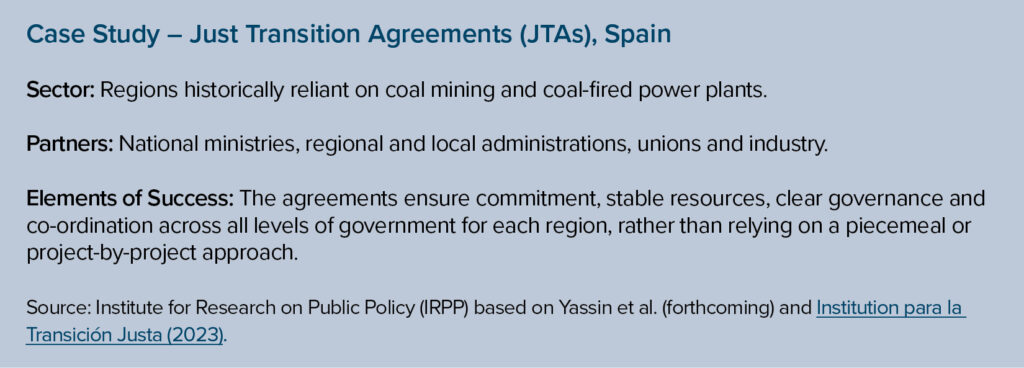
Because many proposed major projects will take place in and around rural or remote communities, governments can work with relevant organizations to ensure accessible skills training and tailored wrap-around social supports are in place. For communities that want it, these partnerships could form the basis of long-term, co-designed and co-led community transformation agreements (such as in the case study, “Just Transition Agreements [JTAs], Spain”).
The impact of economic disruption, including mass layoffs and major closures, extends far beyond the workers and companies directly impacted, extending to supply chains, local services, businesses, housing markets and families (see figure 4).
 Source: Institute for Research on Public Policy (IRPP) based on Dallaire-Fortier (2024).
Widespread job loss can impact the social and economic fabric of communities. Unemployment can increase mental health concerns. Workers that must commute to find replacement employment have less time for community engagement, which can chip away at social cohesion. Reduced household incomes due to job loss can impact revenues for local businesses and governments, and economic uncertainty can lead to a drop in home prices and deter investment in the local economy.
Rapid-response community support hubs would serve as a one-stop/single window in the acute phase of a major closure or mass layoff. Several service models already exist in Canada, including Community Transition Services in British Columbia and Protect Ontario Workers Employment Response Centres (POWER Centres) in Ontario.

The Community Transformation Fund would establish hubs where none exist and expand the scope, capacity and resources of partial models in provinces that already run comparable services. Upon activation, these hubs would deploy a package of both pre-set and locally adapted support, including early information sessions, prompt individual and personalized needs assessments, and wellness fairs to surface mental health, addictions, financial counselling and legal/tenancy needs. They could also co-ordinate with Community Futures Organizations to identify new employment and entrepreneurial opportunities. Staff can provide hands-on navigation to employment insurance and other longer-term income supports as well as provincial employment and training services. They can also make rapid referrals to housing and community services.
Industrial policy can help major employers adapt to structural change while strengthening the economic foundations of communities. Rural and Indigenous communities are likely to bear the brunt of economic transformations, yet they face different challenges and opportunities than urban centres. Canada’s industrial policy tools remain fragmented and project-driven, favouring large proponents with administrative capacity.

Indigenous communities, rural businesses and local governments often face barriers to accessing private or public capital because of limited scale, necessity for collateral or risk-sharing requirements. Place-based industrial policies can help overcome these barriers and tap into local knowledge, assets and networks while ensuring alignment with national goals (see figure 5).
 Source: Institute for Research on Public Policy (IRPP) based on Organisation for Economic Co-operation and Development (OECD) (2025).
IRPP profiles of select susceptible communities, based on local interviews, provide on-the-ground perspectives that show how co-ordinated industrial policy and follow through could make a real difference.
In Estevan, Saskatchewan, the community faces a possible eventual closure of two coal plants and a coal mine. Here, leaders are calling for a long-term co-ordinated response that leverages emerging projects, such as those related to nuclear power, battery material and renewable energy.
In Yellowknife, Northwest Territories, the closure of diamond mines before new critical-mineral mines come on stream could disrupt the local workforce in the absence of advance targeting planning. Territorial premiers have called for a 15 per cent top-up to the Mineral Exploration Tax Credit to accelerate investment and recognize the higher costs of exploration in the territories.
In Ingersoll, Ontario, the General Motors CAMI plant secured government support to transition to producing electric BrightDrop vans. In October 2025, GM announced it will end BrightDrop production at CAMI; the community’s prospects now hinge on securing a new product line or other new manufacturing opportunity.
In Sault Ste. Marie, Ontario, Algoma Steel is undergoing two major transformations. One is to switch to an electric arc furnace to reduce emissions and improve flexibility, while the other is to pivot to products that are in greater demand within Canada. Combining these investments with buy Canadian procurement policies and investments in enabling infrastructure (such as a new port) can boost product demand and protect jobs.

To help employers and workers in susceptible communities adapt to structural economic change, federal programs should incorporate a place-based lens into industrial policies, including tax credits, grants, procurement and loans. Major project investments should be linked to local skills, infrastructure and ownership opportunities. Governments should invest in local capacity-building so that communities with limited resources can participate in industrial planning and co-ordination. This approach aligns competitiveness with cohesion, ensuring that every major project creates lasting, inclusive value for the people and places that host it.
Effective community planning in an environment of economic change requires synthesizing complex and cross-sector information, including exposure to disruption across industries, demand forecasts for emerging occupations and skills, the capacity, accessibility and quality of local training pathways, documented outcomes and lessons from comparable communities, and the eligibility and take-up of support programs. Yet this information is fragmented across federal departments (ESDC, NRCan, ISED, etc.) and Statistics Canada surveys, which use distinct methodologies and definitions that are difficult to reconcile. Susceptible communities, which are often under-resourced and capacity-constrained, are left to navigate technical challenges and scattered data sources at a time when they need to focus on strategic economic transformation plans. Figure 6 summarizes these challenges and the key data co-ordination needs required to support communities.
 Source: Institute for Research on Public Policy (IRPP).
Without easy access to timely data, communities could face delayed action, misallocated investments and missed opportunities. As transition windows narrow, these outcomes compound by limiting the capacity and time available for proactive skills training, economic diversification and infrastructure planning — elements that are necessary to mitigate the effects of economic disruptions.
Co-ordinated synthesis and clear communication of user-oriented data are required. This includes integrating existing sources, harmonizing definitions and geographies, filling critical gaps (such as timeliness, local detail, program take-up and outcomes) and packaging information for community use. This co-ordination function falls outside the mandate of any single department and requires a cross-cutting lens focused on the data and planning needs of susceptible communities.
Modelled on the governance approach of the Canadian Centre for Energy Information, the Centre would serve as a one-stop public information hub to harmonize datasets, publish community-level data and dashboards, and provide navigation across federal and provincial programs.
Starting by integrating existing federal data using standard definitions and local geographies, the Centre can then phase in provincial, territorial, municipal and Indigenous information sources as partnerships develop. The Centre could also track outcomes and establish performance indicators to enable evidence-based policy evaluation and provide early signals — such as rising unemployment or falling home prices — for when a rapid response at the community level may be needed. This would ensure that investments are adjusted and reallocated toward approaches that demonstrate results on the ground.

Comparable international tools could illustrate the concept. For example, the U.S. Climate and Economic Justice Screening Tool (CEJST) helps federal agencies identify disadvantaged communities for Justice40 programs by combining eight burden categories into clear decision criteria for community investments. The tool was rescinded in January 2025 under the Trump administration. Europe’s Regional Green Transition Vulnerability Index provides a composite measure of European regions’ vulnerability to the socio-economic reconfigurations of the green transition. It distinguishes direct (e.g., fossil-fuel dependency, industry) and indirect (e.g., agriculture and land use, tourism, energy, transportation) impacts and assesses how regional environmental vulnerability relates to income distributions.
The Centre could also curate a living library of case studies, community planning playbooks, and national and international lessons to support local planning and enable cross-jurisdiction mentorship. It could create infrastructure for communities of practice, connecting communities facing similar challenges to share approaches and avoid reinventing solutions.
 |
Interactive online map of community susceptibility to the net-zero transition: This map visually represents communities across Canada that may be susceptible to workforce disruptions related to the low-carbon transformation. It is accompanied by a detailed methodology document that describes how the map was created. |
 |
Interactive online map of community susceptibility to U.S. tariffs: The IRPP created an interactive map and dashboard of community susceptibility to U.S. tariffs. The IRPP also published a commentary on ways Canada can reduce its vulnerability to these tariffs. |
 |
Policy briefs: These briefs explore various policy areas and tools, such as community-led economic development, place-based skills development, social supports, place-based industrial policy and employment insurance, where governments can support communities and workers through economic transformation. The briefs provide recommendations to various levels of government. |
 |
Community profiles: Ten communities across Canada were selected to be featured in more detailed profiles. These profiles offer a deeper understanding of the unique opportunities and challenges facing each community, and are informed by people who live and work in the community. So far, the IRPP has published profiles of Ingersoll, Ontario; Estevan, Saskatchewan; Cape Breton, Nova Scotia; Kitimat and Kitamaat Village, British Columbia; Yellowknife, Northwest Territories; and ChannelPort aux Basques, Newfoundland and Labrador. |
This commentary was prepared by the IRPP’s Community Transformations Project team. The manuscript was copy-edited by Prasanthi Vasanthakumar and proofread by Claire Lubell. Editorial co-ordination was by Étienne Tremblay, production was by Chantal Létourneau and art direction was by Anne Tremblay.
A French translation of this commentary is available on the IRPP website under the title Les gens et les lieux doivent être au cœur du plan d’action pour des emplois durables.
To cite this document:
Institute for Research on Public Policy. (2025). People and places should be at the centre of the Sustainable Jobs Action Plan. Institute for Research on Public Policy.