



| Location | France |
| Initiative | The Compte personnel de formation (“Personal Training Account”) |
| Program snapshot | The Compte personnel de formation is a quasi-universal system that encourages all French working-age adults to engage in lifelong learning and skills development as part of a national strategic plan for anticipating labour market changes, including changes resulting from the net-zero transition. Workers are credited with an annual training allocation in a personal account that is managed by the state but funded through mandatory employer levies. Credits in the account can be redeemed for certified training. The digital delivery platform is also starting to enable workers to document and certify their skills and training as well as develop personalized learning plans to anticipate future career changes. While not specific to so-called green-task jobs, at least one region has used the program infrastructure to incentivize retraining for high-priority occupations in the green economy. Available data do not permit any conclusions on the take-up of training related to net-zero transition occupations, nor do data permit analyses of relative participation by workers in sectors that are more or less exposed to the impacts of the net-zero carbon commitments made by the French government. However, the program infrastructure and data systems offer a national model for monitoring and influencing workers’ training decisions and their alignment with demand during the net-zero transition. |
| Sector focus | The Compte personnel de formation is not sector specific but is adaptable as a tool to promote green-task jobs. |
| Time frame | The Compte personnel de formation was launched in 2018, building on an older program, with programmatic updates since. |


| Location | Spain (regions historically reliant on coal mining and coal-fired power plants, such as Aragón, Castilla y León, Asturias, Andalusia, Galicia and the Basque Country) |
| Initiative | Spain’s Just Transition Strategy, including the Just Transition Agreements, Job Banks and Urgent Action Plan |
| Program snapshot | Spain’s Just Transition Strategy emerged to manage the phase-out of publicly subsidized coal production and coal-fired plants, in line with national and European climate goals. Designed to mitigate the impacts of decarbonization on coal-dependent communities, the strategy promotes employment creation, up-skilling and re-skilling and sustainable growth. Overseen by the Ministry for the Ecological Transition and the Demographic Challenge and the autonomous Instituto para la Transición Justa (“Just Transition Institute”), the strategy engages multiple partners, including Spanish regional governments, local authorities, trade unions, companies and the National Federation of Coal Mining Businesses. An Urgent Action Plan addresses immediate challenges in regions with closures of coal mines and coal and nuclear power plants. Tripartite agreements among governments, unions and companies have produced sectoral accords to guarantee compensation for lost jobs as well as new employment opportunities and vocational training, thereby maintaining local employment levels. Two Job Banks provide affected workers with advisory services, individual career counselling and priority hiring for site-restoration activities. Local business projects receive higher subsidies if they hire the Job Banks registrants. Complementary to the sectoral accords, Just Transition Agreements are place-based co-governance tools with extensive social participation. They ensure cross-government commitment and co-ordination at the national, regional and local levels, providing tailored, place-based support for economic diversification, thereby preserving employment and stabilizing rural populations. Currently, 15 agreements are in place. Funding comes from the European Commission’s Just Transition Fund, the Spanish government and the European Commission’s NextGenerationEU fund. |
| Sector focus | The focus is on coal regions, coal-fired power plants under closure and nuclear power plants without reconversion plans. |
| Time frame | The Just Transition Strategy was approved in February 2019, and the Just Transition Agreements were established in 2020. The Urgent Action Plan spans 2019-21 but remains active, continuing efforts in the 2018 Framework Agreement for a Just Transition for Coal Mining and the Sustainable Development of Mining Regions for the Period 2019-2027. Two Job Banks opened in 2019 and 2020; by 2021, their employment-improvement services were operational. As of 2023, a support plan for re-skilling and job placements was still under development. |

| Location | Harlow, Essex County, United Kingdom |
| Initiative | Harlow College’s Electric and Hybrid Vehicle Training Centre |
| Program snapshot | In 2022, the Essex County Council (the local authority governing Essex County) partnered with Harlow College (a local college serving over 4,500 learners) and the Harlow District Council (the local authority for the town of Harlow) to launch a pilot program to train local residents in electric vehicle and hybrid vehicle repair and maintenance. The program takes a proactive approach to skills development by equipping local residents, including youth and local practicing mechanics, with industry-recognized professional qualifications to meet emerging demand for the growing electric vehicle sector. During the Training Centre’s two-year pilot, a £100,000 investment from Essex County Council’s Levelling Up fund fully subsidized tuition for 50 new training spots. The pilot targeted smaller local employers who were least able to afford commercial training fees for their technicians. Since the Centre’s launch, over 200 trainees have participated in courses, ensuring local businesses can meet the growing demand for electric-vehicle-maintenance expertise as electric vehicle adoption continues to expand in the coming years. A secondary objective of the Training Centre is to serve as an accessible community space where residents can participate in workshops at the facility’s “live garage” to learn about electric and hybrid vehicles, helping build market demand over time. |
| Sector focus | The focus is on electric and hybrid vehicle aftermarket services and maintenance. |
| Time frame |
|

| Location | Michigan, United States |
| Initiative | Community and Worker Economic Transition Office and Michigan Works programs for unemployed working-age residents |
| Program snapshot | The Michigan Department of Labor and Economic Opportunity has created a new office to co-ordinate activities in support of the net-zero transition with a statewide mandate, rather than as a response to highly localized economic shocks from employment loss. However, the office was created without earmarked funding and must find ways to leverage existing resources, particularly from federal sources created by the Biden administration. As of the time of writing, funding under the Inflation Reduction Act, the Infrastructure Investment and Jobs Act, and the CHIPS and Science Act has all been paused. However, the Michigan Department of Labor also maintains the U.S.’s only state-wide integrated network of workforce development agencies, Michigan Works, that delivers federally funded workforce training and employment development programs, including career counselling, vouchers for skills training, apprenticeship programs and outreach to hard-to-serve populations. However, there is not, as yet evidence of collaboration between the two bodies. This case study highlights the challenges involved in adapting existing services and funding for transition-related goals, even when there is considerable place-based flexibility. |
| Sector focus | The Community and Worker Economic Transition Office focuses on the automotive and energy sectors because of Michigan’s longstanding concentration of automotive manufacturing and ancillary businesses. Michigan Works programs are not sector-specific and, instead, target eligible unemployed workers. |
| Time frame | Created by state legislation in November 2023, with service eligibility retroactive to 2020 and anticipated until 2040, determined at the municipal, county or regional level. Existing Michigan Works programs are ongoing, but the regional board for Detroit has developed a new strategic plan for 2024-27. |

| Location | Esbjerg, Denmark (North Sea coast) |
| Initiative | Offshore Academy |
| Program snapshot | Esbjerg is Denmark’s energy hub, historically focused on oil and gas. The Offshore Academy program aims to transition workers from this hub to offshore wind jobs to ensure that Denmark’s workforce is equipped with the skills needed to accommodate the expansion of wind power installations and exports, and to ensure that the local economy stays central to the country’s broader net-zero goals. Port Esbjerg is home to more than 200 companies that employ more than 10,000 people. The Offshore Academy is governed through a partnership between Port Esbjerg (a municipally-owned port authority), the United Federation of Workers (the largest Danish general workers union) and local learning institutions. The program is funded through public funds, the European Commission’s Just Transition Fund and private investments such as pension funds. It promotes the skills needed to grow the wind industry by providing local, paid training to oil and gas workers at the port, allowing them to smoothly transition to offshore wind without needing to relocate or forgo income. |
| Sector focus | The focus is on the energy sector, specifically the transition from offshore oil and gas to offshore wind and green hydrogen. |
| Time frame | The program has been in development since 2020. An agreement between Port Esbjerg and the United Federation of Workers took place in 2022 to establish the training facilities at the port. The program is currently active. |

| Location | Taranaki, New Zealand |
| Initiative | Taranaki 2050 Roadmap and 2025/26 Action Plan |
| Program snapshot | In 2019, Venture Taranaki, a local development agency, convened a wide-ranging social dialogue to support the Taranaki region’s transition away from oil and gas. The place-based co-design process identified local assets and economic opportunities, building community consensus and mobilizing stakeholders to act. The dialogue included iwi (the Māori term for ‘clan’), local and central governments, businesses, educators, unions, workers and other community members. As a result, the community-driven Taranaki 2050 Roadmap emerged, followed by an updated 2025/26 Action Plan. Several localized skills training and workforce development initiatives took shape, particularly targeting youth and Māori communities and focusing on growth sectors, such as renewable energy, conservation, food and fibre and tourism. Guided by a community-developed monitoring and evaluation framework, these programs support workers, preserve and create employment opportunities and diversify the regional economy. The overarching goal is a sustainable future that preserves Taranaki’s quality of life. |
| Sector focus | The focus is on the energy sector, specifically transitioning from oil and gas to broader and diversified economic development by leveraging local assets in sectors such as renewable energy, conservation, tourism and food and fibre. |
| Time frame | In 2017, three district councils (local authorities), the Taranaki Regional Council and Ngā Iwi o Taranaki (a collective of eight Māori tribes) released Tapuae Roa: Make Way for Taranaki, a document comprising a high-level regional economic development strategy. In 2019, Venture Taranaki released a detailed communityco- designed planning document called Taranaki 2050 Roadmap. In 2024, these efforts were updated and consolidated into the 2025/26 Action Plan. |

| Location | Australia |
| Initiative | Net Zero Economy Authority (NZEA) and Future Made in Australia (FMiA) Program |
| Program snapshot | NZEA is a new arms-length agency that is run by an independent board with legislated powers to identify regions where energy transitions will create employment disruptions and develop transition plans engaging affected firms, both those shedding jobs and alternative employers adding jobs. NZEA is initially targeting six regions in five Australian states facing energy and industrial transitions, potentially involving tens of thousands of affected workers. The initial goal is to facilitate a faster and smoother phase-out of fossil-fuel-fired electricity generation and related activities. The goal is to ensure that workers can transition from fossil-fuel-based activities to sustainable industries without dislocation or involuntary layoffs, while preserving the economic viability of regional communities. Over time, this approach may be expanded to other high-emission sectors. The agency is supported by a complementary suite of industrial policy programs under the FMiA with financial and regulatory resources to foster the growth of alternative employers in the affected regions. The FMiA, in turn, integrates actions by several federal government departments, co-ordinated through the Department of the Prime Minister and Cabinet. The activities of the NZEA and FMiA are complemented by an array of training and industrial policy initiatives, many involving partnership with state governments. |
| Sector focus | NZEA planning powers are targeted at the phase-out of fossil-fuel-fired electricity generation facilities, primarily coal and some natural gas, and closely associated suppliers, including coal mines. Regional transition plans will engage alternative employers in existing or emerging renewable energy, manufacturing, technology or transportation sectors. |
| Time frame | Legislation to establish the NZEA was passed in 2024 and the authority was established the same year. Legislation enabling various FMiA interventions was also passed in 2024. Both programs will run indefinitely. |
Global and Canadian efforts to reduce greenhouse gas emissions and shift away from fossil fuels have created a central policy question: How can workers, sectors and regions adapt and develop the skills needed for a low-carbon future?
Some communities will feel the impacts sooner and more severely, particularly smaller, rural or remote areas with high concentrations of employment in exposed sectors and limited local economic diversification.
Although Canada offers a broad menu of supports for training, employment insurance and regional economic development, many programs are designed for the general population rather than tailored to the needs of susceptible communities. Targeted, place-based interventions that integrate economic and workforce development can help address this gap. Skills training and workforce development are critical levers for enabling effective and equitable transitions. This joint IRPP–Future Skills Centre research study reviews eight international initiatives — from Australia, Denmark, France, New Zealand, Spain, the United Kingdom and the United States — that incorporate place-based approaches to skills training and workforce development designed to help workers stay in or close to their communities while gaining the skills they need for long-term employment. Viewed collectively, these case studies inform a comprehensive, unique-to-Canada framework for building workforce resilience in the net-zero transition. Each case highlights specific design choices, strategies, challenges and foundational elements that could be adapted to Canadian institutions and labour market realities.
For Canada, the lessons point to a practical path: identify susceptible communities using transparent indicators, and then governments can layer targeted strategic interventions — for example, training subsidies, infrastructure or economic development grants, targeted employer incentives and local employment services — in proportion to each community’s exposure and readiness. The forthcoming Sustainable Jobs Action Plan, mandated by the Canadian Sustainable Jobs Act, can incorporate these lessons by emphasizing robust co-ordination across orders of government and meaningful engagement with workers, unions, industry and Indigenous communities alongside investments in local capacity and policy certainty.
| ✔ Lesson 1 Consensus building and tripartite collaboration between government, industry and labour unions enable co-ordinated transition efforts. |
✔ Lesson 6 Participation of Indigenous Peoples and communities in transition planning and implementation is essential. |
| ✔ Lesson 2 Community involvement in transition planning builds local buy-in and resilience. |
✔ Lesson 7 Rural communities may require additional targeted supports to stabilize populations. |
| ✔ Lesson 3 Developing local, viable replacement industries before phasing out existing ones prevents community-level economic disruption. |
✔ Lesson 8 Mechanisms for continuous assessment and plan adaptation are essential to keeping strategies responsive. |
| ✔ Lesson 4 Proactively developing skills and leveraging transferable skills can smooth worker transitions. |
✔ Lesson 9 Workforce training harmonized with broader economic development plans is more effective. |
| ✔ Lesson 5 Robust targeted social supports mitigate transition risks for workers and communities. |
✔ Lesson 10 Technical, financial and administrative support is necessary to help communities with capacity constraints implement transition plans. |
Governments have shown a renewed interest in industrial policy in recent years as Canada navigates geopolitical tensions and trade uncertainty, along with long-term challenges such as the global energy transition. While Canada has a long history with industrial policy, robust and consistent evaluation practices are not always followed. This can perpetuate suboptimal policies and inhibit learning from successes and failures.
Canadian governments need a new and consistently applied evaluation framework for industrial policy. Too many evaluations focus on process and operational issues without considering the information needed for funding decisions. While there are methodological challenges in evaluating policy outcomes, modern approaches and tools offer promising avenues for progress.
The author recommends that governments:
The renewed interest in Canadian industrial policy should be accompanied by a renewed focus on sound evaluation practices. Governments need to break the cycle of disinterest in evaluation, given the scale of industrial policies and the risks involved. Robust evaluation practices are critical to the successful use of industrial policy to address Canada’s most pressing challenges.
Canada faces a series of overlapping headwinds. Global efforts to reduce emissions are reshaping cornerstone industries such as energy and manufacturing. Automation and artificial intelligence are redefining job tasks and skills requirements across sectors. A changing trade environment is compelling Canada to diversify beyond its largest partner. At the same time, Canadians are feeling increasingly precarious in the face of the rising cost of essentials, unaffordable and inaccessible housing, and job insecurity.
With any major economic transformation comes opportunities as well as risks. Some communities will be more susceptible to workforce disruptions, which can have ripple effects that touch every business and household. The prosperity and cohesion of the country will be, in large part, determined by how well the people and places shouldering the greatest risk can adapt to change and capture opportunities.
The Institute for Research on Public Policy’s Community Transformations Project has mapped community-level susceptibility to the net-zero transition and U.S. tariffs, and is in the process of assessing susceptibility to Chinese tariffs. Our research and analysis, which includes profiles of communities in Canada and a series of international case studies, show that place-based strategies are more likely to help build community resilience than one‑size‑fits‑all approaches.
The federal government can build a continuum — from rapid response to long-term renewal — that is practical, place-based and community-led, as well as co-designed and co-governed with local partners. This continuum hinges on four mutually reinforcing pillars — strategic, community-led economic development; proactive, co-ordinated skills development; responsive, community-wide social supports; and targeted, empowering place-based industrial policy — supported by a fifth pillar of data, evaluation and continuous learning that cuts across the others (see figure 1).
 Source: Institute for Research on Public Policy (IRPP).
Communities are not looking for top-down, one-size-fits-all plans for their economy or workforce, and they lack the resources to develop their own strategies. Nearly 10 per cent of the Canadian population lives in 68 communities that are susceptible to workforce disruptions as Canada, and the world, reduce greenhouse gas emissions. A subset of these communities is also susceptible to trade disruptions. These communities tend to be more rural or remote, and less economically diverse (see figure 2).
 Sources: Calculations by Institute for Research on Public Policy (IRPP) based on Statistics Canada’s Index of Remoteness (2023) and 2021 census data. For more information on the methodology used, see Chejfec et al. (2025).
Notes: Full-size figures and description of measures are available for Panel 2a and Panel 2b.
Whether they are already facing disruption, or worried about disruption in the decades to come, these communities are looking for plans that will secure their livelihoods, retain their young people and maintain their quality of life. Existing federal, provincial and territorial economic development programs provide some support but are not equipped to guide communities through large-scale economic and societal transformations. They also often lack adequate community engagement.

The federal government already has organizations on the ground in most susceptible communities. Community Futures Organizations (CFOs) are funded by Regional Development Agencies but governed by a board of community members. Right now, CFOs mainly support small businesses, but they could be expanded and resourced to:
A more proactive, co-ordinated and place-based approach to skills development that recognizes the unique challenges and opportunities facing each community can help build the resilience Canada needs as it faces global headwinds. Our analysis finds that 19 Canadian communities, accounting for roughly four per cent of the country’s labour force, are among the most susceptible to both the net-zero transition and U.S. tariffs (see figure 3).
 Sources: Institute for Research on Public Policy (IRPP) calculations based on Chejfec et al. (2025) and Chejfec (2025).
Notes: Susceptibility is based on underlying factors in the community, such as the concentration of employment in emissions-intensive or export-exposed sectors. It is not based on any current or anticipated future policy position in Canada or other countries. Analysis is based on 2021 data. Figure identifies the number of census divisions that scored in the top 10 per cent in at least one of the three metrics of susceptibility to net zero, and in the top 10 per cent by exposure to U.S. tariffs. For the purpose of the analysis, communities are defined as census divisions. The figure’s side panels identify the top subsectors susceptible to net zero and U.S. tariffs. According to Statistics Canada, economic sectors are denoted using two-digit North American Industry Classification System (NAICS) codes, and subsectors are groups of industry groups and correspond to three-digit codes.
Communities susceptible to the net-zero transition tend to have a higher share of workers over 55 years old, a greater proportion of Indigenous people in their workforces, and workers with less post-secondary education, on average, than those in non-susceptible communities. Businesses, particularly those in rural areas, continue to report skills shortages. And rural, remote and Indigenous communities struggle with barriers to training and education, with access to fewer learning institutions and inadequate internet. The onus for arranging and paying for adult training and education often falls on workers, while current employer-provided training typically targets younger, more educated, full-time employees.
Many government programs, including those offered through the Labour Market Development Agreements, focus on current unemployment instead of future opportunities. Services are often only available after job loss, with a focus of getting people back to work as soon as possible. At the same time, future-oriented programs tend to have a narrow focus on specific sectors. At the local level, learning options are not always connected to economic development plans or to capturing opportunities and community benefit from major projects.
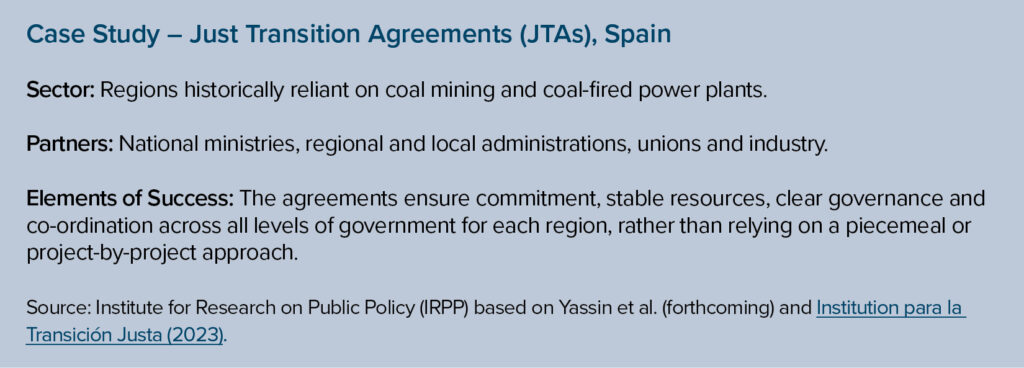
Because many proposed major projects will take place in and around rural or remote communities, governments can work with relevant organizations to ensure accessible skills training and tailored wrap-around social supports are in place. For communities that want it, these partnerships could form the basis of long-term, co-designed and co-led community transformation agreements (such as in the case study, “Just Transition Agreements [JTAs], Spain”).
The impact of economic disruption, including mass layoffs and major closures, extends far beyond the workers and companies directly impacted, extending to supply chains, local services, businesses, housing markets and families (see figure 4).
 Source: Institute for Research on Public Policy (IRPP) based on Dallaire-Fortier (2024).
Widespread job loss can impact the social and economic fabric of communities. Unemployment can increase mental health concerns. Workers that must commute to find replacement employment have less time for community engagement, which can chip away at social cohesion. Reduced household incomes due to job loss can impact revenues for local businesses and governments, and economic uncertainty can lead to a drop in home prices and deter investment in the local economy.
Rapid-response community support hubs would serve as a one-stop/single window in the acute phase of a major closure or mass layoff. Several service models already exist in Canada, including Community Transition Services in British Columbia and Protect Ontario Workers Employment Response Centres (POWER Centres) in Ontario.

The Community Transformation Fund would establish hubs where none exist and expand the scope, capacity and resources of partial models in provinces that already run comparable services. Upon activation, these hubs would deploy a package of both pre-set and locally adapted support, including early information sessions, prompt individual and personalized needs assessments, and wellness fairs to surface mental health, addictions, financial counselling and legal/tenancy needs. They could also co-ordinate with Community Futures Organizations to identify new employment and entrepreneurial opportunities. Staff can provide hands-on navigation to employment insurance and other longer-term income supports as well as provincial employment and training services. They can also make rapid referrals to housing and community services.
Industrial policy can help major employers adapt to structural change while strengthening the economic foundations of communities. Rural and Indigenous communities are likely to bear the brunt of economic transformations, yet they face different challenges and opportunities than urban centres. Canada’s industrial policy tools remain fragmented and project-driven, favouring large proponents with administrative capacity.

Indigenous communities, rural businesses and local governments often face barriers to accessing private or public capital because of limited scale, necessity for collateral or risk-sharing requirements. Place-based industrial policies can help overcome these barriers and tap into local knowledge, assets and networks while ensuring alignment with national goals (see figure 5).
 Source: Institute for Research on Public Policy (IRPP) based on Organisation for Economic Co-operation and Development (OECD) (2025).
IRPP profiles of select susceptible communities, based on local interviews, provide on-the-ground perspectives that show how co-ordinated industrial policy and follow through could make a real difference.
In Estevan, Saskatchewan, the community faces a possible eventual closure of two coal plants and a coal mine. Here, leaders are calling for a long-term co-ordinated response that leverages emerging projects, such as those related to nuclear power, battery material and renewable energy.
In Yellowknife, Northwest Territories, the closure of diamond mines before new critical-mineral mines come on stream could disrupt the local workforce in the absence of advance targeting planning. Territorial premiers have called for a 15 per cent top-up to the Mineral Exploration Tax Credit to accelerate investment and recognize the higher costs of exploration in the territories.
In Ingersoll, Ontario, the General Motors CAMI plant secured government support to transition to producing electric BrightDrop vans. In October 2025, GM announced it will end BrightDrop production at CAMI; the community’s prospects now hinge on securing a new product line or other new manufacturing opportunity.
In Sault Ste. Marie, Ontario, Algoma Steel is undergoing two major transformations. One is to switch to an electric arc furnace to reduce emissions and improve flexibility, while the other is to pivot to products that are in greater demand within Canada. Combining these investments with buy Canadian procurement policies and investments in enabling infrastructure (such as a new port) can boost product demand and protect jobs.

To help employers and workers in susceptible communities adapt to structural economic change, federal programs should incorporate a place-based lens into industrial policies, including tax credits, grants, procurement and loans. Major project investments should be linked to local skills, infrastructure and ownership opportunities. Governments should invest in local capacity-building so that communities with limited resources can participate in industrial planning and co-ordination. This approach aligns competitiveness with cohesion, ensuring that every major project creates lasting, inclusive value for the people and places that host it.
Effective community planning in an environment of economic change requires synthesizing complex and cross-sector information, including exposure to disruption across industries, demand forecasts for emerging occupations and skills, the capacity, accessibility and quality of local training pathways, documented outcomes and lessons from comparable communities, and the eligibility and take-up of support programs. Yet this information is fragmented across federal departments (ESDC, NRCan, ISED, etc.) and Statistics Canada surveys, which use distinct methodologies and definitions that are difficult to reconcile. Susceptible communities, which are often under-resourced and capacity-constrained, are left to navigate technical challenges and scattered data sources at a time when they need to focus on strategic economic transformation plans. Figure 6 summarizes these challenges and the key data co-ordination needs required to support communities.
 Source: Institute for Research on Public Policy (IRPP).
Without easy access to timely data, communities could face delayed action, misallocated investments and missed opportunities. As transition windows narrow, these outcomes compound by limiting the capacity and time available for proactive skills training, economic diversification and infrastructure planning — elements that are necessary to mitigate the effects of economic disruptions.
Co-ordinated synthesis and clear communication of user-oriented data are required. This includes integrating existing sources, harmonizing definitions and geographies, filling critical gaps (such as timeliness, local detail, program take-up and outcomes) and packaging information for community use. This co-ordination function falls outside the mandate of any single department and requires a cross-cutting lens focused on the data and planning needs of susceptible communities.
Modelled on the governance approach of the Canadian Centre for Energy Information, the Centre would serve as a one-stop public information hub to harmonize datasets, publish community-level data and dashboards, and provide navigation across federal and provincial programs.
Starting by integrating existing federal data using standard definitions and local geographies, the Centre can then phase in provincial, territorial, municipal and Indigenous information sources as partnerships develop. The Centre could also track outcomes and establish performance indicators to enable evidence-based policy evaluation and provide early signals — such as rising unemployment or falling home prices — for when a rapid response at the community level may be needed. This would ensure that investments are adjusted and reallocated toward approaches that demonstrate results on the ground.

Comparable international tools could illustrate the concept. For example, the U.S. Climate and Economic Justice Screening Tool (CEJST) helps federal agencies identify disadvantaged communities for Justice40 programs by combining eight burden categories into clear decision criteria for community investments. The tool was rescinded in January 2025 under the Trump administration. Europe’s Regional Green Transition Vulnerability Index provides a composite measure of European regions’ vulnerability to the socio-economic reconfigurations of the green transition. It distinguishes direct (e.g., fossil-fuel dependency, industry) and indirect (e.g., agriculture and land use, tourism, energy, transportation) impacts and assesses how regional environmental vulnerability relates to income distributions.
The Centre could also curate a living library of case studies, community planning playbooks, and national and international lessons to support local planning and enable cross-jurisdiction mentorship. It could create infrastructure for communities of practice, connecting communities facing similar challenges to share approaches and avoid reinventing solutions.
 |
Interactive online map of community susceptibility to the net-zero transition: This map visually represents communities across Canada that may be susceptible to workforce disruptions related to the low-carbon transformation. It is accompanied by a detailed methodology document that describes how the map was created. |
 |
Interactive online map of community susceptibility to U.S. tariffs: The IRPP created an interactive map and dashboard of community susceptibility to U.S. tariffs. The IRPP also published a commentary on ways Canada can reduce its vulnerability to these tariffs. |
 |
Policy briefs: These briefs explore various policy areas and tools, such as community-led economic development, place-based skills development, social supports, place-based industrial policy and employment insurance, where governments can support communities and workers through economic transformation. The briefs provide recommendations to various levels of government. |
 |
Community profiles: Ten communities across Canada were selected to be featured in more detailed profiles. These profiles offer a deeper understanding of the unique opportunities and challenges facing each community, and are informed by people who live and work in the community. So far, the IRPP has published profiles of Ingersoll, Ontario; Estevan, Saskatchewan; Cape Breton, Nova Scotia; Kitimat and Kitamaat Village, British Columbia; Yellowknife, Northwest Territories; and ChannelPort aux Basques, Newfoundland and Labrador. |