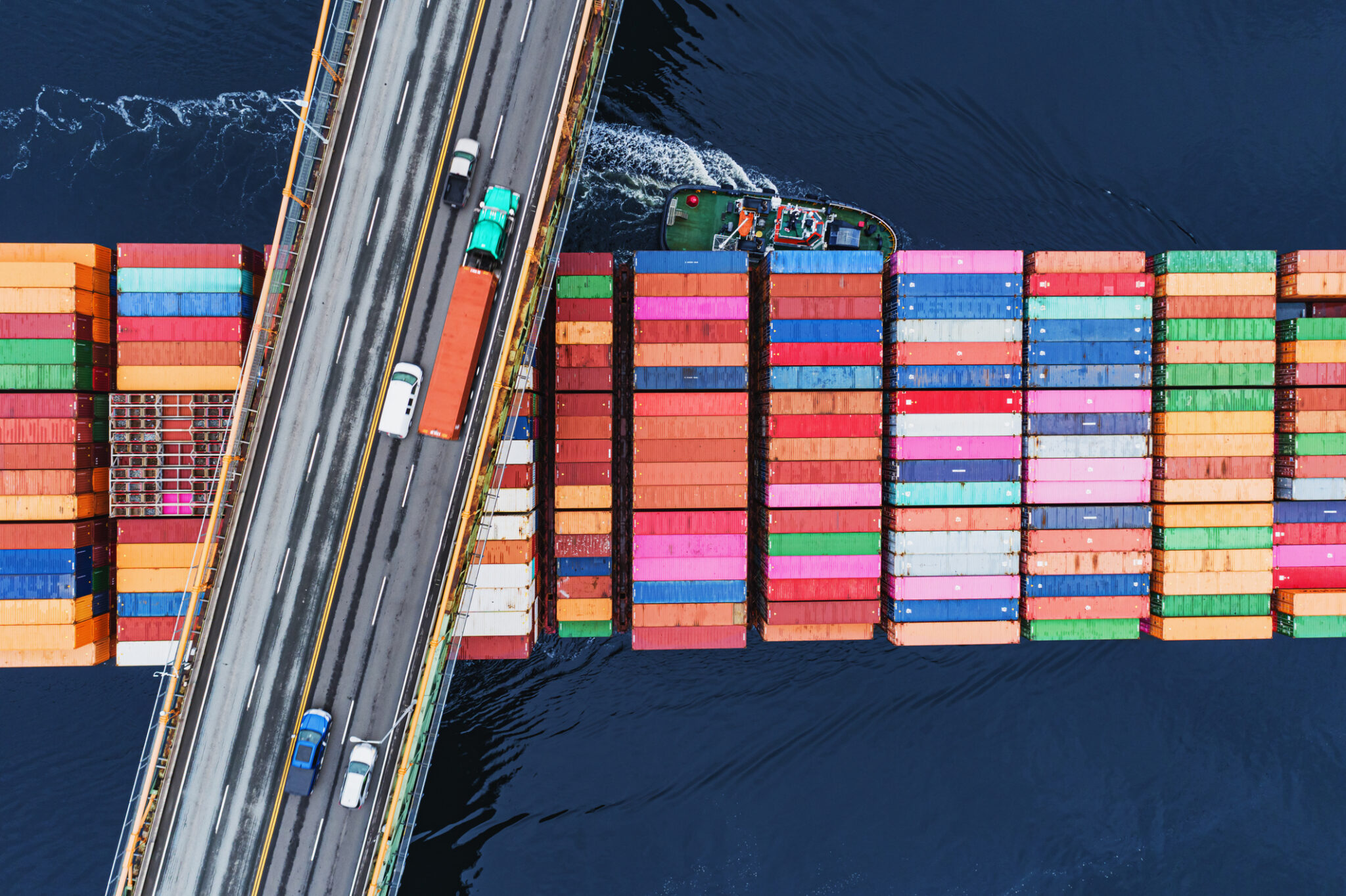
Diversifying Canada’s trade will be one of the most significant policy challenges for Canada over the coming decade. The extent to which we can successfully diversify will determine the trajectory of our country’s economic growth, the resilience of our sovereignty and the prosperity of our local communities.
In economics, the gravity model predicts that countries trade more with large, nearby economies. The gravitational pull of the U.S. – the world’s largest economy and Canada’s neighbour – is strong, which means government policy tools that help Canadian businesses defy gravity and expand into new markets will be increasingly important.
Those tools need to be carefully designed and grounded in rigorous analysis and evidence. Our research project aims to provide that analysis and evidence through collaborations with leading experts, and a series of research papers, commentaries, data dashboards and events.
Featured Publication

Amid U.S. President Donald Trump’s on-again-off-again trade war, trade diversification has been the talk of the town. But for a country like Canada, diversifying trade will be no easy feat. It also shouldn’t be the goal in and of itself. This paper explores the ultimate objectives of trade diversification; it presents a diversification plan, identifies what stands in the way of implementation, and proposes a pathway to develop policy solutions to overcome obstacles.

Stay Informed
Sign up to receive future publications, event invitations, and policy updates.

Chris Ragan, Rachel Samson

Webinar
October 6, 2026

Max Bell Foundation Senior Fellow at the IRPP

Vice-President, Research

Senior Research Director

Research Director

Research Associate

Research Associate

Research Associate

Max Bell Foundation Senior Fellow at the IRPP

Vice-President of Research at the IRPP
Vice-President and Chief Economist, Export Development Canada

Vice President of Policy and Advocacy, Council of Canadian Innovators

Vice-President, Research and Public Policy, Canadian Council for Indigenous Business

Professor, Balsillie School of International Affairs, Wilfrid Laurier University
Vice-President, Policy and External Affairs, Calgary Chamber of Commerce

Professor and Simon Reisman Chair in International Economic Policy, Carleton University’s Norman Paterson School of International Affairs

Chief Executive Officer and Chief Economist, Centre for the Study of Living Standards

Professor, Department of International Business, HEC Montreal

(Place-based and regional implications)
(Investment)

Institute for Research on Public Policy

Ricardo Chejfec

Rachel Samson, Ricardo Chejfec

Former research program

Panel Discussion
June 1, 2026
with Patricia Goff, Matthew Holmes and Steve Verheul

Max Bell Foundation Senior Fellow, IRPP
Christopher Ragan, PhD, is the founding director of McGill University’s Max Bell School of Public Policy. An economics professor at McGill since 1989, he has been a special advisor to the governor of the Bank of Canada, a Clifford Clark Visiting Economist at Finance Canada, the president of the Ottawa Economics Association, a member of the C.D. Howe Institute’s Monetary Policy Council, the chair of Canada’s Ecofiscal Commission and a member of the federal finance minister’s Advisory Council on Economic Growth.

Vice-President, Research
Rachel Samson is the vice-president of research at the Institute for Research on Public Policy, overseeing research on trade diversification, community transformations, industrial policy, affordability and other topics. Prior to her current role, she was the clean growth research director at the Canadian Climate Institute. Rachel also spent 15 years as an economist and executive with the federal government, and five years as an independent consultant.

Senior Research Director
Shaimaa Yassin is a senior research director at the Institute for Research on Public Policy. She leads the Toward a More Equitable Canada research program, which has published studies on affordability, including housing and other basic needs that intersect with climate and energy policy, food insecurity and income supports for lower income Canadians, and proposed dental care and pharmacare programs. She leads the IRPP’s role as a research and knowledge mobilization partner of the Affordability Action Council and also serves as a member. She also supports the IRPP’s Community Transformation Project. Shaimaa manages the IRPP’s postdoctoral fellowship program in support of Indigenous, Black and other racialized scholars.
She is a policy-oriented economist with over 15 years of experience in translating challenging academic research into strategic advice for a broad audience. A labour economist by training, her work focuses on identifying ways that governments can help lower costs of living, improve access to basic needs, enhance economic participation, increase income, and address barriers people face in capturing opportunities—particularly where labour market dynamics and skills intersect with issues of equity.
Previously, Shaimaa served as senior director at the Community Economic Development and Employability Corporation (CEDEC) in Montreal. Shaimaa has consulted for several governments and organizations such as the World Bank, Chaire “Sécurisation des Parcours Professionnels” in France, and the Economic Research Forum in Egypt. She was a research fellow in the economics department of several academic institutions, namely McGill University (Swiss National Science Foundation Fellow), the University of Lausanne and the University of Neuchâtel. She has an extensive record of publications, including peer-reviewed journal articles, the Les Accidents de Carrière book (Presses de Sciences Po, 2017) and chapters in edited volumes on labour markets in the Middle East and North Africa (Oxford University Press, 2014 and 2015). Shaimaa holds a PhD in economics from the University of Paris 1 Panthéon-Sorbonne and a MSc in empirical and theoretical economics from the Paris School of Economics.
Recent Publications and Projects by Shaimaa:

Research Director
Ricardo Chejfec is a research director at the IRPP, leading the Empowering Canada’s Workforce program. He also helps lead the Community Transformations Project, aimed at supporting workers and communities through the low-carbon workforce transformation, is involved in research examining the role of industrial policy in Canada’s next economic transformation, and is part of the secretariat of the Affordability Action Council.
As the former Lead Data Analyst, Ricardo spearheaded research and analysis for IRPP-authored publications, including Building a Package of Compromise Solutions for EI Reform and others in a series on Employment Insurance, as well as several policy briefs related to housing, transportation and food as part of the work of the Affordability Action Council. He also advises the research team on artificial intelligence, technology adoption, data analysis and visualization. He previously worked as a research associate and business analyst and holds a Bachelor of Arts and Science in cognitive science and a Master of Public Policy from McGill University.
Recent publications by Ricardo:

Research Associate
Dena Abtahi is a policy researcher with a Master of Public Policy from the University of Toronto, specializing in public health and energy transitions. At the IRPP, she supports the Community Transformations project, with a focus on rural post-secondary access, workforce resilience and regional fairness. Her previous work includes research on youth justice, Indigenous engagement and health equity. She has also published on long-term care, opioid policy and cystic fibrosis care models.

Research Associate
Nicolas Côté is a research associate at the IRPP, where he focuses on trade diversification and Canada’s economic resiliency. Before joining the Institute, he spent three years as a policy analyst at ECCC and NRCan, working on clean tech adoption, industrial policy, and behavioural science for climate action.
Prior to that, he held research roles on projects looking into new forms of climate communications and sociology of energy transitions. Most recently, his project Municipal Matters: Building Capacity for Local Climate Misinformation, examined how local governments across Canada can better communicate on climate issues in a frayed information environment.
Nicolas holds a Master of Public Policy from UBC, and a Master in Anthropology and Bachelor in Physics from the University of Toronto.

Research Associate
Georges Rigas is a research associate at the IRPP, where he focuses on trade diversification and economic resilience. Prior to joining the IRPP, he worked as a policy analyst in the federal public service, most recently at Global Affairs Canada, where he contributed to advancing Canada’s trade priorities in multilateral organizations. He holds a master’s degree in public and international affairs from the University of Ottawa, with a specialization in data analysis for public policy, and a bachelor’s degree in economics from McGill University. His research interests include international trade, economic policy and the application of quantitative methods to public policy analysis.

Vice-President and Chief Economist, Export Development Canada
Stuart Bergman joined Export Development Canada (EDC) in 2003 and has held various leadership positions, including vice-president of environmental, social and governance (ESG); deputy chief economist; director of the Economic and Political Intelligence Centre; director of corporate strategy; and director of the Research and Analysis Division. Stuart is responsible for overseeing EDC’s economic analysis and forecasting, global markets intelligence, and corporate research groups. In addition to advising EDC’s senior management and Board of Directors, Stuart is a featured speaker at conferences, international roundtables and policy forums. He regularly appears in television, radio and print media commenting on the world economy and Canadian international trade issues. He produces a widely circulated digital international trade commentary covering a range of global economic and business issues.

Vice President of Policy and Advocacy, Council of Canadian Innovators
Laurent Carbonneau is the Vice President of Policy and Advocacy at the Council of Canadian Innovators (CCI), where he leads the organization’s national policy agenda on behalf of Canada’s high-growth, Canadian-headquartered companies. At CCI, Laurent works directly with founders, CEOs, and policymakers to advance reforms that strengthen Canada’s innovation economy — including modernizing procurement, improving access to growth capital, strengthening intellectual property and data strategies, and ensuring government policies support the scale and global competitiveness of domestic firms. His work focuses on building the conditions for Canadian companies to grow, anchor their operations at home, and contribute to the country’s long-term economic resilience and sovereignty.
Prior to joining CCI, Laurent worked in federal politics in legislative, policy, and issues management roles for a senior Member of Parliament, in the NDP leaders office, and on a national campaign. He later led government relations in the post-secondary sector, advancing national policy priorities related to talent, research, and innovation.
Laurent holds a master’s degree in Political Management from Carleton University and a master’s degree in History from the University of St Andrews. He earned his BA from Mount Allison University and is based in Ottawa.

Vice-President, Research and Public Policy, Canadian Council for Indigenous Business
Matthew Foss is a member of the Metis Nation of Alberta. He brings over 25 years of public policy experience, specializing in energy economics along with research and public policy development. Mr. Foss currently serves as the Vice President of Research & Public Policy for the Canadian Council for Indigenous Business, is a Member of the Board for the Canada Energy Regulator, serves on the Indigenous Advisory Circle for Social Sciences and Humanities Research Council and is an Executive Fellow at the University of Calgary School of Public Policy.
Matthew’s focus at the CCIB is on advancing Indigenous business through research and advocacy related to procurement, international trade, celebrating Indigenous entrepreneurs and natural resource development. Matthew has frequently provided seminars and presentations to domestic and international audiences and has taught university-level economics courses. Prior to joining CCIB, he ran his own energy economics and public policy consulting business for several years and served as the Chief Energy Economist for the Alberta Government.

Professor, Balsillie School of International Affairs, Wilfrid Laurier University
Patricia Goff is a professor in the Department of Political Science at Wilfrid Laurier University and at the Balsillie School of International Affairs. She has held visiting positions at the Graduate Institute of International and Development Studies in Geneva and the University of Southern California’s School of International Relations. She has published widely on the politics of trade, with a special focus on the intersection of trade and culture. Recent publications include Trade and Culture: The Ongoing Debate (Routledge Press) and The Multilevel Politics of Trade (with Jörg Broschek, University of Toronto Press).

Vice-President, Policy and External Affairs, Calgary Chamber of Commerce
Ruhee Ismail-Teja is an executive leader in public affairs and economic policy, with cross-sector experience spanning private, public and non-profit sectors. Ruhee currently serves as Vice President, Policy and External Affairs at the Calgary Chamber of Commerce, where she leads the Chamber’s public affairs portfolio, including government relations and advocacy, public policy and thought leadership, media and external relations, Indigenous reconciliation, and inclusion, diversity, equity and accessibility initiatives. Prior to this role, Ruhee has worked in the upstream energy industry, post-secondary sector, and contracted with government.
She currently serves on the Werklund Centre (formerly Arts Commons) Board of Directors, Run Calgary Board of Directors and McGill University’s Max Bell School of Public Policy Advisory Board. She has previously served on the YMCA Canada Board of Directors, ParticipACTION Board of Directors, the SAIT Board of Governors and the Queen’s University AMS Board of Directors.
She holds a Master of Public Policy from McGill University’s Max Bell School of Public Policy, a Bachelor of Science (Honours) from Queen’s University and a Governance Essentials Certificate from the Institute of Corporate Directors.

Professor and Simon Reisman Chair in International Economic Policy, Carleton University’s Norman Paterson School of International Affairs

Meredith Lilly, Ph.D., is a full Professor and Simon Reisman Chair in International Economic Policy at Carleton University’s Norman Paterson School of International Affairs. Her research focuses on North American trade relations, Canada’s trade diversification strategy, economic sanctions, and the use of research evidence in policy making. Prior to her appointment at Carleton, she served as Foreign Affairs and International Trade Advisor to Canadian Prime Minister Stephen Harper. She was previously appointed at the University of British Columbia Okanagan, and has worked in policy roles in several Canadian government departments. She engages regularly with foreign governments and diplomats, and is a frequent media commentator on North American trade issues.
She is a member of CD Howe Institute’s International Economic Policy Council, a non-resident scholar at Rice University’s Baker Institute for Public Policy in Texas, an Advisory Board member for the Canadian Global Affairs Institute, a Senior Fellow at the Centre for Strategic Statecraft, and serves as the Academic Partner for Canada’s delegation to the North American Forum.

Chief Executive Officer and Chief Economist, Centre for the Study of Living Standards
Stephen Tapp is the CEO and chief economist at the Centre for the Study of Living Standards. He previously served as the chief economist and senior vice-president of research, data and analytics at the Canadian Chamber of Commerce, where he launched and managed the Business Data Lab.
Stephen is the president of the Canadian Association for Business Economics and a member of the Canadian Statistics Advisory Council. He has 25 years of diverse experience at many of Canada’s top economic organizations, including Export Development Canada, where he served as deputy chief economist; the Bank of Canada; the Parliamentary Budget Office; and Finance Canada. He has also worked with academia and think tanks, such as the Institute for Research on Public Policy and the C.D. Howe Institute.

Professor, Department of International Business, HEC Montreal
Ari Van Assche (PhD in Economics, University of Hawaii at Manoa) is full professor in international business and co-director of the International Institute of Economic Diplomacy at HEC Montreal. He is a senior fellow at the Centre for Strategic Statecraft, editor-in-chief of the Journal of International Business Policy, a visiting professor at the University of Leeds, a fellow at the Academy of International Business, a research fellow at CIRANO, and a fellow-in-residence at the C.D. Howe Institute. He specializes in the organization of global value chains and their implications for public policy.

Doctoral Candidate in Economics, Oxford University
Jacob Greenspon is the Research Manager at the Harvard Kennedy School Reimagining the Economy Project and a Doctoral Candidate in Economics at the University of Oxford. He has previously served as a consultant on energy transition research at Resources for the Future and the World Bank and worked as an economist at several think tanks and government organizations in Canada and the US. He holds a Master in Public Policy from the Harvard Kennedy School of Government, a MA in Economics from Queen’s University, and a BA in Economics and Political Science from McGill University

Chief economist, Momentus Global
Glen Hodgson has more than 40 years of experience in global macro-economics, international finance, fiscal policy and climate policy. Glen’s career has spanned time at the Canadian Department of Finance, the International Monetary Fund in Washington D.C., Export Development Canada and the Conference Board of Canada, where he was senior vice-president and chief economist for more than a decade. His current affiliations include chief economist with Momentus Global, and senior fellow at the C.D. Howe Institute. He is a graduate of McGill University (MA and PhD candidate in economics, 1981) and the University of Manitoba (BA Honours, 1978).