



Amid U.S. President Donald Trump’s on-again-off-again trade war, trade diversification has been the talk of the town. But for a country like Canada, which has long felt the gravitational pull of the enormous U.S. market, diversifying trade will be no easy feat. It also shouldn’t be the goal in and of itself. As the first part of the IRPP’s new multi-year research initiative, this paper explores the ultimate objectives of trade diversification. It presents a diversification plan, identifies what stands in the way of implementation, and proposes a pathway to develop policy solutions to overcome obstacles.
Economic theory uses a gravity model, inspired by Newton’s law of gravity, to explain and predict bilateral trade flows between countries, based primarily on the size of GDP and the geographic distance that separates them. In simple terms, trade is more likely between countries with large economies that are close together.
Canada has been in the trade orbit of the United States since before Confederation in 1867, in large part due to the sheer size of the U.S. economy and its proximity. With the creation of pacts and free trade agreements, our two economies have become more intertwined over time.
No wonder many view U.S. President Donald Trump’s tariffs as an existential crisis. It’s why trade diversification has risen to the top of the policy agenda. And on the face of it, diversification, led by the creation of more free trade agreements with more countries, seems like the obvious solution.
But is it really that simple? To answer this question, the Institute for Research on Public Policy (IRPP) is launching a multi-year research project, of which this paper is the first step.
This paper lays out how trade diversification is more complex than meets the eye. It can improve our economic fortunes if it focuses on four key objectives:
Today, we’re a long way from diversification. Our exports and imports are concentrated in a few industries. The bulk of our trade is with the United States. And large flows of investment between Canada and the United States further cement the trade corridors between our two countries.
The status quo underscores the, pardon the pun, gravity of the situation. To counter the economic pull of the United States, we present a four-point trade diversification plan:
This plan can bring many benefits, but it comes with challenges. Because most international trade occurs within the private sector, businesses have to be the primary drivers of this change. However, they must first cross a veritable obstacle course.
Here are some of the roadblocks we have heard about so far:
Governments can shape public policy to help businesses overcome obstacles. This might mean revisiting existing policies or developing new tools. It might mean governments providing more comprehensive trade information to businesses as a public good, perhaps through the Canadian Trade Commissioner Service. It could entail enacting policies that de-risk business expansion. It might also mean helping companies enter new markets. These are some of the areas that the IRPP Defying Gravity research project will explore.
For Canada, trade diversification will be a marathon, not a sprint — only an evidence-based, collaborative effort can get us across the finish line. Our long-term prosperity and sovereignty will depend on getting it right.
The 2024 re-election of U.S. President Donald Trump and the subsequent wave of tariffs and threats against Canada have pushed trade diversification to the forefront of policy priorities. While trade diversification has long been debated in this country, reducing the vulnerability of Canadian prosperity to economic and policy shocks from the United States has become an urgent priority. President Trump’s threats to use economic force to make Canada the 51st U.S. state, or at least to bend the Canadian government to his will, have made it clear that diversifying trade is not just an economic priority but imperative to protect Canada’s sovereignty and national security.
Yet there are many unanswered questions. What precisely is meant by greater trade diversification? Is the quest for more diversification about trading our current mix of goods and services with different countries, trading a different collection of goods and services, or producing at home more of those things we currently import from abroad? How much more diversification does Canada need, and what are the metrics to gauge success? What challenges must be overcome? Are there risks associated with increasing our reliance on certain markets? Can a stronger relationship with the EU help to address Canada’s diversification challenge?
At first blush, the case for greater trade diversification may seem obvious and the way to achieve it clear: the federal government can lead the way by creating more free trade agreements and then Canadian businesses can expand their exports into currently untapped markets. But diversifying trade carries costs, not only directly but through the economic gains we would sacrifice by deviating from our traditional trading patterns. While it is easy to focus on the benefits of diversification when our prosperity is actively tested, our policy actions need to measure the obstacles and potential losses on a much larger horizon.
To explore the obstacles and potential policy responses in more detail, the Institute for Research on Public Policy (IRPP) is launching a multi-year research initiative titled Defying Gravity: Diversifying Canada’s Trade.
Here we begin the discussion by presenting the economic case for diversifying Canada’s trade and describing some of the natural economic forces working in opposition. This paper also lays out many questions and issues we will examine over the course of our research. While, at this stage of the project, we have more questions than answers, we plan to work intensively in the coming months to better understand and articulate the most promising opportunities for trade diversification, the barriers businesses face in capturing them and the policies governments can use to move the dial.
This paper is organized as follows. The next section describes four broad policy objectives that can be achieved, at least in part, through greater trade diversification. We then provide a brief review of Canada’s current trade patterns, focusing on our main trading partners, trading sectors and the role of foreign investment. After that, we explain why increasing our trade diversification will encounter many obstacles; we also provide a preliminary list of these roadblocks. The final section offers our concluding thoughts and considerations for the path ahead.
The federal government is aiming to double the value of exports to non-U.S. markets by 2035. But is this enough to improve Canada’s economic resilience? If the goal is achieved primarily by shifting our exports to another single partner, like China, are we actually better off? Should we focus on moving our major exports, such as oil and automobiles, away from the United States and toward other markets? Or should we try to expand our exports of other products?
In our view, it helps to begin with first principles. The ultimate policy goal should not be greater trade diversification itself. Instead, the objective of public policy should be to enhance the economic standard of living of current and future generations of Canadians. In today’s more complicated and challenging geopolitical context, however, it is no longer enough for Canadians to have higher incomes. The country will also need to improve its economic and workforce resilience to shocks, strengthen its resilience to sovereign threats, and capture opportunities amid global structural change. Let’s examine these objectives in more detail.
Economists often use the term “material living standards” to describe this objective and rely on some measure of average real income, thereby focusing on the typical Canadian’s command over the resources available to purchase the essential and discretionary items of daily life. Quality of life does not hinge solely on income, of course, but raising average income is one of the best ways governments can raise their citizens’ well-being (see box 1).

Perhaps surprisingly, there is no perfect measure of average Canadian income, although commonly used measures include real per capita GDP, median real incomes and average real wages. Whatever the precise measure considered, it is clear that rising average real incomes make it easier to address our economic and social challenges, whether these involve affording the costs of daily private life, redistributing resources toward lower-income households, or financing greater public spending on education, health care and other public priorities.
Especially in recent years, there has been considerable concern about slow Canadian income growth and widening income gaps between Canada and other advanced economies, particularly the United States. Donald Wright (2025), a former senior government official, argues that the sluggish growth in real incomes amounts to a broken promise to young Canadians. To support his point, he emphasizes measures of average real wages and real median incomes and shows that both have grown much more slowly since the mid-1970s than in earlier decades. Selected groups, especially young men between the ages of 24 and 35, have experienced an outright decline in real employment earnings over the past four decades.
We also know the incomes of Indigenous Peoples in Canada continue to fall below those of the non-Indigenous population (Indigenous Services Canada, 2023). Additionally, certain regions and communities in Canada experience greater levels of income disparity than others (Weaver et al., 2023). Though public policies are often motivated by the desire to raise average real incomes, it is equally important to consider ways to close income gaps across groups of people and regions.
Some aspects of trade diversification, such as securing adequate and reliable supplies of vaccines or military equipment, may involve broader goals beyond raising average incomes. But those are also areas that may need heavy government intervention to overcome the difficulties associated with convincing public institutions, businesses and private investors to pursue trade and supply chain diversification. Our focus will therefore be on what is likely the trickier part of the challenge: diversifying Canada’s trade in a way that increases average incomes for Canadians over the course of the next several decades.
One key aspect of improving Canadians’ standard of living is limiting the impact of economic shocks that can lead real incomes to fall or to grow more slowly. Shocks can come from economic downturns in our trading partners, declines in the international prices of our exports, technological change, disruptions in critical supply chains and higher foreign tariffs on Canadian exports. We may be unable to prevent these shocks from occurring, but we can influence the way our economy and incomes are affected. In this vein, building economic and workforce resilience is key.
Resilience sounds like an attractive feature for an economy, but what does a more resilient economy look like, and how is it achieved?
Having a more resilient Canadian economy means that, when large negative shocks occur, a significant proportion of businesses and workers can adjust their activities relatively easily to replace their production and employment income. Completely avoiding a decline in income caused by the shock would be too much to expect for all businesses, but greater resilience means the income and employment loss will be smaller and of shorter duration at the national and regional level than would otherwise be the case (figure 1).

As for businesses confronting such shocks, those that are resilient can more easily change their product mix, switching away from products with falling demand and toward others where demand is still robust. Resilient businesses can adjust their participation in domestic or global supply chains by switching to more reliable suppliers when shocks threaten to disrupt their access to key inputs. Resilient businesses can also redirect their sales away from markets with diminished profitability and toward those with more promising profit opportunities.
Greater economic resilience also involves workers and their labour markets. Resilient workers are more willing and able to shift to attractive businesses or economic sectors when shocks occur. In some cases, workers will need new skills to make these occupational adjustments (Oschinski & Tobin, 2026). Failure to relocate and/or retrain will usually result in an extended period of unemployment and lower income in the face of negative shocks; greater resilience will mean shorter spells of unemployment and less lost income as workers adjust more quickly to their changed circumstances.

Ideally, workers will be able to stay in or near their community when shocks occur, limiting societal and economic disruption. If local businesses can adapt to changing circumstances and local economies are sufficiently diverse, it is more likely that workers will not have to move, thereby avoiding cascading community-wide impacts (Yassin et al., 2026). Building community resilience is therefore a critical element of overall resilience (Samson & Chejfec, 2025).
A focus on enhancing economic resilience may lead to a different policy approach to trade diversification — one that goes beyond simply expanding Canada’s non-U.S. exports. If a sector or business can pivot quickly in the face of a shock, achieving a near-term policy goal on exports to non-U.S. countries may be less relevant. However, if it would be extremely difficult for a sector or business to pivot — and devastating to workers and communities if a shock were to occur — there is a stronger rationale for emphasizing growth in non-U.S. export opportunities.
President Donald Trump’s open threats against the territorial integrity of Canada and Greenland, combined with other global threats to geopolitical stability, have revealed Canada’s challenging position in navigating its trade diversification goals.
In his January 2026 speech to the World Economic Forum in Davos, Prime Minister Mark Carney said, “More recently, great powers have begun using economic integration as weapons, tariffs as leverage, financial infrastructure as coercion, and supply chains as vulnerabilities to be exploited” (Prime Minister of Canada, 2026a, para. 22). This applies not only to the United States, but also to China, which has used tariffs on Canada and export controls of certain critical minerals as leverage in trade negotiations (Anderson & Shi, 2026; Chejfec, 2026).
Of course, concerns about Canadian sovereignty are as old as our country — sovereignty played a central motivation for Confederation in 1867, when British North American colonies determined that their future would be more secure if they banded together rather than individually facing the threat of absorption by an expansionist United States. Worries about sovereignty ebbed and flowed in the subsequent decades. By the end of the Second World War and for several decades thereafter, Canadians rarely gave much thought to their sovereign claims, secure in the knowledge that their participation in NATO, and their proximity to and close friendship with the world’s largest military power, freed them to devote their minds to other things. But those halcyon days are now over.
It is now clear that trade policy — in addition to foreign and defence policies — must be a central consideration for ensuring Canadian sovereignty. Enhancing Canada’s sovereignty and national security will be a broad and complex project, including military preparedness, coalition-building with allies, shared supply chains for crucial military equipment, and a careful balancing of geopolitical tensions and opportunities through effective international diplomacy.
For the purposes of this paper, however, we focus on the role that enhancing our economic structure and performance can play in building resilience to threats to Canada’s sovereignty. After all, President Trump did threaten to use economic — rather than military — force to press Canada into becoming the 51st U.S. state (Samuels, 2025). China is also quick to impose trade restrictions when countries take actions not supported by the Chinese Communist Party, and so improvements in our economic resilience can pay off in this dimension as well (Reynolds & Goodman, 2023).
A focus on resilience to economic coercion could also lead to an approach to trade diversification more complex than simply expanding our non-U.S. trade. If Canada shifts toward China exports that are currently going to the United States, we could be trading one type of sovereignty risk for another. Strengthening trade ties with our long-time allies, such as the European Union, other G7 countries and NATO members, may be more prudent and might also help provide greater collective power to resist coercion.
As Canada rethinks its approach to international trade, five major structural changes are occurring in the global economy, which carry both risks and opportunities.
First, a global energy transition is well underway. Massive cost declines in wind and solar power over the past two decades have driven their enormous growth in generating capacity. A related phenomenon is the growing overall demand for electricity and the increasing adoption of electric vehicles (International Energy Agency, 2026a). These changes represent threats to some existing economic sectors and opportunities for others.
Second, the development and adoption of artificial intelligence are accelerating. In the process, business models are being upended and jobs are being threatened in many occupations and sectors (McKinsey & Company, 2025; Oschinski & Walia, 2025).
Third, the aging population in many advanced economies is putting fiscal pressure on governments due to rising health-care and elderly-support expenditures (International Monetary Fund, 2025). Demographic shifts are also transforming consumption patterns and increasing demand for health technology and products.
Fourth, the NATO commitment to increasing defence and security spending to five per cent of GDP by 2035 will significantly raise demand for military equipment, technologies and related areas such as infrastructure and cybersecurity. Military expenditures for NATO member countries are expected to rise from around US$1.5 trillion in 2024 to almost US$4.2 trillion by 2035 (Tian et al., 2025).
Finally, demand for critical minerals is expected to accelerate dramatically over the coming decades, with growing demand for clean electricity and batteries. This trend is driven by both the energy transition and the increasing use of drones and other electrified equipment in national defence (International Energy Agency, 2026b).
These major global shifts must be factored into any Canadian strategy aimed at increasing our trade diversification. Canada may be able to tap into these global trends, expanding exports in growing and emerging markets and enhancing the reliability of critical imports from stable allies. Investments in sectors where demand is expected to decline over the course of the century may also present a greater risk.
Canadian policy discussions about international trade have evolved markedly in recent years, and for good reason. For roughly half a century following the Second World War, Canadian trade policy (and that in many countries) focused on achieving greater trade liberalization and the benefits it would deliver to average real incomes. During those years, an emphasis on expanded trade with the United States — the world’s largest and most dynamic economy — made considerable sense. The federal government also expanded trade agreements with countries around the world, but the proportion of Canadian merchandise exports going to the United States declined only modestly, dropping from about 84 per cent in 2001 to about 77 per cent in 2024 (Grantham, 2025).
Today, however, with protectionist and other threats coming from our largest trading partner, the national discussion in Canada has shifted. It now includes a greater focus on resilience to threats to our economy, incomes and sovereignty, and capturing opportunities amid structural change. This means the traditional focus on the economic benefits from trade and specialization will also need to shift.
To achieve the goals outlined in the previous section, Canada needs to make progress on two fronts.
First, we must diversify critical supply chains by increasing domestic production and expanding international sources of some key goods and services. Relying on imports from a small number of countries increases our vulnerability to supply disruptions.
Second, we need to export a wider range of products, develop relationships with new trading partners, and better participate in global supply chains to improve our economic resilience and capture new market opportunities.
Making progress in these areas may involve important trade-offs: in particular, Canadians may need to sacrifice some economic benefits traditionally associated with specialization and trade in return for the greater security of supply from more domestic production and the intentional building of redundancies into our supply chains. Policy discussions about trade diversification must also begin with a reminder of why trade is important, and why trade with the United States has been so convenient and advantageous.
Canada’s economic prosperity, as reflected by the average real income of its citizens, has relied for decades on access to global markets. We export Canadian products abroad, and we import foreign products here, either for consumer use or as intermediate inputs that businesses need to produce things, including our exports. What are the sources of these gains from trade?
Economic theory dictates that, in aggregate terms, all countries receive economic benefits from international trade. Countries gain from exporting products they are especially good at producing while importing products that are better and more cheaply produced elsewhere. These are the familiar gains from international trade associated with patterns of comparative advantage, an idea first developed by David Ricardo over 200 years ago and still highly relevant today (Ricardo, 1817). These trade gains apply to countries of any size. However, countries with smaller populations typically receive proportionately larger gains from trade than do countries with larger populations, which tend to have more diversified economies that rely proportionately less on international trade.
International trade is especially important for Canadians’ prosperity because, in the absence of access to large foreign markets, we would be forced to produce everything we use at a small scale. For many products, this smaller scale of production would result in much higher unit costs. In contrast, access to foreign markets allows us to produce our exports on a large scale, even though we consume only a fraction of these goods at home, while avoiding altogether the small-scale and high-cost production of those things we can import from abroad. In other words, access to foreign markets lowers Canadian production costs and raises overall productivity. This higher productivity is an important long-run determinant of our rising average incomes. Melitz and Trefler (2012) identify these benefits as an important aspect of Canada’s gains from trade with the United States.
The result of Canada’s decades-long embrace of global markets is that it is today a major trading country, with about one third of its national income coming from exports (Finance Canada, 2025). Canada’s considerable openness to global trade partly explains why we are roughly the 10th-largest economy in terms of GDP with only the 38th-largest population (World Bank Group, n.d.-a, n.d.-b).
As Canada seeks to diversify trade, it will be important to retain — to the greatest extent possible — the benefits we have gained over the past decades. For certain exports, it may make sense to maintain a focus on the U.S. market. And for certain imports, it may be wise to remain focused on sourcing lower-cost inputs that support competitiveness and affordability. This renders the calculation of what makes sense for trade diversification more complex than aggregate, national export numbers. It requires a careful balance between the efficiency and cost-effectiveness of unfettered trade flows, and the very real need to limit our economic dependency on the United States and — in some cases — China (Ruhl, 2026).
An interesting feature of the Canadian economy is that, although overall economic production is highly diversified, our trade patterns are much less diversified with respect to the industry mix of imports and exports. Figure 2 shows 2024 data on real GDP and trade for seven categories of the largest goods- and service-producing sectors, where categories are ranked according to their share of total export value. A few important points emerge.
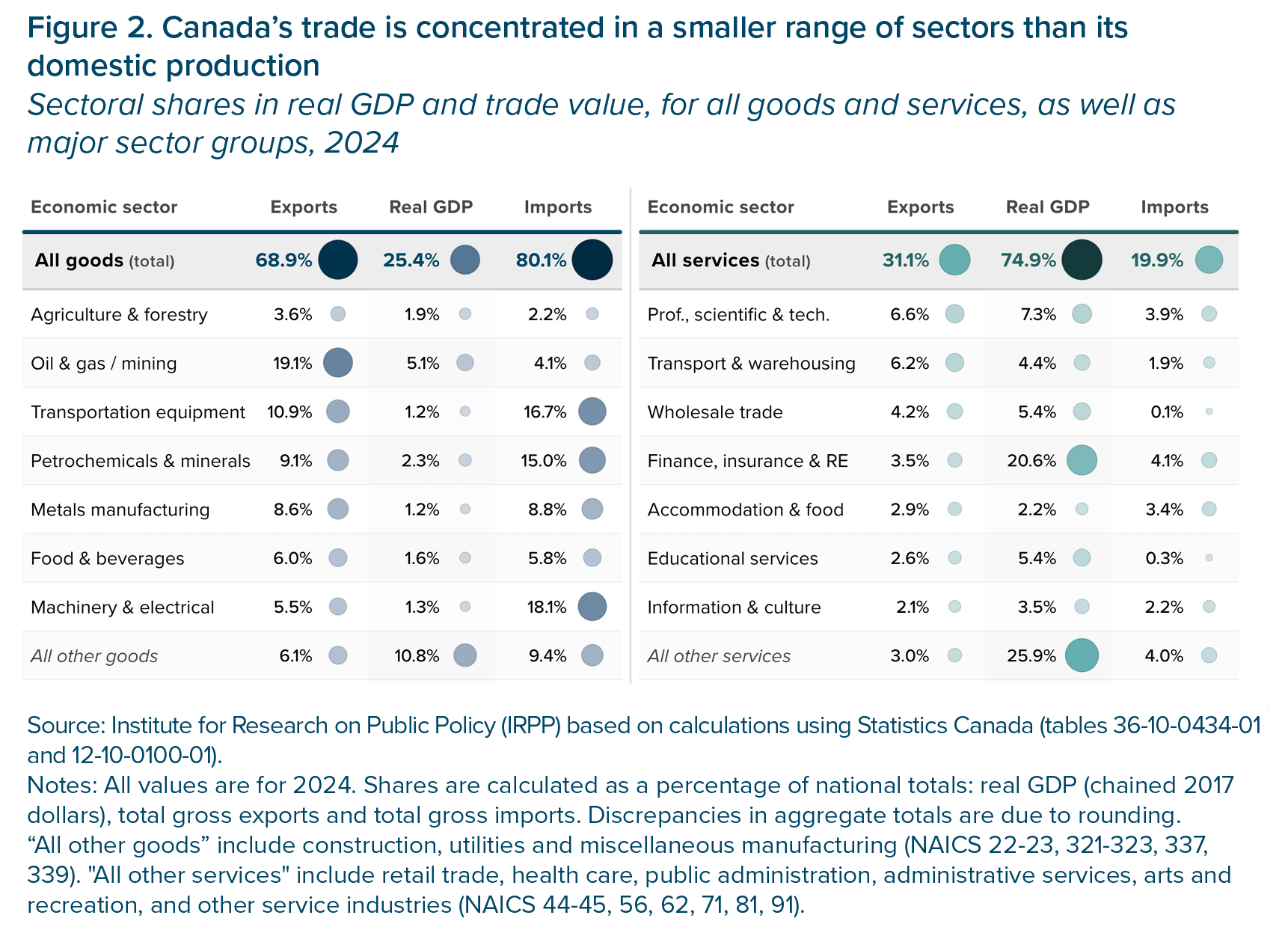
First, as is the case for most advanced economies today, the production of services represents well over half of national GDP; in Canada’s case, services production is almost 75 per cent of GDP while goods production accounts for just over 25 per cent. Yet these sectors’ representation in international trade is almost exactly inverted, with goods accounting for about three-quarters of the value of our total trade while services make up only about one-quarter.
This pattern itself is not surprising. Goods constitute a large majority of exports in most advanced economies, partly because many services are aimed at the local market or difficult to trade. In addition, many exported goods have a large service component that is embedded in their value as an intermediate input.
However, this point alone shows one sense in which Canada’s trade is less diversified than our overall economic activity: a large fraction of our trade is driven by a relatively small part of the economy. This could mean there is significant potential to expand exports in new areas, particularly where shifting global market conditions create opportunities for new entrants.
Second, within the goods-producing part of the economy, no single sector dominates Canadian GDP. The largest goods-producing sector is construction (not shown in figure 2), which accounted for just over seven per cent of GDP in 2024 but had almost zero trade in either direction; it is an excellent example of a non-traded sector. The seven goods sectors shown in figure 2 each account for less than six per cent of GDP, and usually a lot less, yet each of them is much more highly represented in export and import shares. This outcome is a combination of having both a highly diversified economy and active trade heavily aligned with our patterns of comparative advantage.
Note that at a regional and local level, however, the sectoral share of GDP is often much higher than the national share. In Alberta, for example, the export-oriented oil and gas sector accounted for almost one-quarter of provincial GDP in 2025 (Government of Alberta, 2026). This regional concentration of some economic activity points to the need to consider building resilience at both national and regional scales.
A third point, which applies to both goods and services, is that significant trade occurs in both directions within a given sector. In transportation equipment manufacturing and professional services, for example, we export and import large amounts at the same time. This two-way “intra-industry” trade is a common characteristic of modern trade in sectors where there are both economies of scale and considerable product differentiation, with each country specializing its production and exports in some product versions while importing others.
Geography also plays a role in a large country like Canada. A specific Canadian city may be closer to a U.S. city than other Canadian cities. Import substitution — by which Canada encourages greater domestic production of goods it currently imports — may nevertheless be a viable option for diversification in certain cases.
Finally, the largest-exporting service sectors tend to be greater in terms of GDP than the largest-exporting goods sectors, reflecting the service sector’s overall dominance of the Canadian economy. Note that the finance, insurance and real estate (including rental leasing and company management) sector, which at over 20 per cent of GDP is far bigger than any other service- or goods-producing sector, accounts for a much smaller share of trade in either direction. As Goldfarb and Suominen (2025) argue, expanding our trade in services, especially digital services, represents a valuable opportunity for Canada. Global trade in services has steadily grown, expanding by roughly nine per cent in 2025 to reach 27 per cent of total global trade — more than half (56 per cent) was in digitally delivered services (UN Trade and Development, 2026).
As mentioned previously, Canadian trade has largely focused on the United States for decades. The academic economics literature examines the “gravity” approach to international trade, which can be used to understand this strong trading relationship (Head & Mayer, 2014, 2021). In Newtonian physics, the gravitational force between two bodies depends positively on their masses and negatively on (the square of) their distance from each other. Following a similar logic, trade flows between countries are shown to depend positively on their respective GDP and negatively on the distance between them and other irritants, such as transportation costs, and legal and language differences.
Table 1 shows Canada’s trade in 2024 with our largest trading partners. Given our proximity to and broad similarity with the United States, the world’s largest economy, it should not be surprising that such a large fraction of our trade — in both directions and for both goods and services — is with that country (Finlayson & Globerman, 2026). If we consider Europe a single entity made up of the European Union plus the United Kingdom (which, taken together, is roughly the same size as the United States in terms of GDP), it is still a far smaller trading partner than the United States, and is roughly double the importance of China. If we consider European countries separately, all are smaller trading partners than China. After Europe and China, all other countries are very small trading partners for Canada. Table 1 clearly shows the role of economic “gravity” in determining Canada’s geographic trade patterns.

Yet, as stated above, it is more than merely distance — or “gravity” — that explains why Canada trades so much with the United States. Much of Canada-U.S. trade is driven by a high level of integration of industrial supply chains, especially in manufacturing sectors. The automobile and auto-parts supply chains are probably the clearest example of such integration and one that is partly due to the 1965 Auto Pact and active industrial policy on both sides of the border (IRPP, 2025).
The development of highly integrated supply chains reflects increasing specialization of production and trade, whereby a country like Canada may not have an obvious comparative advantage in producing and exporting a whole product (such as a car), but may well have a comparative advantage in producing many of its individual components. This integration of supply chains also explains why an individual sector may display large volumes of intra-industry trade, as a single country exports some components but imports others. Canada’s growing participation in these specialized supply chains has allowed greater efficiencies, which generate gains for businesses and consumers — more productivity, higher real wages and lower prices.
Ultimately, distance in the gravity model of international trade is meant to act as a proxy for the various difficulties associated with making connections between trading partners and transporting goods. However, these frictions can be reduced through the creation of free trade agreements, improved education about foreign markets and regulations, expanded transportation and trade infrastructure, and long-term supply deals. To the extent that such changes make it easier to conduct trade between “distant” countries, they help defy gravity.
Another feature of Canadian global trade, and especially the Canada-U.S. trading relationship, relates to the role of foreign direct investment (FDI) coming into Canada and the outward flow of Canadian direct investment abroad (CDIA). As Canadian and foreign businesses make these investment decisions, and thereby establish production facilities in their partner countries, they naturally build corridors for future trade, especially for the kinds of intermediate inputs that make up integrated global supply chains.
Since 2014, the annual outflow of CDIA has averaged about $100 billion, while the annual inflow of FDI into Canada has averaged about $60 billion (Global Affairs Canada, 2026). Foreign direct investment supports the development of businesses in Canada, and may provide channels and sources for the imports of valuable inputs for domestic production. Through CDIA, domestic companies can build affiliated firms abroad that send profits back home and make it easier for other Canadian companies to enter the foreign market. Today’s flows of FDI and CDIA should be expected to drive greater trade between the partner countries in the years ahead.
The flows of investment between Canada and the United States have been especially large, and help to explain the outsized role that country plays in our trade patterns. In 2025, for example, Canadian firms devoted over 34 per cent of the $74 billion in CDIA to investments in the United States. In the same year, almost 57 per cent of the $93 billion of FDI entering Canada came from the United States (Global Affairs Canada, 2026). No other country comes anywhere close to the size of this investment relationship with Canada. For both FDI and CDIA in 2025, the United Kingdom was the second-largest partner country, but with investment flows less than one-sixth the size of Canada-U.S. flows.
It should be no surprise that an important plank of Prime Minister Carney’s efforts to diversify Canadian trade involves visits to many countries in pursuit of new foreign direct investment and the hosting of a major investment summit in September 2026 (Prime Minister of Canada, 2026b). Indeed, many major exporters in Canada are subsidiaries of U.S.-owned multinationals that are naturally focused on the American market. Attracting more subsidiaries from businesses headquartered in countries outside the United States could lead to greater exports to these countries.
We have now developed the essence of the case for Canada to increase its trade diversification: to make our average incomes more resilient to various outside shocks, to reduce our economic and workforce exposure to policy developments in other countries, to enhance our resilience to sovereign threats, and to capture opportunities amid ongoing structural changes in the global economy.
We have also illustrated the strong gravitational pull of the large, nearby U.S. market, which explains Canada’s long-standing and deep trading relationship with that country. China also has considerable gravitational pull due to its size, though its distance means this economic pull is not as strong as that of the United States. Diversifying trade for Canada will, in many ways, be like defying gravity. It will require significant and sustained forces pushing in the opposite direction — forces which may be enhanced through effective public policies.
To develop the required counter-gravitational forces, we need to understand where to focus our efforts. As a starting point, we should aim to diversify our international trade in four fundamental ways.
We should aim to trade more (in both directions) with countries with whom our current trade is below its potential. Selling more Canadian products to the Netherlands or Singapore or South Africa would increase economic benefits for our businesses and workers. Importing more of what we need from France or India or Brazil would benefit our businesses and consumers. As shown in table 1 above, Canada’s trade is heavily weighted toward the United States, with Europe and China far below in second and third place, and all other countries significantly lower still. At least on the surface, there appears to be no shortage of opportunities to expand our trade with many non-U.S. countries. A 2026 report from Export Development Canada supports this idea, highlighting significant latent potential for Canadian goods exports around the world (Victor, 2026).
Tapping into this latent global potential is not an argument for trading less with the United States. Indeed, we should never lose sight of the immense value Canada has long received from its close trading relationship with that country and so, if possible, we should secure, and even enhance, our access to the large U.S. market. A successful renegotiation of the Canada-United States-Mexico Agreement (CUSMA) is therefore of primary importance for the Canadian government. This argument for diversifying Canada’s trade is really an argument for trading more with other countries — and in doing so, trading more overall if we do not reduce our U.S. trade. Thus, Canada would enjoy the economic benefits that come from those new, larger trade flows.
We should ensure our supply chains for imported inputs are more diversified across countries and have built-in redundancies, so that delivery disruptions from one supplier in one country can be easily offset by reliable supply from businesses in others. This redundancy and security of supply is especially important in economic sectors essential to our broader national security, including defence, energy security, food security and health security. One aspect of improving our supply chain resilience may involve stockpiling some critical inputs, which would naturally involve economic costs.
We should increase our range of exported products, thereby reducing our relative reliance on a short list of traditional exports. Recall from figure 2 above that our exports are considerably less diversified than our economy is overall; this fact alone suggests an opportunity to expand our range of exports.
This growth could be achieved in the following ways:
Overall expansion of both outward flows of CDIA and inward flows of FDI will play an important role in enhancing trade diversification. Greater investment ties with non-U.S. companies, in both directions, will almost certainly grow trade with those countries. Greater investment flows between Canada and China are also valuable. However, in this case, care must be taken to ensure that Canada is not unduly exposed to security and other risks that may emanate from a non-democratic country that is increasingly prepared to flex its growing geopolitical muscle.
Achieving greater trade diversification in these four ways would generate several benefits for Canada.
First, it would grow our trade volume, hopefully dictated largely by patterns of comparative advantage, and thus increase Canada’s overall economic gains from trade. This alone should raise worker productivity and lift average material living standards.
Second, greater trade diversification would likely involve expanding the scale of Canadian production in some sectors and, to the extent that scale economies are present and significant, would lead to lower unit costs and further increases in labour productivity.
Third, greater flows of FDI into Canada would likely bring some technology transfer and an influx of capital to scale Canadian innovation, thus advancing the technological frontier in Canada and stimulating both domestic investment and labour productivity.
Fourth, reducing exposure to economic or political shocks from specific countries or sectors would make the Canadian economy more resilient.
Fifth, reducing reliance on any single market or small range of economic sectors would buttress Canada’s sovereignty. This would make us less vulnerable to foreign coercion and give us a greater ability to pursue policies in our long-term national interest.
Finally, capturing opportunities in markets expected to grow through global energy, technological and demographic transitions will help lay the groundwork for Canadians’ long-term prosperity.
As attractive as these benefits appear, it is crucial to recognize the considerable challenges to achieving them. Almost all international trade takes place within the private sector. In most cases, profit-seeking businesses already have an incentive to reduce their exposure to economic and trade risks by expanding their markets, diversifying their export patterns and improving the resilience of their supply chains. It is therefore essential to ask why Canadian trade is not more diversified than it appears in figure 2 and table 1. If businesses would naturally benefit from diversifying export markets, developing new lines of business and enhancing supply chain resilience, why isn’t this already happening? This brings us to a discussion of obstacles.
As most international trade is between businesses, the gravitational attraction of the U.S. market must reflect the underlying behaviour of the thousands of Canadian businesses involved (or not) in global trade. Finding buyers in new markets, redesigning supply chains, and producing and exporting new products all entail Canadian businesses doing things they currently do not. So, changing business behaviour is an essential part of diversifying our trade.
In some cases, Canadian businesses may be unaware of promising, formerly unknown opportunities, but once these are brought to their attention, they quickly recognize a clear benefit. New products will then be developed, and new foreign markets will be found. This scenario is entirely possible. But who or what has the specialized knowledge to inform businesses about these opportunities? Do these entities know more about market opportunities than the businesses who have a clear financial incentive to find such profitable ventures? Maybe, but we should probably not rely heavily on the idea that profit-seeking and self-interested businesses are simply ignorant of profitable opportunities that are somehow clearly visible to analysts and policymakers.
It is more likely that the specific changes in business behaviour that would increase diversification and overall economic benefits, while in the private interests of the businesses involved, are not already occurring because of restrictions on the businesses themselves. In this view, Canadian businesses recognize the benefits of developing new products, redesigning their supply chains or pushing into new foreign markets, and would be happy to do so — if they were not blocked by some real or perceived obstacle. Perhaps the obstacle is inadequate access to financial capital or appropriately skilled workers; perhaps it is an inability to deal with complex regulations in the foreign country; perhaps it is Canadian laws standing in the way of exporting specific products; perhaps it is something else altogether.
Following this line of argument, two obvious questions emerge: First, what are the most relevant obstacles standing in the way of Canadian businesses? Second, what policy actions can be taken to reduce or eliminate them?
Based on our preliminary conversations with industry insiders and trade experts, and on recent survey evidence from the Business Development Bank of Canada (2025), we identify a list of likely obstacles (table 2).

Even this long list of potential obstacles is likely incomplete. An important aspect of the IRPP’s Defying Gravity research project is to identify actual, tangible examples of how specific obstacles prevent greater trade diversification, and to get a sense of their quantitative importance. We will do this by working with industry and business groups across the country to better understand specific business challenges, the precise nature of these obstacles and how public policies can be designed to reduce them.
Once key obstacles to trade diversification are identified, the practical policies required to surmount them can be determined.
If some obstacles are the result of a specific Canadian government policy, then presumably a change in that policy could remove the obstacle — in which case we need to ask why that policy exists and whether its removal creates other problems that must be addressed, perhaps through a new, more carefully designed policy.
If existing obstacles are largely explained by Canadian businesses’ lack of knowledge about foreign markets, there is a clear argument for government to provide this information. Such information would be provided as a public good whose acquisition is much more cost-effective if done once by the government rather than many times by each business separately. This is a large part of the raison d’être of the Canadian Trade Commissioner Service (TCS). It is worth examining whether the TCS provides the amount and quality of services required for Canada to successfully increase trade diversification.
Some Canadian businesses may not be willing to take the financial risks associated with developing new products or breaking into new foreign markets. In these cases, public policy can provide financial mechanisms through which the government can de-risk trade diversification. This is the general principle behind Canada’s existing financial Crown corporations — such as Export Development Canada, Farm Credit Canada, the Canada Infrastructure Bank and the Business Development Bank of Canada — whose activities are largely devoted to providing financial capital of various forms to private businesses when there are notable gaps in private financial markets. However, care must be taken to ensure taxpayers are not forced to bear undue risks and private lenders are not displaced from the market. Indeed, the identification of genuine gaps in private capital markets is not so straightforward.
Finally, some obstacles to trade diversification may be difficult or even impossible to eliminate: if individual Canadian businesses are simply not interested in developing new products, expanding markets or diversifying supply chains, perhaps little can — or should — be done to change their behaviour. They have a right to “underperform” if they so choose. Observers may lament the fact that some Canadian business owners are satisfied with their current situation and uninterested in making the effort and taking the risks necessary to pursue new opportunities. But unless their private activities are somehow inconsistent with the public interest, there is no compelling argument for using public policies to encourage them to change.
On the other side, however, some Canadian businesses are eager to tap into new markets but frustrated by their inability to attract sufficient capital, make domestic sales to prove product viability or ship product at a reasonable cost. Identifying these businesses, and helping them unlock their potential, could be critical to achieving Canada’s trade diversification goals.
Canadians have spent nearly 160 years building an economy within the gravitational field of the world’s largest market — a pull that has made us richer. But now, in the face of growing protectionism abroad and new geopolitical threats, the case for increasing trade diversification is building. Canada can no longer afford to let gravity alone dictate its economic future.
Canadians’ average real incomes would rise faster if we expanded our global trade. Those incomes would be more resilient to various outside shocks if we expanded our range of exports, deepened our trading relationships with countries beyond the United States, and redesigned our supply chains. Reducing our trade reliance on a small set of countries and a relatively small set of sectors would reduce our vulnerability to foreign coercion and enhance our national sovereignty.
When we keep in mind that almost all international trade takes place between privately owned and profit-seeking businesses, the key to expanding our range of production and exports, breaking into new foreign markets and redesigning our global supply chains must begin with identifying the most significant obstacles standing in the way of Canadian businesses.
In terms of public policies to overcome those obstacles, the path forward is a challenging one. Yet there is no shortage of suggested solutions.
Should new free trade agreements be a central priority? Many obstacles to trade have little or nothing to do with existing tariffs or regulations. Unless new free trade agreements address the underlying obstacles facing Canadian businesses, they may do little to stimulate trade. In fact, preference utilization rates — the share of eligible exports that claim preferential tariff treatment — remain low for key trading partners such as the EU. This shows that free trade agreements, while valuable in general, are neither necessary nor sufficient to increase trade.
The federal government’s new Defence Industrial Strategy illustrates some of the hurdles and trade-offs facing trade policy. The strategy combines issues of trade diversification, supply chain security and military preparedness for an increasingly hostile world (National Defence, 2026). Its central theme of “Build-Partner-Buy” outlines a clear strategy: first, build in Canada the military equipment we need; second, partner with foreign countries for such production if necessary; third, purchase this equipment from abroad only if we cannot do the job adequately at home.
This is a clear and sensible approach, but much will rely on the details of implementation. In principle, Canadian businesses and workers could produce anything, although in many cases, the final products would have higher costs and lower quality than those imported from elsewhere. How much cost premium or quality discount should we accept to ensure production takes place inside Canada? What is the trade-off between a more effective spending of the defence budget and the greater economic benefits to defence-related businesses and workers in Canada?
Another approach would be for the Canadian government to reduce or eliminate existing restrictions on Canadian exports, notably those applied to the sale of military-related equipment. There would no doubt be economic gains for businesses and workers involved in producing those goods for export. But would Canadians be prepared to turn a blind eye to the possible human rights abuses that may result in some importing countries? How should we weigh the certain economic benefits for Canadians against the possibility of serious human rights violations in foreign lands?
As mentioned earlier, at this point in the project we have more questions than answers. But one thing is certain: Canada’s continued prosperity is intrinsically tied to its sovereignty, and increasing our trade diversification is central to securing both. That outcome demands a wider circle of partners, an understanding of the source of trade obstacles and how public policy can be designed to overcome them. Identifying the roadblocks and paths around them will be the task of the IRPP’s new research initiative in the coming years.
Anderson, H., & Shi, H. (2026, April). China’s export control architecture and its use of critical minerals as strategic pressure points. Anderson Institute for Finance and Economics. https://anderseninstitute.org/wp-content/uploads/2026/04/AI-Note-06-2026.pdf
Benjamin, D., Cooper, K. B., Heffetz, O., & Kimball, M. (2017). Challenges in constructing a survey-based well-being index. American Economic Review, 107(5), 81-85.
https://www.aeaweb.org/articles?id=10.1257/aer.p20171099
Business Development Bank of Canada (BDC). (2025, October). Diversification: A gamble that is paying off for Canadian businesses. BDC blog. https://www.bdc.ca/en/articles-tools/blog/diversification-gamble-paying-off-for-canadian-businesses
Chejfec, R. (2026, February 24). Chinese tariff rollback: What does it mean for communities across Canada? Institute for Research on Public Policy.
https://irpp.org/research-studies/chinese-tariff-canada/
Council of Canadian Innovators. (2026, August 11). The scale-up gap: A research study on why Canadian firms sell abroad and how to anchor Canadian firms here.
https://www.canadianinnovators.org/content/the-scale-up-gap-a-research-study-on-why-canadian-firms-sell-abroad-and-how-to-anchor-canadian-firms-here
Finance Canada. (2025). Budget 2025: Canada strong. Government of Canada. https://budget.canada.ca/2025/report-rapport/pdf/budget-2025.pdf
Finlayson, J., & Globerman, S. (2026, June). The gravity model and efforts to diversify the markets for Canadian exports. Fraser Institute. https://www.fraserinstitute.org/sites/default/files/2026-06/gravity-model-and-efforts-to-diversify-markets-for-canadian-exports.pdf
Global Affairs Canada. (2025). Canada’s state of trade 2025: Small and medium enterprises taking on the export challenge. Government of Canada.
https://international.canada.ca/en/global-affairs/corporate/reports/chief-economist/state-trade/2025#a3_1
Global Affairs Canada. (2026). State of trade 2026: The rise of services in Canada’s trade landscape. Government of Canada. https://international.canada.ca/en/global-affairs/corporate/reports/chief-economist/state-trade/2026#a3_6
Goldfarb, D., & Suominen, K. (2025, July). Canada’s under-the-radar trade opportunity: Digital and AI-enabled trade. Asia Pacific Foundation of Canada.
https://www.asiapacific.ca/sites/default/files/publication-pdf/AI-Digital_July-05.pdf
Government of Alberta. (2026). Gross domestic product. https://economicdashboard.alberta.ca/topics/gdp/
Grantham, A. (2025, February 25). Seeking diversification: Can Canada reduce its dependency on the US? In Focus. CIBC Economics. https://economics.cibccm.com/cds?id=bc69d5a2-1a78-45b5-8227-775ecdb5e758&flag=E
Head, K., & Mayer, T. (2014). Gravity equations: Workhorse, toolkit, and cookbook. In G. Gopinath, E. Helpman, & K. Rogoff (Eds.), Handbook of international economics, Vol. 4 (pp. 131-196). Elsevier.
Head, K., & Mayer, T. (2021). The united states of Europe: A gravity model evaluation of the four freedoms. Journal of Economic Perspectives, 35(2), 23-48.
https://www.aeaweb.org/articles?id=10.1257/jep.35.2.23
Indigenous Services Canada. (2023). An update on the socio-economic gaps between Indigenous Peoples and the non-Indigenous population in Canada: Highlights from the 2021 census. Government of Canada. https://www.sac-isc.gc.ca/eng/1690909773300/1690909797208#chp3-1
Institute for Research on Public Policy (IRPP). (2025). Building for the future: How industrial policy can strengthen Canada’s economy and sovereignty.
https://irpp.org/wp-content/uploads/2025/09/How-Industrial-Policy-Can-Strengthen-Canada-Economy-and-Sovereignty.pdf
International Energy Agency. (2026a). Global energy review 2026.
https://iea.blob.core.windows.net/assets/df903e1c-49c6-4757-8cbf-6fbcfe7611a0/GlobalEnergyReview2026.pdf
International Energy Agency. (2026b). Global critical minerals outlook 2026.
https://iea.blob.core.windows.net/assets/19c60aa0-ee07-4a20-a138-33c967ac5008/GlobalCriticalMineralsOutlook2026.pdf
International Monetary Fund. (2025, April). World economic outlook: A critical juncture amid policy shifts. https://www.imf.org/-/media/files/publications/weo/2025/april/english/text.pdf
McKinsey & Company. (2025, November 5). The state of AI in 2025: Agents, innovation, and transformation. https://www.mckinsey.com/capabilities/quantumblack/our-insights/the-state-of-ai-2025
Melitz, M. J., & Trefler, D. (2012). Gains from trade when firms matter. Journal of Economic Perspectives, 26(2), 91-118. https://pubs.aeaweb.org/doi/pdfplus/10.1257/jep.26.2.91
National Defence. (2026). Canada’s defence industrial strategy. Government of Canada.
https://www.canada.ca/en/department-national-defence/corporate/reports-publications/industrial-strategy/security-sovereignty-prosperity.html
Oschinski, M., & Tobin, S. (2026). A skills-based approach to career transitions: Identifying pathways for workers and communities facing economic disruption. IRPP Study No. 98. Institute for Research on Public Policy. https://doi.org/10.26070/xd5t-h478
Oschinski, M., & Walia, R. (2025). Harnessing generative AI: Navigating the transformative impact on Canada’s labour market. IRPP Study No. 97. Institute for Research on Public Policy. https://irpp.org/research-studies/harnessing-generative-ai/
Prime Minister of Canada. (2026a, January 20). “Principled and pragmatic: Canada’s path.” Prime Minister Carney addresses the World Economic Forum annual meeting [Speech transcript]. Government of Canada. https://www.pm.gc.ca/en/news/speeches/2026/01/20/principled-and-pragmatic-canadas-path-prime-minister-carney-addresses
Prime Minister of Canada. (2026b, April 17). Prime Minister Carney announces first-ever Canada investment summit [Press release]. Government of Canada. https://www.pm.gc.ca/en/news/news-releases/2026/04/17/prime-minister-carney-announces-first-ever-canada-investment-summit
Reynolds, M., & Goodman, M. (2023, March). Deny, deflect, deter: Countering China’s economic coercion. Center for Strategic and International Studies. https://csis-website-prod.s3.amazonaws.com/s3fs-public/2023-03/230321_Goodman_CounteringChina%27s_EconomicCoercion.pdf?VersionId=UnF29IRogQV4vH6dy6ixTpfTnWvftd6v
Ricardo, D. (1817). On the principles of political economy, and taxation. Project Gutenberg. https://www.gutenberg.org/files/33310/33310-h/33310-h.htm
Ruhl, K. (2026, June). Rethinking free trade. F&D Magazine. International Monetary Fund.
https://www.imf.org/en/publications/fandd/issues/2026/06/point-of-view-rethinking-free-trade-kim-ruhl
Samson, R., & Chejfec, R. (2025, February 27). More eggs, more baskets: Reducing Canada’s vulnerability to U.S. tariffs should start in the communities most affected. Institute for Research on Public Policy. https://irpp.org/research-studies/reducing-canada-vulnerability-to-us-tariffs/
Samuels, B. (2025, January 7). Trump threatens economic, not military force, to annex Canada. The Hill. https://thehill.com/homenews/administration/5071665-trump-economic-force-canada/
Tian, N., Scarazzato, L., & Guiberteau Ricard, J. (2025, June 27). NATO’s new spending target: challenges and risks associated with a political signal. Commentary. Stockholm International Peace Research Institute. https://www.sipri.org/commentary/essay/2025/natos-new-spending-target-challenges-and-risks-associated-political-signal
UN Trade and Development. (2026, January 15). 10 trends shaping global trade in 2026. https://unctad.org/news/10-trends-shaping-global-trade-2026
Victor, J. (2026, July). Canada’s top export markets and opportunities to 2035. Export Development Canada. https://www.edc.ca/content/dam/edc/en/non-premium/edc-markets-of-opportunity.pdf
Weaver, D., Krawchenko, T., & Markey, S. (2023, June 22). The index of economic disparity: Measuring trends in economic disparity across Canadian census subdivisions and rural and urban communities. Canadian Geographies, (68), 142-158. https://onlinelibrary.wiley.com/doi/10.1111/cag.12859
World Bank Group. (n.d.-a). GDP (current US$) [Data set]. World Development Indicators. https://data.worldbank.org/indicator/NY.GDP.MKTP.CD
World Bank Group. (n.d.-b). Population, total [Data set]. World Development Indicators. https://data.worldbank.org/indicator/SP.POP.TOTL
Wright, D. (2025). The Canadian promise is broken. Substack. https://donwright.substack.com/p/the-canadian-promise-is-broken
Yassin, S., Jackson, A., Abtahi, D., & Chejfec, R. (2026). Supporting communities through layoffs and business closures: A comprehensive framework. Institute for Research on Public Policy. https://doi.org/10.26070/xffk-ea46
This Insight was published as part of the IRPP’s Defying Gravity: Diversifying Canada’s Trade project, a multi-year research initiative that explores barriers to trade diversification and potential policy responses. The publication was developed under the direction of IRPP vice-president of research Rachel Samson, with support from research director Ricardo Chejfec and research associate Nicolas Côté. The manuscript was copy-edited by Sandra Cordon and Prasanthi Vasanthakumar, proofreading was by Zofia Laubitz, French translation was by Étienne Tremblay, production was by Chantal Létourneau and art direction was by Anne Tremblay.
Christopher Ragan, PhD, is the Max Bell Foundation Senior Fellow at the IRPP and co-lead of the Defying Gravity project. Christopher is the founding director of McGill University’s Max Bell School of Public Policy. An economics professor at McGill since 1989, he has been a special adviser to the governor of the Bank of Canada, a Clifford Clark Visiting Economist at Finance Canada, the president of the Ottawa Economics Association, a member of C.D. Howe Institute’s Monetary Policy Council, the chair of Canada’s Ecofiscal Commission and a member of the federal finance minister’s Advisory Council on Economic Growth.
Rachel Samson is the vice-president of research at the Institute for Research on Public Policy. Prior to her current role, she was clean growth research director at the Canadian Climate Institute. Rachel also spent 15 years as an economist and executive with the federal government, and five years as an independent consultant.
The authors report no use of artificial intelligence in the research or drafting of this manuscript. For publication, the IRPP utilized AI coding assistants exclusively in the web implementation and styling of data visualizations.
The IRPP’s research on trade diversification is in part supported by the Clean Economy Fund, Export Development Canada and the Max Bell Foundation. The IRPP, as an independent think tank, retains control over the scope, methodology, conclusions and recommendations of its work.
To cite this document:
Ragan, C., & Samson, R. (2026). Defying gravity: The compelling but challenging case for diversifying Canada’s trade. IRPP Insight No. 65. Institute for Research on Public Policy. https://doi.org/10.26070/k0b7-9k12
The opinions expressed in this paper are those of the authors and do not necessarily reflect the views of the IRPP, its Board of Directors, project advisory council members or sponsors. Research independence is one of the IRPP’s core values, and the IRPP maintains editorial control over all publications.
IRPP Insight is a refereed series that is published irregularly throughout the year. It provides commentary on timely topics in public policy by experts in the field. Each publication is subject to rigorous internal and external peer review for academic soundness and policy relevance.
If you have questions about our publications, please contact irpp@nullirpp.org. If you would like to subscribe to our newsletter, IRPP News, please go to our website, at irpp.org.
Illustration: Auni Milne, Sumack Loft
ISSN 2291-7748 (Online)