



Supporting Communities Through Layoffs and Business Closures: A Comprehensive Framework
Shaimaa Yassin, Abigail Jackson, Dena Abtahi, Ricardo Chejfec



A one-time northern Ontario fur-trading post, Sault Ste. Marie’s fortunes changed when U.S. industrialist Francis Clergue built a hydroelectric power plant on the banks of the St. Mary’s River more than 100 years ago. The dam brought cheap power to the area and turned it into an industrial hub. Clergue also opened a steel mill, a pulp and paper mill and a railway.
The Algoma Central Railway closed in 1914 and the paper mill, St. Mary’s Paper, was shuttered in 2011, putting 30 people out of work. But the steel mill endures; it went on to make shells and other products during the First World War, survived bankruptcy during the Great Depression and went through several other restructuring efforts, most recently in 2018.
Today, Algoma Steel, one of Canada’s three big steel producers and the only one that is independently owned, stands at another crossroads. Buffeted by punitive tariffs imposed by the Trump administration on Canadian steel imports and stiff domestic competition by lower-priced foreign producers, the steelmaker once again faces an uncertain future.
As does the city of 78,000 residents in which it sits, affectionately known as “the Soo.” Algoma is the town’s biggest employer and a main anchor of the local economy.
One bright spot may be Algoma’s nearly $900-million conversion to electric arc furnace (EAF) technology to produce its steel, a process that is fuelled by electricity rather than carbon-emitting coal. Unlike blast furnaces, EAFs can more readily produce lower-carbon steel used in infrastructure projects, heavy manufacturing, transportation equipment, and defence and shipbuilding procurement.
But the change comes at a price for the community. The technology requires fewer employees. In December, the company issued layoff notices to roughly 1,000 employees as a result of Algoma’s accelerated transition to EAFs and closure of its blast furnace operations.
The announcement, coming a year earlier than expected, was a major blow to Algoma employees and the city, and it has bolstered the community’s efforts to diversify the local economy beyond steel production.
Its efforts may get a boost from the federal government’s renewed focus on building major national projects such as pipelines, ports, defence infrastructure and clean energy projects, and its commitment to adopt a “Buy Canadian” policy when sourcing steel and other commodities for the projects. But whether they will come online in time to replace the quickly shrinking U.S. market for Canadian steel, and whether Algoma can successfully pivot its product line to serve domestic markets, remains unknown.
For Algoma Steel, the first volley in the current Canada-U.S. trade war came in March 2025, when U.S. President Donald Trump imposed 25 per cent tariffs on global imports of steel. It was the second time that Trump had enacted steel tariffs, as he had also done during his first presidency in 2018. The March measures were briefly paused, then reinstated, and by early June the Section 232 tariff on Canadian steel was doubled to 50 per cent, effectively shutting Algoma and other Canadian steelmakers out of the U.S. market.
Catherine Cobden, president and chief executive of the Canadian Steel Producers Association, called the tariffs “devastating” and said Canadian steel companies faced “a dire situation.” In a news release, she said the sector had lost close to one thousand jobs at the end of June and “was preparing for thousands more.”
In Algoma’s 2025 third quarter, the company reported a net loss of $485.1 million, compared to a net loss of approximately $106.6 million in the same quarter of the previous year. It said the direct costs of tariffs totalled $89.7 million in the third quarter and $164.3 million in the nine months ended Sept. 30.
In a news release announcing the results, outgoing chief executive Michael Garcia, who planned to retire at the end of 2025, said the tariffs had effectively closed the door on Algoma’s exports to the U.S. market and that broader market conditions continue to present headwinds. In the third quarter, Algoma’s shipments to the United States accounted for approximately half of its total volume.
The company said $500 million in liquidity support from the federal and Ontario governments will provide Algoma with long-term financial flexibility and help it weather the storm. In late September, the federal government announced it would provide Algoma with $400 million through the Large Enterprise Tariff Loan facility, a $10-billion program designed to provide liquidity to large firms facing tariff-related financial pressure.
The Ontario government provided an additional $100 million through its Protect Ontario Financing Program. Both governments indicated the support was necessary to maintain stability at one of Northern Ontario’s largest private-sector employers, to pivot to producing products for the Canadian market, and to sustain the company’s transition to electric arc furnace technology. Ontario also linked its contribution to its broader $200-billion infrastructure plan and its commitment to use more domestically sourced steel.
At the same time, Ottawa took other measures to shore up Canada’s steel industry. It imposed tariffs of 50 per cent on foreign steel imports from countries without a free trade agreement with Canada, lowering the quota from 50 per cent of 2024 shipment levels to 20 per cent. In addition, it said countries with free trade agreements with Canada, except the United States and Mexico, will be subject to a 50 per cent tariff if their steel shipments to Canada exceed more than 75 per cent of 2024 levels. A 25 per cent surtax will also be applied on imports from all countries other than the United States that contain steel melted and poured in China.

Prime Minister Mark Carney also announced that the government will invest $70 million in Labour Market Development Agreements to provide training and income support for up to 10,000 steelworkers affected by the tariffs and an additional $1 billion to the Strategic Innovation Fund to help steelmakers advance projects that will make them more competitive at home. And $150 million of the previously announced $450 million made available through the Regional Response Tariff Initiative will prioritize the steel industry.
The federal government’s 2025 budget added a major “Buy Canadian” plank to the strategy, dedicating $186 million to fully implement a federal procurement policy that prioritizes Canadian steel, aluminum, lumber and other inputs in major infrastructure and defence projects. Ottawa has also pledged to work with provinces, municipalities and Crown corporations to align their procurement rules with the new policy, effectively turning public-sector construction into a major demand driver for domestically produced steel.
The measures were welcomed by the industry. Still, concerns remain high, not just for Algoma but throughout Sault Ste. Marie. Its U.S. counterpart, Sault Ste. Marie, Michigan, will also feel the pinch, predicted Matthew Shoemaker, mayor of Sault Ste. Marie, Ontario, as Canadian “Sooites” increasingly forgo crossing the border to spend their wages in Michigan restaurants, department stores and tourist destinations. Local media reported that cross-border traffic fell by nearly 24 per cent in 2025. “They have been reliant on us for generations because we are the bigger of the two communities,” he said in an interview on the IRPP’s Futureproofing Canada podcast.
The inflammatory and divisive language used by President Trump and his repeated references to annexing Canada have added to the tension, Shoemaker said. “It has put a real strain on the relationship between the two communities. I hope it is not irreparable.”
He and other border mayors have urged federal and provincial governments to provide their towns with added support to weather the trade war. “It still makes economic sense to make steel here, but we need the economic support to make sure that our economy isn’t crippled by American efforts,” Shoemaker said.
As Algoma Steel navigates these tariff pressures, it is completing one of the most significant industrial decarbonization projects underway in Canada: the transition to the production of lower-emission steel.
The project, backed by substantial public investment, is expected to bring many benefits to Algoma. However, the path to a low-carbon future has resulted in heavy job losses, heightening uncertainty for workers and families whose livelihoods have long been tied to the plant.
After a series of delays, Algoma started production using the first of its two new electric arc furnaces, or EAFs, in early July 2025. More than three years in the making, the project will replace Algoma’s conventional blast furnaces with two electricity-powered EAFs that melt scrap and direct-reduced iron rather than smelting iron ore with coke (made from coal). Once both units are fully operational, Algoma expects to have annual raw steel production capacity of about 3.7 million tonnes, up from 2.8 million, and expects to reduce its annual carbon emissions by 3 million tonnes a year, or 70 per cent.
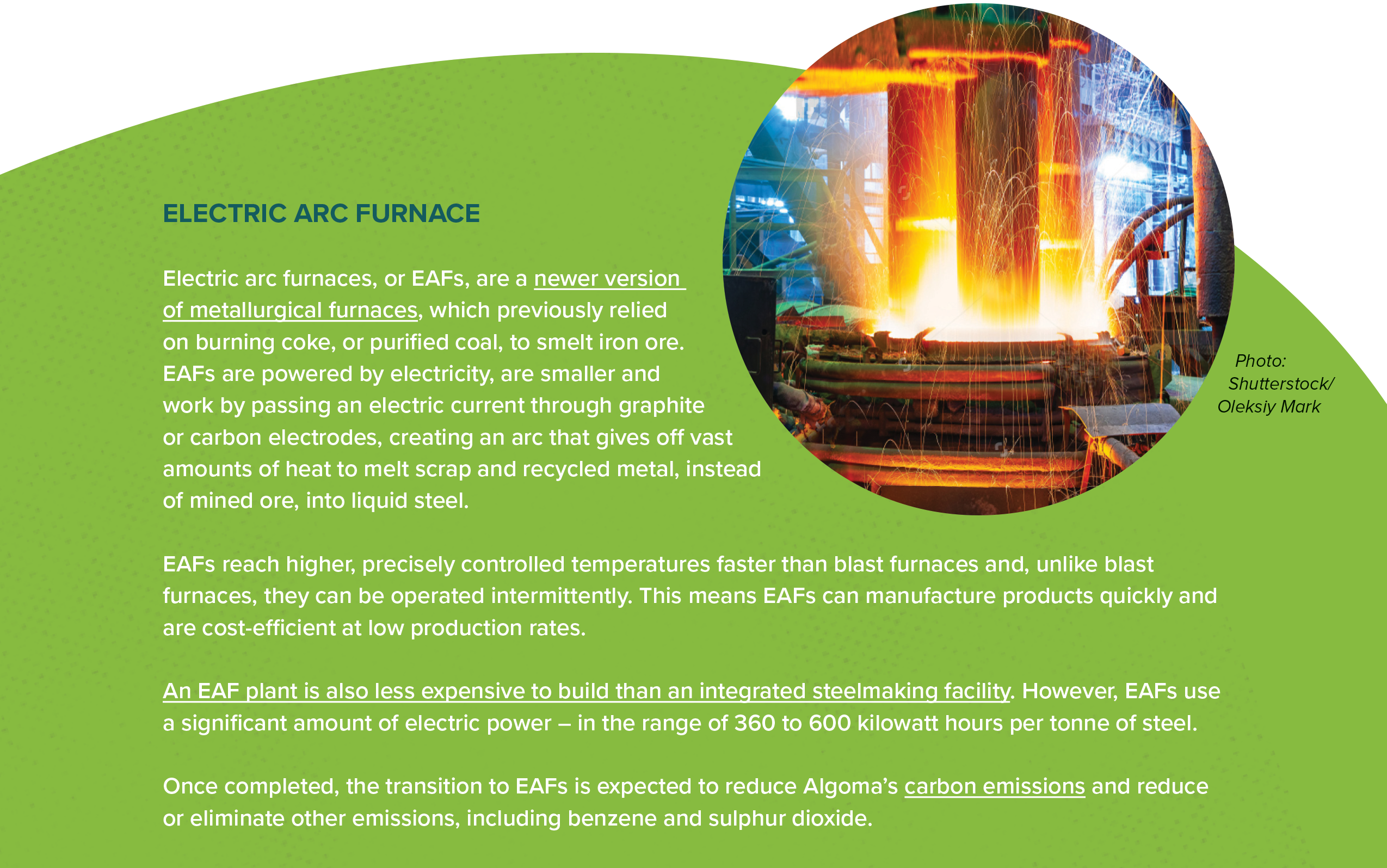
EAF operations were limited to two days a week in the third quarter of 2025, but Algoma shut down its blast furnace in January 2026 and increased EAF production to 6 days or more per week by March 2026.

As of June 2025, Algoma’s cumulative investment in the EAF project was $881 million, according to the company. The federal government contributed $420 million to the project, with additional provincial support delivered through Ontario’s industrial decarbonization program.
The conversion is being watched closely by workers and the community where, over the years, local employment patterns have mirrored Algoma Steel’s operational and financial changes. Mike Da Prat, president of the United Steelworkers Union Local 2251, said the company had almost 8,000 workers at its peak and now employs about 3,100. That number is expected to continue to fall as the company fully transitions to EAF technology, to 1,600 or 1,700 workers, according to some reports.
On December 1, Algoma confirmed it had issued roughly 1,000 layoff notices, effective March 23, 2026, as part of the accelerated closure of its blast furnace operations, one year ahead of schedule.
In a statement, Garcia said the loss of the U.S. market has required a shift in Algoma’s strategy, forcing the company to accelerate its plans to transition to EAF steelmaking.
“For Algoma Steel, the foundation was shattered six months ago [June 4, 2025] with the unprecedented 50 per cent tariff imposed by the United States — effectively closing off a market that has been essential to our viability for generations, and rendering traditional blast-furnace steelmaking no longer viable,” he said. The EAF conversion will lower costs, increase flexibility, reduce carbon intensity and strengthen Algoma’s ability to serve domestic customers and Canada’s major national priorities, he added.
He also defended the support provided by Ottawa and the province, saying that without it, the consequences would have been more dire. “Make no mistake, Algoma Steel would have experienced an even darker day — months ago, most likely its last,” he said.
Union leaders said the layoffs affect roughly one-third of the company’s workforce. United Steelworkers Local 2724 president Bill Slater told local media that about 150 of his members received notices, alongside roughly 900 members from United Steelworkers Local 2251 and a number of non-union staff, bringing “the true number to about 1,050 employees.”
Local 2251 president Mike Da Prat said the cuts will hit “the coke, iron and steelmaking plants” and that all departments will be affected as the company restructures for EAF operations.
The job losses arrived earlier than expected and at a larger scale. Both Slater and Da Prat warned that these layoffs will be a major blow to Sault Ste. Marie. “I don’t believe this community can absorb 900 jobs,” Da Prat said. “If there is an opportunity to go elsewhere, what choice do they have?”
Municipal leaders echoed the unions’ concerns. Shoemaker called the announcement “a real sad day for the community,” adding that the mill’s downsizing demands an urgent regional response. He said he wrote to Prime Minister Mark Carney and Ontario Premier Doug Ford urging immediate action to stabilize the economy, including fast-tracking key projects, accelerating defence-procurement benefits tied to Canadian steel, and relocating additional Ontario Lottery and Gaming Corporation positions to the city. One of the projects Shoemaker has promoted is the planned public, multimodal port and trade corridor anchored by an expanded Port of Algoma, something he argues should be considered a “nation-building project.”
Union leadership is similarly focused on transition supports. Da Prat urged workers to contact the union hall before making any final decisions, emphasizing the scale of the disruption and the need for co-ordinated support across the community.
In the face of ongoing turmoil caused by the trade war, community leaders are seeking ways to diversity the local economy beyond steelmaking.
Some worry that if Algoma Steel is forced to close, the city could become a retirement community much like Elliot Lake and Wawa.
Dan Friyia, former executive director of the Community Development Corporation of Sault Ste. Marie and Area, noted that the health of the local economy depends heavily on that of its main sector, steel, and the sector’s two largest employers: Algoma Steel and Tenaris, a manufacturer of steel tubes primarily used in the oil and gas industry.
Dave McHattie, Institutional Relations Director at Tenaris in Canada, said in an interview conducted before the U.S. tariffs were announced, that the company’s Sault Ste. Marie facility has more than doubled its workforce in recent years to about 800 employees. A global company with 26,000 employees, it was named ExxonMobil’s Supplier of the Year in 2024.
McHattie said the proximity between Algoma Steel and Tenaris is ideal for Tenaris’ input of hot rolled steel coil, which feeds the company’s electric resistance welded pipe manufacturing line. For its other pipe-manufacturing process, seamless pipe, it requires solid steel bars as an input. Tenaris manufactures the bars outside Canada in its own EAF steel production facilities and delivers them to Sault Ste. Marie by ocean vessel.
Along with the federal government’s major projects initiative, Sault Ste. Marie could also benefit from Canada’s emerging defence industrial strategy. Ottawa’s “buy, build, partner” approach explicitly ties defence procurement to domestic supply chains, with steel as a core input.

In a speech, Industry Minister Mélanie Joly, said defence procurement will be used to rebuild Canadian industrial capacity, noting that firms like Algoma are being integrated into national-security supply chains as Canada expands naval, aerospace and continental defence investments. She said the $500 million in government financing will help Algoma diversify its product offerings, including steel beams and plate for housing construction and defence projects.
In April 2025, Ontario Shipyards announced that Algoma Steel signed a letter of intent to join Team Vigilance as the exclusive supplier of steel plate for the proposed Canadian Continental Defence Corvette, a new naval warship. This marks the first time Royal Canadian Navy vessels would be built primarily with made-in-Canada steel.
Algoma also signed a memorandum of understanding with Seaspan Vancouver Shipyards and Stigterstaal Canada to assess re-establishing a domestic steel supply chain for federal shipbuilding programs under the National Shipbuilding Strategy.
And in March 2025, the province announced a $215-million Shipbuilding Grant Program to help secure federal naval work in Ontario. This program aims to “support a more self-reliant and resilient province” by enabling Ontario shipyards to build, retrofit and repair Navy ships using domestically produced steel, said Ontario Minister of Transportation Prabmeet Sarkaria.
For Algoma, these projects could partially offset the loss of U.S. export markets. Terry Sheehan, the Member of Parliament for Sault Ste. Marie-Algoma, has said that federal support for Algoma will help the company “pivot to the future, to diversify what and how they produce” as it adapts to tariff pressures and a changing market.
That potential is already beginning to take shape. In January 2026, South Korean shipbuilder Hanwha Ocean announced it had signed a memorandum of understanding with Algoma Steel as part of its bid to supply Canada’s future submarine fleet. The proposed arrangement includes up to approximately $275 million dollars in financial support toward the potential development of a structural steel beam mill in Sault Ste. Marie, along with anticipated purchases of Algoma steel for submarine construction and the maintenance, repair and overhaul infrastructure required to support the fleet in Canada. Both commitments are conditional on Hanwha Ocean being awarded the federal submarine contract, but the announcement signals how defence procurement and “Buy Canadian” objectives could translate into new domestic demand and industrial investment for Algoma as access to U.S. markets continues to shrink.
These domestic pathways sit alongside longer-term global opportunities. The energy transition is expected to increase worldwide demand for green iron ore and low-emission steel. Some researchers argue that Canada is well positioned to compete in this emerging market, given its high-quality iron resources, strong renewable energy potential, established infrastructure and skilled workforce.

When asked about the challenges their city faces, several interview participants raised the issue of population aging and difficulty attracting workers in some sectors. They noted that Sault Ste. Marie’s population has remained stable largely because of recent immigration, but many long-time labourers are retired or retiring, and younger residents often leave for post-secondary education or employment in other regions. This has created shortages across the skilled trades, clean energy, health care and engineering fields. These workforce pressures are unfolding at the same time as large structural transitions in the industrial sector, including recent job losses at Algoma Steel, which are reducing demand for traditional roles while new technical positions emerge.
Employers also acknowledged that the rise of electrification, green technology, automation and artificial intelligence require different skills and education levels than the local workforce currently offers. Katie Elliott, director of enterprise strategy at the municipal utility, PUC Services Inc., said this disconnect largely explains the current and growing labour market shortage in these sectors.
For instance, PUC and Heliene Inc., a photovoltaic solar module manufacturer, are concerned about recruiting workers with the needed expertise and education to fill roles such as electrical engineers. “In Sault Ste. Marie and Algoma District, there’s been a lot of growth in power generation within the [clean-energy] transition. We are seeing an increase in employment, not decrease, and cannot get enough employees to work in the sector,” said Martin Pochtaruk, chief executive and president of Heliene. But attracting people from elsewhere has been challenging, he noted. “Moving to Sault Ste. Marie is not what Canadians are prepared to do,” he said. “Generally, we hire employees from overseas and help them through the immigration process.”
Brent Lamming, deputy chief administrative officer of the City of Sault Ste. Marie, also raised the issue of worker shortages in the skilled trades and green jobs, especially in jobs with skill sets that are in higher demand due to the shift to electrification.
The federal government’s 2025 budget introduced several measures intended to support workers affected by trade shocks, automation and the transition to clean industry. These measures include $570 million in new Labour Market Development Agreement (LMDA) funding, aimed at providing training and employment assistance for workers impacted by global market disruptions. The budget also reaffirmed the previously announced
$70-million LMDA support package announced in July, which provides income supports and retraining for up to 10,000 displaced steelworkers nationwide.
National business groups expressed cautious optimism about the budget’s labour provisions. In a statement, Diana Palmerin-Velasco, the Canadian Chamber of Commerce senior director for the Future of Work, said the measures are “a step in the right direction, particularly around supports for workers impacted by U.S. tariffs, expansion of apprenticeship training in the skilled trades, focus on an international talent strategy to drive innovation, and action on foreign credential recognition.”
However, the federal government must “expand access to skilled trades investments and not limit eligibility to training exclusively provided by unions,” she added. And she urged faster foreign credential recognition “so thousands of workers prevented from contributing meaningfully to the economy can help alleviate labour shortages in critical sectors like health care and construction.”
At a time when skills upgrading has become more urgent, Sault College, under financial strain, has cancelled or suspended several academic programs and laid off staff. Sherri Smith, former vice president of academics, innovation and student services, said the federal government’s cap on international students announced in 2024 significantly impacted the college’s tuition revenues. The college is projecting a $5.6-million deficit in 2025-26 as a result of the cap, the provincial government’s ongoing freeze on tuition fees and higher operating costs.
 These financial pressures are also shaping how the college is prioritizing its role in workforce development.
“Sault College is focused on the fact that our main funding source was severely impacted, so we are knee deep in those conversations,” said Smith. “We are a leader for change and have a role to support change by training workers in emerging areas, but haven’t turned our attention to conversations about the low-carbon transition,” underscoring the tension between immediate funding challenges and the longer-term need to prepare workers for economic and industrial transition.
Shoemaker said the decrease in the number of international students admitted to Canada has affected the finances of the city’s other major post-secondary institution, Algoma University. “The policy changes at the federal and provincial governments have had a real detrimental effect on their bottom line and on our community’s benefit,” he said of the two institutions. He noted that he has advocated for a middle ground when it comes to international student recruitment because the institutions play an important role in helping to diversify the local economy.
Municipal leaders are also looking to expand health care training capacity. Shoemaker said he would like to see the Northern Ontario School of Medicine expand its physical presence in Sault Ste. Marie to address the city’s physician shortage. The institution, now known as NOSM University, was created in 2002 to attract more doctors to northern and Indigenous communities in the province. It currently has campuses in Sudbury and Thunder Bay but operates digitally across northern Ontario. Originally affiliated with Laurentian University and Lakehead University, it became an independent medical school in 2021.
Chamber President La-Na Fragomeni said in a statement that the new permanent-resident levels combined with a 43 per cent reduction in temporary residents “will further impact colleges and universities which have already seen a drastic reduction in enrolment, as well as businesses that rely on temporary foreign workers.”
“We know the important role that temporary foreign workers play in some sectors of the economy and in some parts of the country, particularly Northern Ontario,” Fragomeni said. “The reduction in international students that we have seen locally directly impacts the revenues of our local post-secondary institutions, their ability to offer programs and employment opportunities. Further, it also trickles down to the community at large and impacts everything from busing to housing, tourism and small business.”
Across interviews, employers emphasized that immigration alone cannot address the city’s labour shortages. Algoma steel’s transition to an electric arc furnace, as well as the broader trend toward electrification, is changing the types of skills the workforce needs, and workforce preparation has not kept pace. Companies such as PUC, Algoma Steel and Tenaris expect to expand in-house training as electrification deepens.
Katie Elliott said, “there is support from provincial and federal governments with electrification, but more needs to be done to prepare the workforce so the right skills are in place as we move through the transition, and the PUC needs to be better at informing secondary and post-secondary students on careers in the energy sector.”
Sault Ste. Marie declared itself the Alternative Energy Capital of North America in 2008. Since then, it has invested nearly $1 billion in a series of clean-energy projects, including wind and solar generation, battery storage and hydroelectricity.
Several interview participants said new sources of clean energy will be needed to meet increasing demand. They said there is already a shortage of clean energy, which would be even more acute if demand for electric vehicles were to grow faster than the ability of local power supplies and demand-management strategies to keep up.
Elliott said PUC is well aware of the challenges ahead and is currently focused on providing a new load of about 300 megawatts for the area to power Algoma Steel’s EAFs.
The EAFs are expected to be partially powered by a natural-gas-fired generating plant owned by Algoma. In August 2024, the Ontario Energy Board approved PUC Transmission LP’s plan to build a new 10-kilometre, 230-kilovolt transmission line and a dedicated transformer station to connect Algoma Steel to the Ontario power grid. Construction began in 2025 and is scheduled for completion in 2027. The project, estimated at around $190 million, will provide roughly 280 megawatts of grid power for the two furnaces.

Rob Brewer, president and CEO of PUC Transmission LP, said in a media interview that the investment was essential to “a resilient and sustainable energy future” for Sault Ste. Marie, improving system reliability in the city’s west end while enabling the emissions reductions promised by Algoma’s transition.
Emily Cormier, the sustainability co-ordinator at the city, said that future infrastructure investments should account not only for capacity but also resilience, given projected increases in extreme weather.
Colleges and universities are similarly adapting their operations. Smith said Sault College plans to become leaner and more efficient, as it strives to fulfil Ontario colleges’ commitment to reduce emissions by 65 per cent from 2020 levels by 2030 and to achieve net zero by 2050, though leaders acknowledge that reaching them will be difficult without targeted public investment.
Meanwhile, Tenaris is aware of the possibility of adopting hydrogen as a fuel, but believes the technology is still uncertain and cost-prohibitive, McHattie said. Tenaris has also announced plans to reduce the carbon dioxide intensity of its global operations by 30 per cent from 2018 levels by 2030. McHattie said the company is more than halfway to the goal. He said the Sault Ste. Marie plant is using fossil-fuel-free electricity with very good emissions performance, comparable to Tenaris’ industry-leading average per tonne worldwide. “Businesses would love to do everything all at once but can’t, especially if we don’t know which change is making the most impact,” said McHattie. “The challenge is knowing what pace to invest and selecting building blocks to improve things year-over-year.”
Small businesses may face the steepest hurdles. Dan Friyia, formerly with the Community Development Corporation, warned that many local firms lack access to the capital required to participate meaningfully in the low-carbon transition. “We are watching with concern on how the low-carbon transition will evolve,” he said. “There are opportunities for small businesses if they can make a case locally and reduce costs. However, most opportunities are more for larger corporations. For example, it’s harder to quantify [the benefits of] solar installation on a small scale.”
Interview respondents cited the community’s resilience and ability to cope with adversity as key strengths that will see it through the current economic uncertainty. Despite concerns, they expressed optimism about future growth and confidence that everyone will come together to overcome challenges.
The city and local employers are making efforts to attract talent and fill jobs with returning youth, international students, immigrants and other people new to the community. According to the most recent data, the city’s population grew to 78,574 in 2023, up 2,560 over the previous year and its highest level since 1996.

Attracting youth who left or are new to the community and training them for tomorrow’s jobs is top of mind. The city employs post-secondary students through its summer student program where they gain valuable work experience, Cormier said. Internships and student placements from Sault College and Algoma University also support city projects when opportunities arise. In 2024 and 2025, Sault Ste. Marie received funding from the Canadian Parks and Recreation Association’s Green Jobs Initiative to hire a summer student with parks, recreation and sustainability initiatives.
Both Tenaris and Algoma also hire summer students. “There are synergies between education and industry,” said McHattie of Tenaris. “Education is the cornerstone of our strategy, as we want youth to understand the meaningful career opportunities in the steel industry, especially within our unique segment where we are the largest and most comprehensive OCTG [oil country tubular goods] producer in Canada.”
Until the federal government introduced the cap on international study permits in 2024, and later tightened temporary resident admissions in the 2026-27 Immigration Levels Plan, the local population of international students was growing rapidly. Many students stayed after completing their studies and brought their families to live here, according to interview participants.
Even with the caps, interviewees emphasized that newcomers remain central to the city’s economic future, with initiatives for immigration and direct recruitment by employers complementing the city’s efforts to bring in youth.
From 2019 to 2024, the Rural and Northern Immigration Pilot (RNIP) supported economic development and strengthened the capacity of local businesses by creating a path to permanent residency for skilled foreign workers. The Sault Ste. Marie Economic Development Corporation, FutureSSM, Local Immigration Partnership and Sault Community Career Centre managed the RNIP in partnership with the federal government.
Matthew Shoemaker, the mayor, said the RNIP program, since extended and renamed the Rural Community Immigration Pilot program, has been helpful in attracting immigrants to smaller communities across Canada and has helped boost Sault Ste. Marie’s population. He noted that the program was extended, at a time when several other immigration categories were tightened, partly at the behest of northern cities including Sault Ste. Marie, Timmins, North Bay and Thunder Bay.
Since its establishment in 2009, the Local Immigration Partnership (LIP) of Sault Ste. Marie and Area has created a welcoming and inclusive community for newcomers. Funded by Immigration, Refugee and Citizenship Canada, the LIP involves over 50 local and regional organizations, including service providers, settlement agencies, cultural groups, employers and other key institutions.
Heliene and Tenaris said they support diversity by hiring people new to Canada through the pilot program, LIP or directly to get the expertise they need. For example, Pochtaruk has recruited engineers with master’s degrees and PhDs from various countries, such as the Philippines, Mexico and Russia.
“Not only do they fill local labour shortages, but the newcomers have also helped revive the city’s public transit system”, added Jason Naccarato, of the Chamber of Commerce.
Several interviewees said they’ve noticed a shift over the last two decades in the makeup of newcomers who work and live in Sault Ste. Marie. They said previous generations of immigrants from Italy, France, Portugal, Poland, Finland and Croatia, among other countries, are thriving and now populations from India, China, the Philippines, Latin America and the Middle East are growing.
Sandra Mongui, founder of the Northern Ontario Latin-Hispanic Association, is originally from Colombia but has lived in the Soo for 20 years and has seen the changes first-hand. She estimates that there are about 400 Latin-Hispanic families living there today. Many of the new immigrants come with the goal of obtaining permanent residency status, although some struggle with the transition because of the language barrier, she said.
Cormier said there are many businesses and services to support newcomers that were not previously available, such as multicultural grocers and restaurants.
Several interviewees agreed that Sault Ste. Marie’s greatest asset is its proximity to the natural environment and the access people have to outdoor activities.
Another attraction is its comparative affordability. Elliott said living in Sault Ste. Marie is more affordable than other cities in Ontario, and some people have moved to the area because they can work remotely while maintaining a work-life balance. Cormier agreed that the lower cost of living compared with that of other mid-sized communities in Ontario is very attractive for people, and there’s a push to build more housing to support those coming to the community, as we are also seeing elsewhere in Ontario.
Sault Ste. Marie is adjacent to Batchewana First Nation and Garden River First Nation, and home to a growing population of Indigenous Peoples, who accounted for 13.1 per cent of the region’s population in 2021.
Many of the same regional factors that affect the city also affect Garden River First Nation, located immediately northeast of the city. Garden River has 3,241 registered citizens, many of whom live outside the immediate community.
Several participants cited strong ties between the city, local employers, Indigenous communities, and the local college and university. For example, Tenaris invites young women and Indigenous students in Grade 8 to walk through its facility and learn about potential career opportunities through the company’s open doors program, in partnership with the Canadian Manufacturers and Exporters’ Women in Manufacturing initiative.
Evan Belleau, energy adviser at the Garden River First Nation, said Sault Ste. Marie and Garden River First Nation have an intergenerational history and close ties. He added that members of his community want to give input in the early stages of the city’s planning processes to help improve outcomes, while reducing the costs of development and impacts on the natural environment.
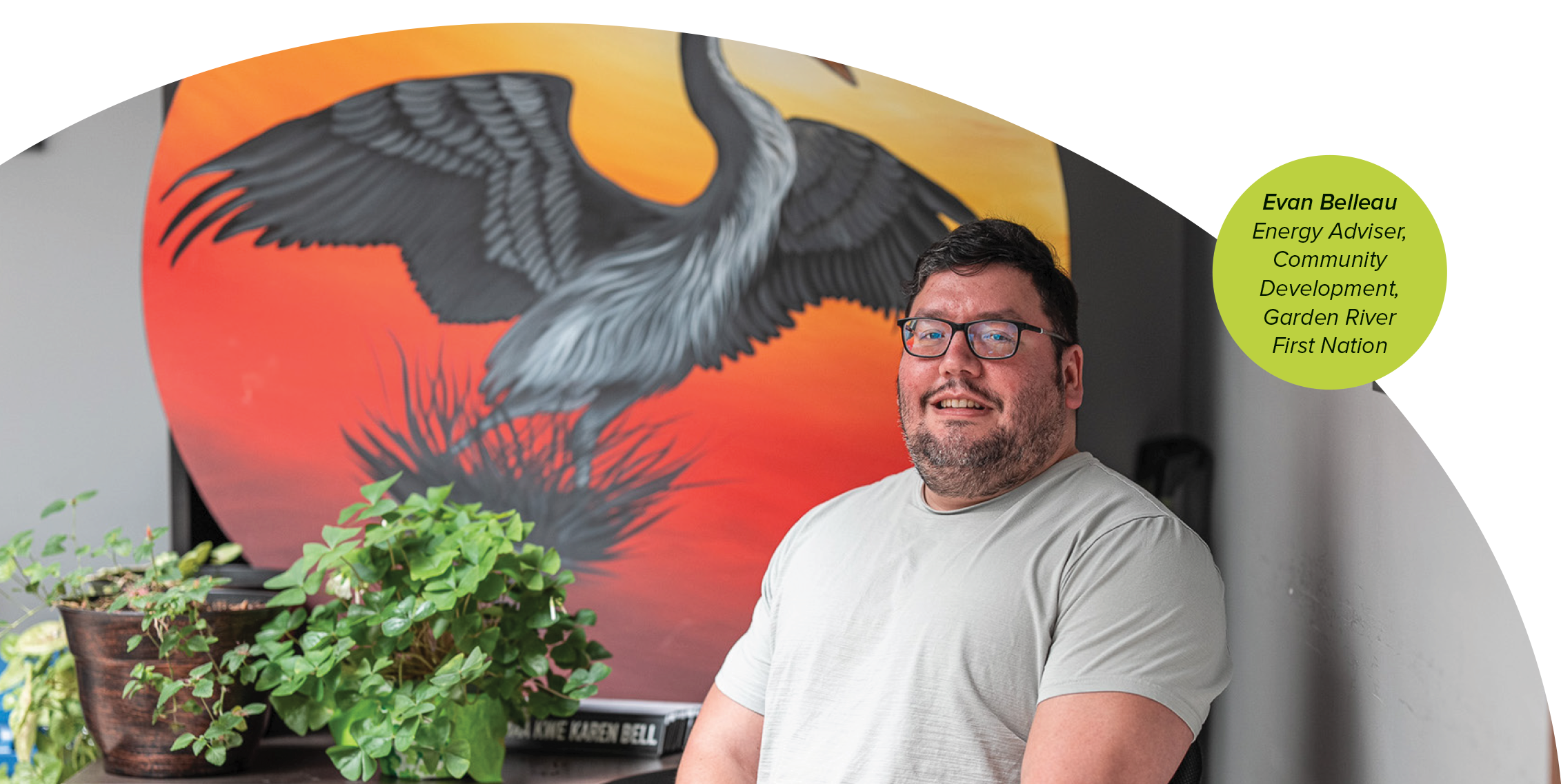
“The Garden River community is always willing to talk. We want to increase employment and capacity in the area by accommodating opportunities,” said Belleau. “We are trying to create a place for the most employment options.”

He said he has noticed that engagement between industry and Indigenous communities is encouraged by federal and provincial governments. Recently, his community has engaged in conversations about electricity development with local employers like Algoma Steel and Tenaris. For example, the Garden River and Batchewana communities were involved in discussions with Hydro One on plans for a new transmission line from the utility’s Mississagi transformer station west of Sudbury to Sault Ste. Marie.
To address its own energy needs, the Garden River First Nation has acted on low-carbon and net-zero plans and capacity development, including renewable energy projects, retrofitting, net metering and changing energy use behaviours in homes. Guided by its 2023 Indigenous Community Energy Plan, the community created a database of its electrical demand and use, then developed and implemented steps to reduce use and lower greenhouse-gas emissions.
Part of the community’s green energy success is attributed to social media initiatives that raise public awareness and provide information. In partnership with the City of Sault Ste. Marie, the Garden River First Nation has launched webinars on solar energy and energy literacy in general. They plan to review the effort every five years, said Belleau.
Respondents said Sault Ste. Marie has taken a leadership role in the electrification of industry and transit, and the wider energy transition.
PUC is expanding its local clean energy infrastructure with investments in renewable energy (primarily solar), battery storage, new transmission lines and reducing its greenhouse gas emissions to support changes in the community. Its facility currently reflects its net-zero efforts, including modifications to buildings and grid infrastructure. The utility is also working to electrify its own vehicle fleet.
In 2021, PUC partnered with Axium Infrastructure in forming PUC Transmission to construct new transmission facilities to provide power for Algoma Steel’s electric arc furnaces and other businesses. PUC also completed Canada’s first community-wide smart grid project for its entire service territory to reduce outages and provide energy savings.
A smart grid is an electricity network that uses digital technologies, sensors and software to better match supply and demand of electricity in real time, while minimizing costs and maintaining grid stability and reliability. The community-scale smart grid in Sault Ste. Marie covers all of PUC’s service area. It integrates complementary smart-grid technologies and the enhancement of existing advanced metering infrastructure. It was also set up to accommodate new distributed energy resources and economic development.

These local infrastructure investments are anchored in broader municipal climate policy, including Sault Ste. Marie’s first community-wide greenhouse-gas reduction plan, launched in 2020 with a goal of achieving net-zero emissions by 2050.

“The city has an opportunity to be a leader in the energy transition and embracing sustainability is good for business, not just the environment, through sustainable development,” said Cormier.
She added that staff reports to council routinely to provide updates on the climate impacts of proposed decisions, including the capital budget, and the city’s annual sustainability reports summarize its efforts related to the greenhouse-gas reduction plan. The council’s environmental sustainability committee recommends sustainability projects to receive support from the city’s Green Initiatives Program fund.
Cormier and Lamming said the city is investing in capital projects, making buildings greener with energy retrofits such as LED lighting and solar roofs, and revitalizing its vehicle fleet with electric vehicles and charging stations.
“The city of Sault Ste. Marie is thinking innovatively to create new power,” said Lamming. “The largest transition has been to the city’s transit fleet, including solar panels on the hub roof to charge buses.” Funds from the Investing in Canada Infrastructure Program helped renew the city’s buses, which were one of the oldest fleets in Ontario, with vehicles up to 13 years old.
He also noted the city bought the first electric ice resurfacer in Ontario for its arena in 2023 and has since added two other electric units. Lamming said the purchase will help the city understand the impact of cold conditions on the longevity and frequency of electric charging, as northern climates can be a challenge for electric vehicles. The city plans to convert each unit of its gas-powered ice resurfacer fleet to electric as they reach their end of life.
PUC is also helping customers switch home heating and cooling systems from natural gas to electricity, though it expects questions and some degree of pushback, said Elliott. It has 30 industry partners to build EV charging infrastructure to support the fleets of Sault Ste. Marie police and Natural Resources Canada. A home EV charging program is also in place to support the switch for personal vehicles.
Among other diversification efforts, Matthew Shoemaker, the mayor of Sault Ste. Marie, has argued that the Ontario Lottery and Gaming Corp., a provincial government agency, should expand its operations in the city. He noted that the agency opened offices in Sault Ste. Marie in 1993 and at one time had 85 per cent of its workforce based there. But, over time, some jobs have migrated back to Toronto, and now just 45 per cent of the agency’s jobs remain in the Soo, he said.
Municipal officials also point to transportation and logistics as a critical constraint on diversification. Located at the confluence of Lake Huron, Lake Superior and Lake Michigan, Sault Ste. Marie has long been a hub for rail, water and road transportation, with ready access to the United States and southwestern Ontario. However, some respondents noted the city has challenges with the procurement of supplies and the transport of goods and people.
To address these constraints and support diversification, the city is advancing plans for the proposed Port of Algoma. Algoma Steel’s existing port, which it shares with other businesses, is at capacity, according to Shoemaker. The city’s economic development team, in partnership with the Hamilton Oshawa Port Authority, is working on a plan for a new public, multimodal port and trade corridor anchored by a newly developed port facility in Sault Ste. Marie — a plan it hopes the federal and provincial governments support. As part of this initiative, the partners are exploring the Algoma Steel site along the St. Mary’s River as a potential host location, given its deepwater access, existing industrial infrastructure, and more than 100 acres of redevelopment-ready land. The project received a $233,100 FedNor investment on December 18, 2025, to support technical assessments and a comprehensive development plan for a public access port in the city.
Another potential bright spot is the Ring of Fire, a proposed development of critical minerals located 500 kilometres northeast of Thunder Bay. The Ontario government has sought to expedite the approval process for the development by designating it a special economic zone.
In November 2025, Ontario signed a strategic agreement with Marten Falls First Nation, located about 450 kilometres north of Thunder Bay, to advance an all-season road connecting the community to the provincial highway network and, eventually, to the Ring of Fire. The deal includes $39.5 million for community infrastructure and commits Marten Falls to completing its portion of the road “on an expedited basis,” pending environmental approvals. While the Ring of Fire is geographically distant from Sault Ste. Marie, municipal officials said the project is relevant to local diversification efforts because future mining and processing activity could generate demand for transportation and port infrastructure.
Rick Van Staveren, the city’s director of economic development, said municipal staff are focused on growing the city’s tax base and potentially using industrial lands to support the construction of a port and other infrastructure. He said he and his team at the city have assumed the role of co-ordinating the various economic development agencies. But, with just three people, the team has limited capacity. He said he supports the idea of expanding the role of federally funded Community Futures Organizations, a national network of 267 non-profit offices that provide small business loans, training, tools and advisory services in rural and remote communities, which could improve access to financing and supports for local businesses.

Jason Naccarato, president of the Sault Ste. Marie Chamber of Commerce, said the government should do more to support the struggling forestry industry, adding that the sector needs help innovating and investing in new products and methods. Forestry has played an important part in the city’s local economy. The Great Lakes Forestry Centre, a research institute of Natural Resources Canada, is located there. In addition to the closure of St. Mary’s Paper more than a decade ago, Midway Lumber Mills, based in nearby Thessalon, shut its doors in January 2025, putting 40 people out of work. Naccarato would also like to see support for business service companies that have been involved in the retooling of Algoma.
Some participants said there has been some growth and diversification in the local economy in recent decades, including in the tourism, health, retail, transportation and government sectors.
The city’s economic development department supports planning and coaching for youth, entrepreneurship and programs to advance business projects. It also promotes the benefits of operating in a city with lower costs to attract larger employers.
The Sault Ste. Marie Chamber of Commerce, Sault Downtown Association (now dissolved) and Community Development Corporation of Sault Ste. Marie and Area actively support new ventures. Da Prat said the new businesses are a positive change as an entrepreneurial spirit expands the local economy.
Even before Algoma announced the layoff of a third of its workforce, job losses at the company, post-secondary institutions and the forestry sector were being felt in the area. As Sault Ste. Marie navigates economic and workforce change, United Way Sault Ste. Marie & Algoma District is seeing the ripple effects show up in community services. “Our funded partners are experiencing higher demand, and it underscores how important a strong local support network is during periods of transition,” noted Lori Huston, executive director of the organization.
Most respondents expressed concern and uncertainty about economic disruption, and its impact on the community, workforce and local businesses.
While the focus has been on the impact of tariffs, several respondents acknowledged a general lack of public awareness and knowledge about what the low-carbon transition is and the changes that could come with it.
“It’s difficult for a lot of people to understand the transition,” said Belleau. There’s a strong need for information and support to help workers to understand the potential impacts that the low-carbon transition could have on existing jobs and how they will change, especially for manual labour jobs that require less formal education, he added. Information is needed to help workers identify upcoming careers and viable employment options. There is already a shortage of workers with the skills needed for low-carbon projects, noted Belleau. “We need ways to train as many people as possible and as fast as possible.”
The workforce transition will not be easy, added Friyia. “No one likes to change their jobs if [they] can help it. It’s not easy for some people to transition from a good-paying job to something else.” Friyia added that education and practical information will be critical in shaping how quickly workers, households and small businesses are able to adapt.

The headwinds facing Sault Ste. Marie are strong. Algoma Steel’s long-anticipated conversion to EAFs was intended to give Canada’s only independent steel producer a leg up on foreign competitors. Instead, punitive U.S. tariffs have shut the company out of its largest export market, casting uncertainty over its future. Given Algoma’s central role in the local economy, that uncertainty now extends to Sault Ste. Marie itself, which has relied on steel production for more than a century.
Matthew Shoemaker, the Soo’s mayor, remains optimistic. When he looks into the future, he says he hopes to see a vibrant city with an enduring steel industry, a busy port, thriving post-secondary institutions and a strong, diversified economy.
What will it take for Sault Ste. Marie to get there? Here are some of the challenges, opportunities and recommendations identified by local leaders:
The Institute for Research on Public Policy (IRPP) has developed a methodology for measuring community susceptibility to workforce disruption as global efforts to address climate change expand. Using three indicators, the methodology scores and ranks census divisions across the country. Based on their ranking, each census division is assigned to one of six groups, ranging from “not susceptible” to “most susceptible.”
The three indicators include Facility Susceptibility (emissions from large facilities relative to the size of the community), Intensity Susceptibility (proportion of employment in emissions-intensive sectors), and Market Susceptibility (proportion of employment in globally traded sectors expected to undergo market transformations).
The analysis is available in an interactive map, developed in collaboration with the Community Data Program of the Community Economic Development Network, on the IRPP’s website (irpp.org/community-transformations/map). A detailed description of the methodology used is also available on the website.
To complement the mapping exercise, the IRPP selected 10 communities across the country to profile through a series of interviews with people that live and work in the community. Most of the communities selected are located within the most susceptible census divisions, but others were chosen because of anticipated development or previous experiences. The profiles are meant to cover a diversity of regions of the country and types of economic activity. These snapshots are meant to provide additional insight into the challenges and opportunities the communities face and to reflect the perspectives of residents.
Sault Ste. Marie, Ontario, is one of the communities selected. It was chosen because the local economy is highly shaped by emissions-intensive, trade-exposed industry, and because the community is navigating significant near-term workforce disruption and longer-term economic restructuring linked to industrial decarbonization and global market volatility.
The Energy Mix conducted interviews with community members in Sault Ste. Marie, the largest municipality in the census division, and in nearby communities across the Algoma District. The IRPP’s research director, Ricardo Chejfec, also visited to meet with local community leaders.
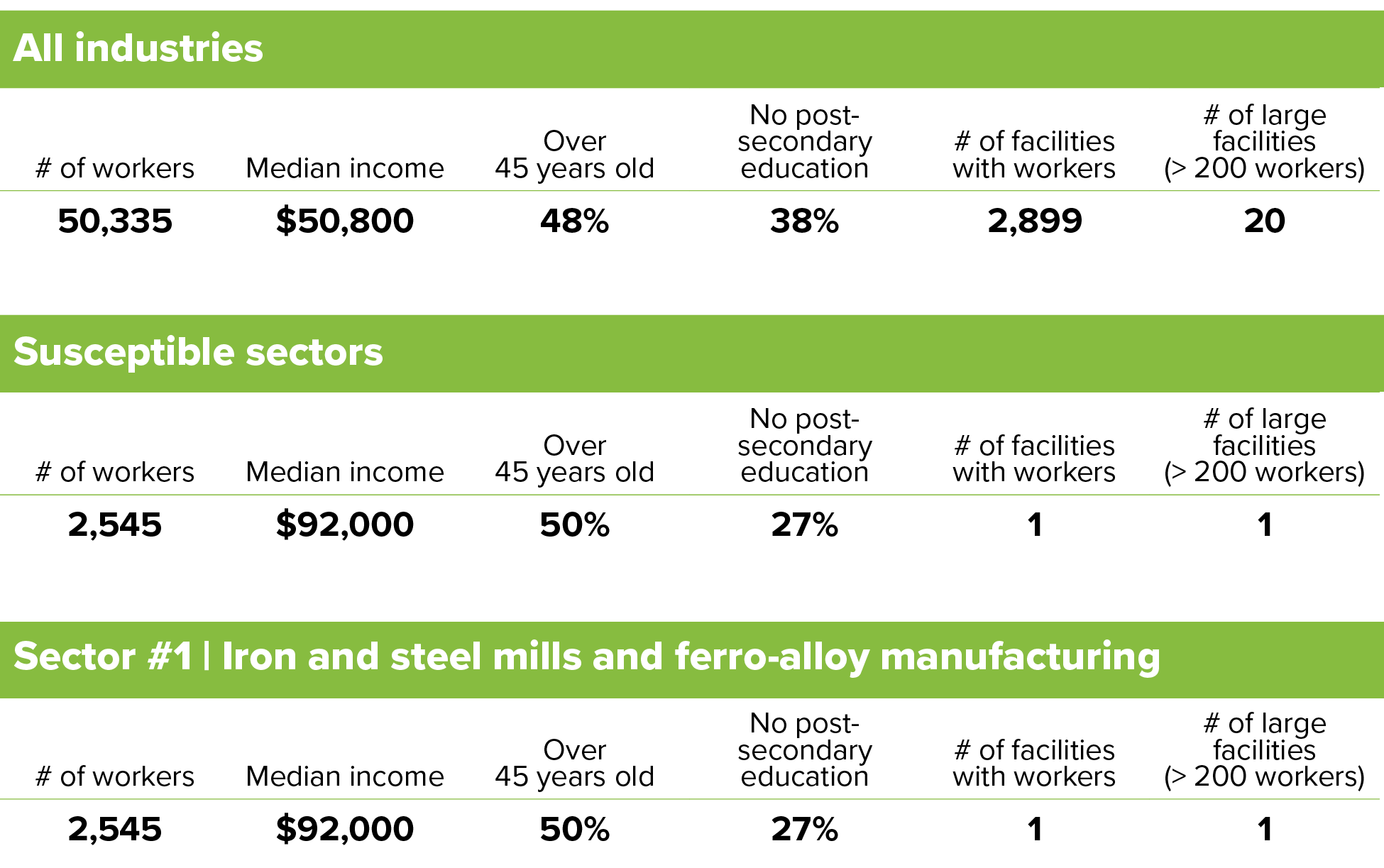
Below, we present a breakdown of the susceptibility analysis for Algoma, Ontario, the census division in which Sault Ste. Marie is situated. Additional information not used in the analysis such as population change, the unemployment rate and demographic characteristics of workers is derived from the 2021 census. Number of facilities comes from the Statistics Canada’s Business Register from June 2020.
If you have questions about the profile or the analysis, please contact us at
communitytransformations@nullirpp.org.

This Community Profile was published as part of the IRPP’s Community Transformations Project. It was authored by The Energy Mix and the IRPP. The manuscript was copy-edited by Rosanna Tamburri with assistance from Dena Abtahi. Ricardo Chejfec was responsible for the data analysis. Proofreading was by Zofia Laubitz, editorial co-ordination was by Étienne Tremblay, production was by Chantal Létourneau, publication management was by Prasanthi Vasanthakumar and art direction was by Anne Tremblay. Photos are by Robert Davies.
The Community Transformations Project was funded in part by The McConnell Foundation and Vancity. Research independence is one of the IRPP’s core values, and the IRPP maintains editorial control over all publications.
A French translation of this text is available under the title Sault Ste. Marie : La ville ontarienne de l’acier en quête d’une nouvelle vocation.
To cite this document:
Institute for Research on Public Policy. (2026). Sault Ste. Marie: Ontario steel city looks to forge new path. Institute for Research on Public Policy. https://doi.org/10.26070/0nef-3y93
We’re grateful to these local contacts for sharing their ideas, experience and time with us: